
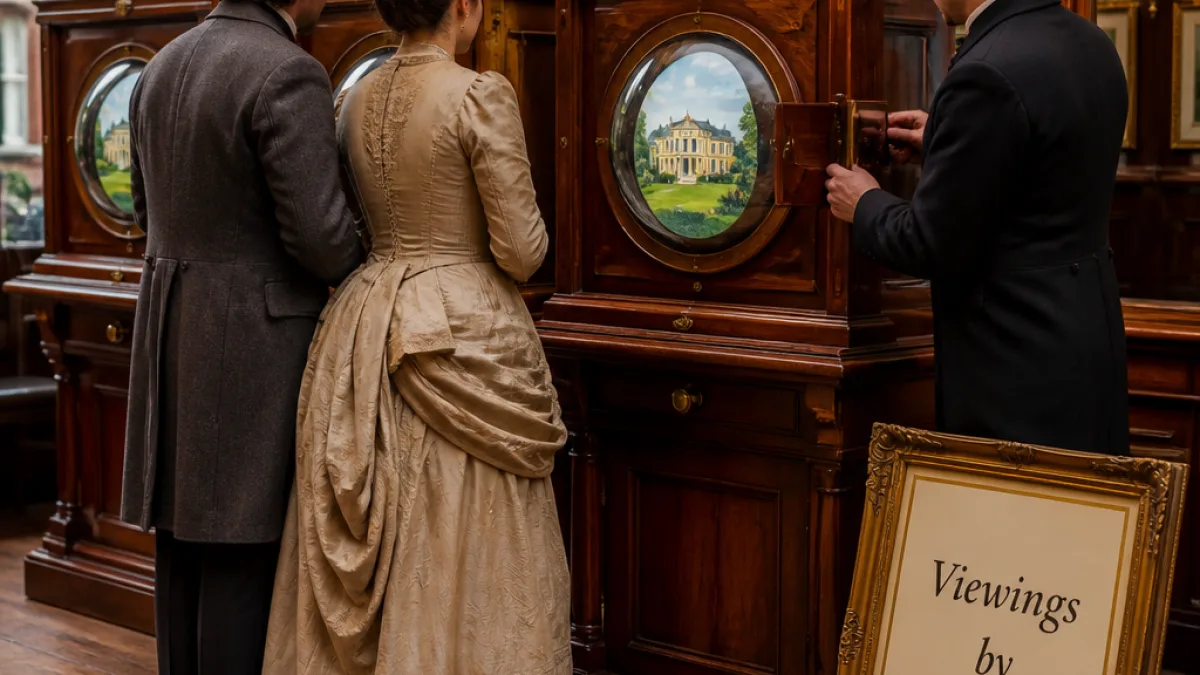
New research from the University of Exeter has unearthed evidence that a high-end London estate agency was offering wealthy clients an early form of "virtual property tour" more than 160 years before online listings and digital walk‑throughs became standard. The discovery links an Old Bond Street firm with a Victorian visual technology called the cosmorama, used in the 1840s and 1850s to present specially commissioned images of houses and estates with an illusion of depth.
How the cosmorama worked
The cosmorama relied on painted or printed views viewed through convex lenses and shown under carefully controlled lighting. The combination enlarged images and created a sense of three‑dimensional space — an effect that researchers say could convincingly suggest the look and feel of a property to a prospective buyer.
The practice was uncovered while academics examined contemporary newspaper advertisements and articles. They found evidence that the Old Bond Street agent, recorded in adverts as Brooks and Green (and later associated names in the same firm), had mounted cosmorama displays to promote sales of luxury townhouses and country estates.
“For half a century, the cosmorama was one of the most common forms of visual show across Europe and the Americas,” Professor John Plunkett, the study's lead author, said. “What we’ve discovered through this latest research project, however, is that its use extended beyond simple entertainment. The appeal of cosmoramas was that they sold an experience of virtual travel. This was utilised by estate agents seeking to sell luxury properties and country estates.”
From entertainment to commerce
Until now, the cosmorama has largely been treated in scholarship as an entertainment medium — a parochial curiosity of nineteenth‑century leisure. The Exeter team’s work reframes the device as a commercial tool with practical applications in the property market, anticipating modern techniques that use images and immersive media to shorten the distance between buyer and house.
Researchers catalogued more than 650 documented cosmoramas across Portugal, Spain and the UK, and identified many others shown in the Americas and Australia. In Britain and Ireland, cosmorama galleries appeared in bazaars, travelling shows and purpose‑built exhibition spaces.
What this means for London and the property trade
The finding underlines how London’s luxury property market has long relied on innovation to reach wealthy and mobile buyers. Old Bond Street — already a hub of taste and commerce in the nineteenth century — provided a setting where prospective purchasers could be offered an evocative preview of estates beyond the capital without leaving the city.
On the streets near Bond Street station today, estate agents still aim to conjure desirability with glossy images and curated staging. The cosmorama episode is a reminder that marketing techniques evolve but the underlying aim — to sell an experience as much as a building — remains unchanged.
Key takeaways from the research
- Brooks and Green (Old Bond Street) used cosmorama displays in the 1840s–1850s to market properties.
- Cosmoramas produced an immersive illusion of depth using lenses and lighting, predating photography as a sales tool.
- Researchers identified more than 650 documented cosmoramas across several European countries, with many further examples internationally.
The paper forms part of a broader study into the history of immersive visual entertainment across Europe and its commercial adaptations. It adds texture to our understanding of how visual culture and commerce intersected during an era of expanding travel, tourism and property speculation.
| Region | Documented cosmoramas |
|---|---|
| Portugal, Spain and the UK | 650+ (combined) |
| Americas and Australia | Many documented examples (number not specified in study) |
Local voices and legacy
On the pavement outside a present‑day Old Bond Street gallery, a passer‑by noted the continuity of salesmanship: “They were selling a dream then, just like now — only now it’s virtual reality headsets instead of lenses.” That observation captures the continuity between a nineteenth‑century parlour trick and the modern digital tools used by estate agents.
For historians of media and for Londoners interested in the city’s commercial past, the cosmorama episode offers a concrete example of imagination meeting commerce. It also raises fresh questions about how other everyday practices now taken for granted — from advertising to visual staging — originated in earlier technological and cultural shifts.
The research is likely to prompt further archival work on the extent to which other firms in London and beyond repurposed entertainment technologies for business ends. For now, the cosmorama stands as a striking footnote in the long story of how houses are shown, sold and made desirable.
















