
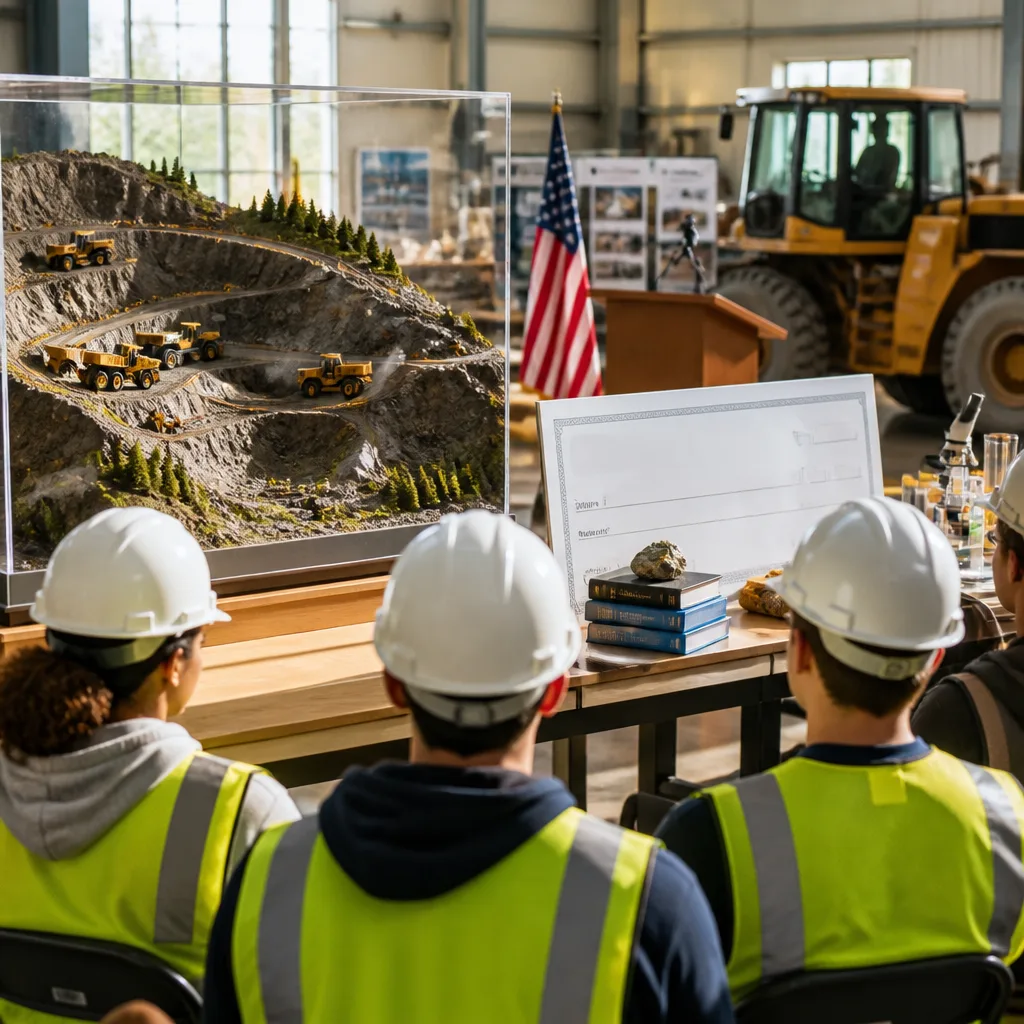
The US Department of Energy (DOE) is to invest €—no—sorry—$100 million in a new education initiative aimed at growing the domestic workforce for critical minerals and strengthening supply chains. The move forms part of a larger federal package announced during a White House roundtable which the administration said will provide $180 million in grants for mining programmes.
What the funding will do
The DOE’s programme, named PROSPECT (Providing Opportunities for Specialized Education in Critical Technologies), is intended to boost the output of graduates from the 14 accredited mining schools in the United States. Officials said the initiative aims to double the number of graduates from those institutions — a response to anticipated labour shortages within the sector.
In addition to the DOE allocation, the announcement included a further $80 million directed to specific institutions: the Colorado School of Mines, the South Dakota School of Mines and Johns Hopkins University. The source material identifies this additional funding as coming from the Department of War.
“Today we are taking another historic action toward the future of American mining,” said the president. “For years, mining schools and colleges that are essential to training the future leaders of this industry have been sadly disappearing.”
Voices from academia and industry
Academic representatives attended the White House roundtable. Among them were senior figures from the University of Arizona’s mining engineering school, which is one of the 14 accredited programmes the initiative targets. Attendees included the university’s senior vice-president for research and partnerships and the leadership chair of Mining and Geological Engineering, alongside faculty and students.
Speakers at the event argued the sector requires both technological investment and a steady supply of qualified graduates. One panelist, the head of the University of Arizona’s mining school, said American mining schools were prepared to meet industry needs and highlighted recent efforts to align academic and commercial priorities through events such as the inaugural U.S. Mining Summit.
Scale of the workforce challenge
The funding emerges against warnings from professional bodies about an ageing labour force. Estimates cited at the meeting from the Society for Mining, Metallurgy and Exploration suggested that more than half of the current workforce could retire by 2029 — equivalent to nearly 221,000 positions. That projection underpins the urgency policymakers and educators have attached to expanding training pipelines.
- Goal: Double graduates at the 14 accredited US mining schools through PROSPECT.
- Lead funding: $100 million from the Department of Energy.
- Additional grants: $80 million allocated to three named institutions.
The announcement signals a national strategy linking higher education capacity with industrial policy for critical minerals. With demand for such materials rising because of technologies like batteries and renewable-energy infrastructure, federal officials framed the investment as essential to national economic and strategic interests.
Funding breakdown
| Item | Amount |
|---|---|
| Total announced in roundtable | $180 million |
| DOE: PROSPECT | $100 million |
| Additional allocation (named institutions) | $80 million |
For educators, the intervention will mean an urgent focus on curriculum capacity, recruitment of teaching staff and facilities to admit more students to mining-related programmes. For industry, it offers the prospect of a larger domestic talent pool. Policymakers will be watching whether the new money translates into sustainable increases in graduate numbers and whether the institutions identified can scale up without diluting training quality.
The presence of both university leaders and industry representatives at the roundtable underlined an aim to align academic supply with commercial demand. The long-term challenge will be to ensure that expanded provision meets labour-market needs while maintaining the specialised training mining and mineral engineering require.