
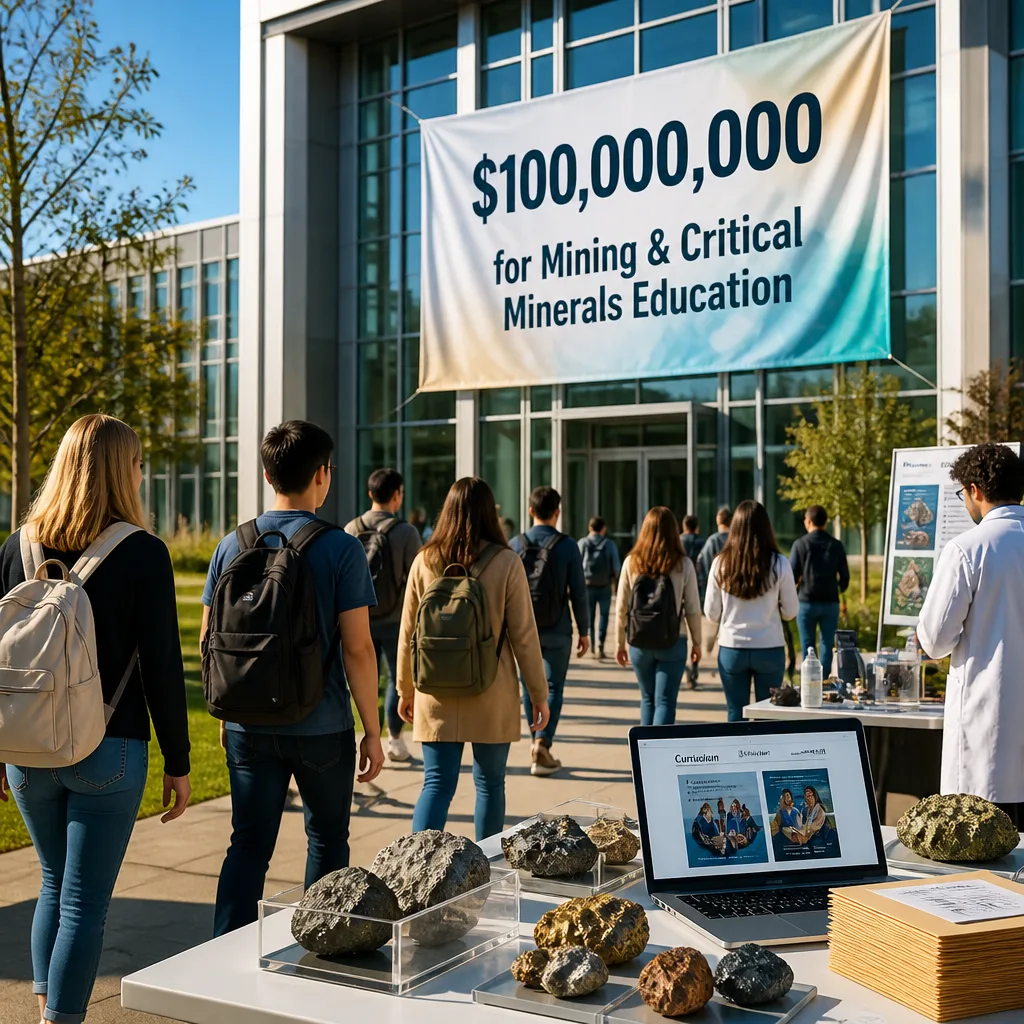
The US Department of Energy has unveiled a $100 million programme designed to enlarge the nation's pipeline of mining, minerals and related technology graduates, with the stated goal of doubling the number of such graduates within two years.
Federal funding to target scholarships, curriculum and teaching tools
Announced on Friday, the Providing Opportunities for Specialized Education in Critical Technologies initiative will channel funds towards scholarships, curriculum development, teaching tools and other measures intended to encourage more students to pursue degrees in mining-related disciplines. Missouri S&T is listed among the universities to receive support.
The Department of Energy has framed the effort as a response to the strategic need for critical minerals — components essential to everything from clean-energy technologies to national defence — and to concerns that the United States currently lacks sufficient domestic capacity in the relevant technical professions.
University response and classroom implications
At Missouri S&T, leaders said the funding would enable more students to enter engineering and science careers that relate directly to mineral supply chains. Chancellor Mohammad Dehghani attended the Washington announcement and said the university’s long history of educating engineers positioned it to take on an expanded role.
“Missouri S&T has educated generations of engineers and scientists who have helped meet our nation’s mineral needs, and this federal support will provide opportunities for even more students to pursue careers in this important field.”
The funding is expected to be used in practical classroom and campus initiatives: scholarships to reduce financial barriers, refreshed syllabuses to reflect industry needs, and teaching equipment or experimental facilities that give students hands-on experience. Those elements are intended to accelerate students’ readiness to enter mining, processing, materials science and recycling roles.
Labour market targets and longer-term needs
DOE officials have set out a clear numerical rationale for the programme. Their estimate is that the country will require roughly 6,000 new engineers in the mining sector over the next decade, in addition to technicians and specialists in processing and recycling.
“We need more engineers and other professionals with the expertise to find, produce and process the minerals our nation depends on for its economic and national security,”
said Dr Catherine Johnson, identified in reports as a Robert H. Quenon Associate Professor and interim chair of mining and explosives engineering at Missouri S&T. A photograph released alongside the announcement shows Johnson with students and DOE assistant secretary Audrey Robertson outside the Eisenhower Executive Office Building in Washington, D.C.
By targeting both short-term graduate numbers and the long-term composition of the workforce, the programme seeks to address immediate shortages while also shaping curricula and recruitment to meet anticipated future demand.
Implications for colleges and employers
For universities with existing mining and minerals programmes, the injection of federal funds may allow them to scale up intake and update facilities. For employers and regional economies reliant on mining and processing, a larger and better-trained cohort of graduates could help fill vacancies and support domestic production and recycling initiatives.
- Investment: $100 million from the Department of Energy.
- Short-term target: Double the number of graduates in mining and related technologies within two years.
- Long-term estimate: Approximately 6,000 additional mining engineers needed over the next 10 years.
| Item | Figure / Aim |
|---|---|
| Total federal funding | $100m |
| Near-term graduate increase target | Double within two years |
| Estimated engineers required | 6,000 over 10 years |
How quickly universities can expand courses and how effectively funds translate into sustained career pipelines will depend on co‑ordination between higher education institutions, industry and federal agencies. Missouri S&T’s leaders argue the university’s existing experimental mine and teaching expertise make it well placed to benefit.
With critical minerals increasingly central to technological and defence strategies, the Department of Energy’s initiative represents a focused attempt to align educational supply with national economic and security priorities. For students, it may open new avenues into a sector requiring practical skillsets and offering roles across exploration, processing and recycling.











