
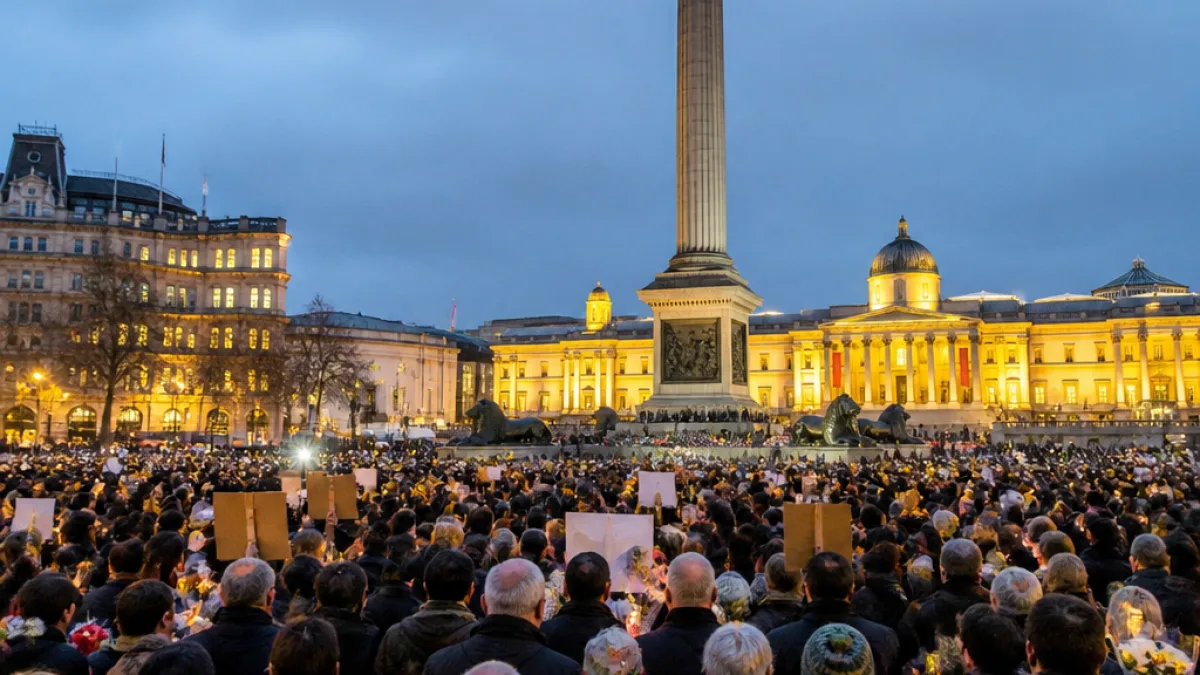
Thousands of people gathered in Trafalgar Square on Monday evening to honour Jason Arday, a former University of Cambridge sociology professor who was found dead on Friday after weeks of intense public scrutiny around accusations of plagiarism and other contested claims.
Public grief meets institutional questions
The event, organised by campaign group Stand up to Racism, drew a large crowd carrying flowers and placards. Some signs read: "Rest In Power Professor Jason Arday". The square, a long-standing focal point for protest and commemoration in the capital, filled with people who came to pay their respects and to protest what many described as a hostile public atmosphere in the days before his death.
The circumstances surrounding Arday's appointment and subsequent resignation have prompted urgent scrutiny of academic procedures and media conduct. Arday resigned on 5 August after a former researcher accused him of plagiarism in his PhD thesis. He denied the allegation but accepted he had made mistakes, according to earlier statements.
"a tragedy on so many levels,"
That was how British Prime Minister Andy Burnham described Arday's death in comments reported after the discovery of his body. Cambridge University has said it will investigate both the circumstances of his appointment and elements of his academic work.
Claims, counterclaims and calls for thorough process
The allegations rapidly drew intense media attention, and lines of inquiry broadened into other aspects of Arday's life — including statements about his career, personal life and medical history. His family said on Friday he had been the victim of misinformation and harassment.
Some critics argue the university’s desire to appoint a prominent Black academic may have led to inadequate vetting and an uneven institutional response when the plagiarism claims emerged. Others cautioned against racialised public reaction. On Monday, Cambridge's Chancellor Chris Smith defended the university’s approach, telling the BBC that it was possible to uphold academic integrity while refusing to "join in a racist feeding frenzy over a particular academic." He added that allegations of plagiarism should be "rigorously investigated" irrespective of the individual's identity.
What happened at the vigil
Attendees placed flowers and stood together in silence at times, while speakers and campaigners addressed the crowd. The demonstration combined elements of mourning and protest, with many participants framing the events leading to Arday’s death as symptomatic of broader problems in public life — the handling of race issues, media intrusion and the pressures faced by academics under intense scrutiny.
- Organisers: Stand up to Racism
- Location: Trafalgar Square, central London
- Context: Resignation on 5 August after plagiarism allegation; death found on Friday prior to the vigil
Institutional responses and next steps
Cambridge University has pledged enquiries into both Arday’s appointment and his published work. The Metropolitan Police issued an apology to a journalist for an investigation linked to a complaint, according to earlier reporting. The intersection of policing, media and university governance will now be a focus for those calling for accountability.
The episode has prompted urgent questions for higher education institutions about recruitment processes, equality and safeguarding standards when academics face sustained public challenge. It has also revived debate over how allegations of academic misconduct should be handled in the public eye, and the potential consequences of rapid, high-profile exposure.
| Event | Timing |
|---|---|
| Resignation from Cambridge | 5 August |
| Found dead | Friday prior to 17 August |
| Vigil in Trafalgar Square | Monday, 17 August |
Local impact and wider significance
On the streets of central London, the vigil served as both a private act of mourning for many and a public demand for scrutiny of how institutions and the media conduct themselves. For those who attended, the loss is not only personal but emblematic of unresolved tensions around race, reputation and redress.
As enquiries proceed, the balance between protecting academic standards and safeguarding individuals from harassment will be central to any reform proposals. The coming days are likely to see campaigns press for clear procedural answers from Cambridge and comment from other bodies involved in the sequence of events that preceded Arday's death.
For now, Trafalgar Square remains a visible symbol of a conversation taking place across universities, newsrooms and political fora about how Britain manages disputes that cross the lines between scholarly integrity and the public sphere.
















