
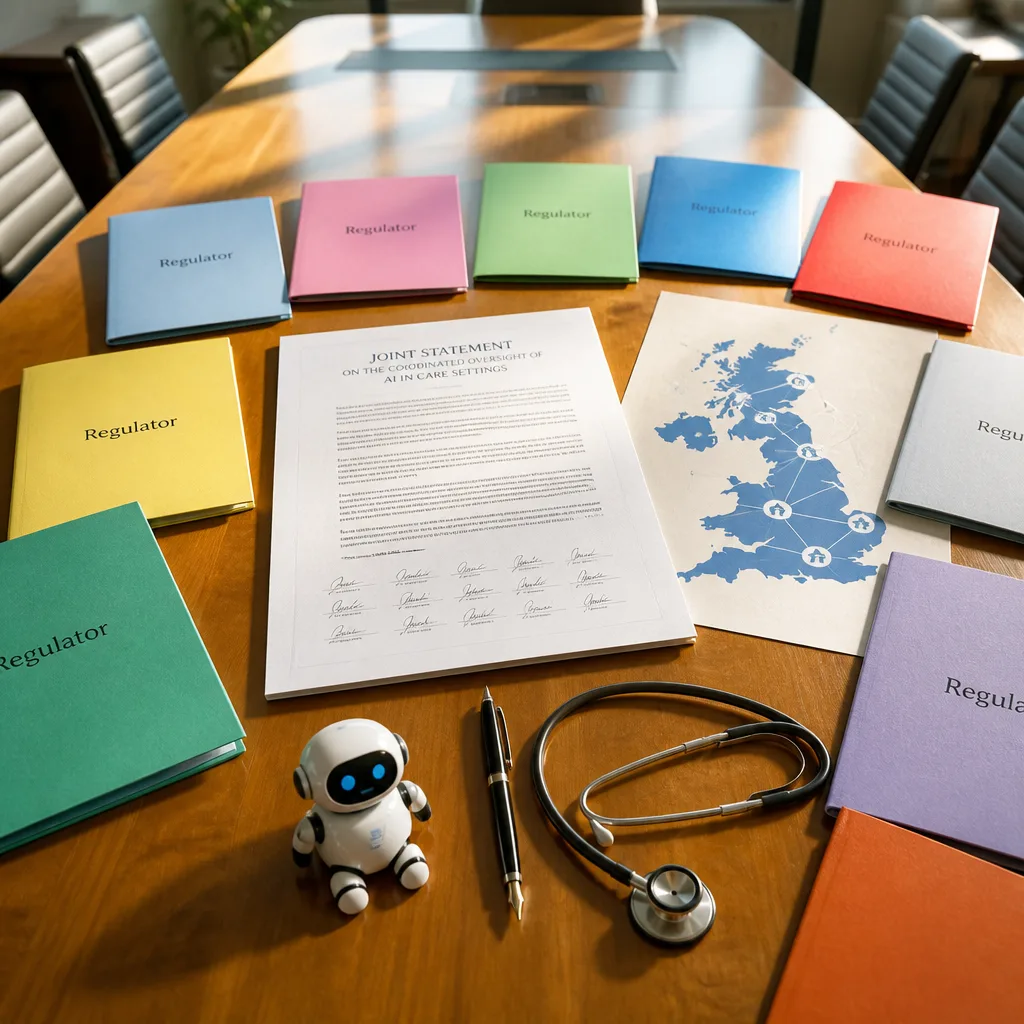
The UK’s principal health and social care regulators have pledged to work together on a coherent regulatory approach to artificial intelligence (AI) across all health and care settings, signalling a move towards a unified framework for professional use of the technology.
Collaborative statement aims for consistent standards
In a joint statement of intent published on 17 September 2026, the ten statutory regulators responsible for the oversight of health and social care professionals, together with the healthcare super-regulator the Professional Standards Authority for Health and Social Care (PSA), committed to developing shared principles to guide how registrants should use AI.
The regulators said the sector needs a “system-wide approach” to AI and that professional regulation can make an “important contribution” to ensuring that technology is deployed in ways that maintain public confidence and uphold the fundamental standards protecting patients, service users and the public.
“Artificial intelligence has the potential to help shape the future of health and care – improving people’s experiences and outcomes when professionals are supported to use the technology confidently, safely and fairly.”
The quote is from Paul Rees, chief executive of the Nursing and Midwifery Council (NMC), one of the signatories to the joint statement.
Context: building on a national commission
The joint statement follows the publication last week of a report from the National Commission into the Regulation of AI in Healthcare, which was established by the Medicines and Healthcare products Regulatory Agency (MHRA) in September 2025. That report, published on 10 September 2026, advocated a regulatory model for AI in healthcare that is more proportionate, lifecycle-based and system-wide.
Regulators said they intend to collaborate with the PSA to convert the commission’s recommendations into practical regulatory principles for professionals who will increasingly encounter AI tools in clinical and social care practice.
What regulators say they will do
The joint statement sets out an intention to cooperate across these broad areas:
- Develop shared principles for safe, fair and transparent use of AI by registrants;
- Ensure regulatory approaches are aligned with system-wide requirements and patient safety priorities;
- Work with the Professional Standards Authority to embed the principles into professional standards and guidance.
While the statement outlines ambition, it does not set a timetable or specific regulatory instruments. The move is designed to avoid a patchwork of different rules for different professions and care settings.
Implications and limits
For frontline professionals and patients, a co-ordinated regulatory stance could produce clearer expectations about when and how AI tools may be used, and by whom. It may also affect professional education, continued professional development and local governance arrangements for introducing new technologies into practice.
However, the statement is a declaration of intent rather than binding regulation. The National Commission’s report recommended lifecycle and system-wide approaches; translating those recommendations into enforceable standards will require further work by the regulators and the PSA, and likely engagement with policymakers, clinicians and industry.
| Element | What regulators have pledged |
|---|---|
| Number of signatory regulators | 10 health and social care regulators plus the PSA |
| Foundational document referenced | National Commission report (published 10 September 2026) |
| Core aims | Shared principles; system-wide approach; proportionate, lifecycle-based regulation |
Regulators stressed that AI has potential benefits, including improved experiences and outcomes for patients, but emphasised that safe and equitable deployment depends on professionals being supported to use AI confidently, safely and fairly. The joint work with the PSA is intended to translate those principles into regulatory guidance that preserves public protection while enabling innovation.
Next steps will include further collaboration between the regulators and the PSA to develop the shared principles and consider how they should be implemented in professional standards and fitness-to-practise frameworks. How quickly this will happen, and whether any statutory changes will be required, remains to be determined.
The statement is the latest effort to bring coherence to the governance of AI in health and social care as machine learning tools and other AI-driven interventions become more prevalent across clinical pathways and care settings.














