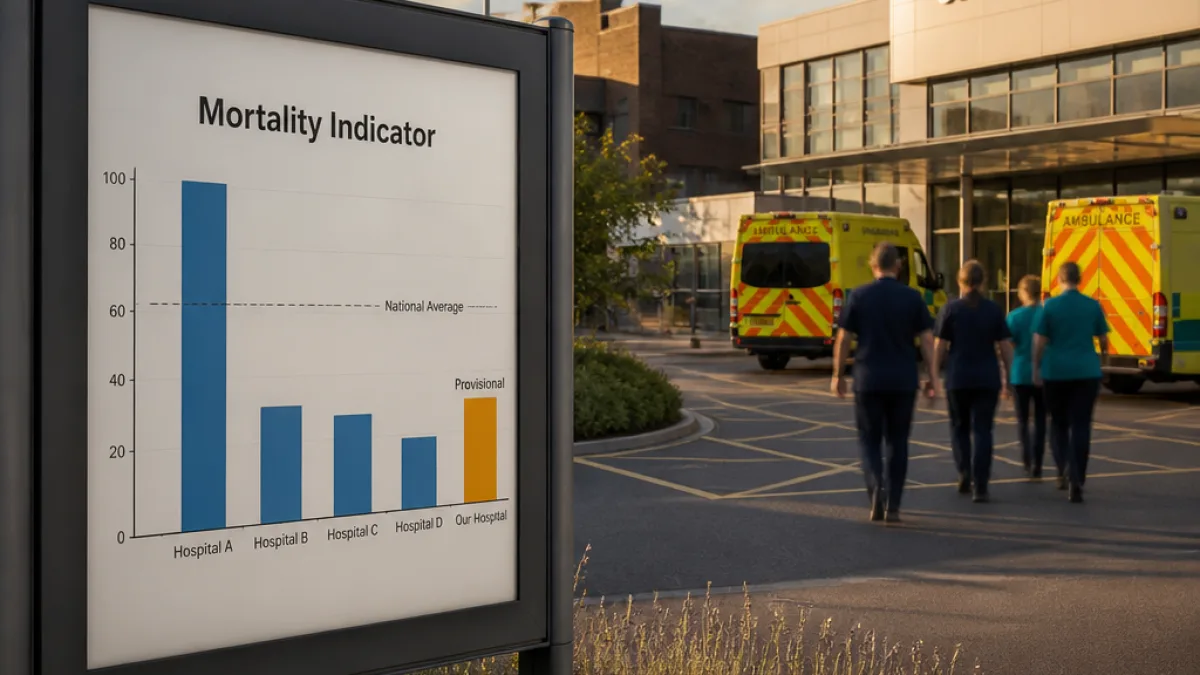
Trust highlights improving trend while mortality indicator remains above benchmark
Wye Valley NHS Trust, which runs Hereford County Hospital, has reported a higher-than-expected number of deaths across a rolling 12-month period, but senior clinicians told board members there are signs the situation is improving.
Board papers presented at the trust's latest meeting show the summary hospital-level mortality indicator (SHMI) at 114.6. That figure is calculated from 1,305 recorded deaths against 1,135 expected deaths, and remains above the national benchmark score of 100.
The trust's chief medical officer said the figure had already begun to fall.
"A provisional SHMI figure for the following month had already fallen to 111,"the report records. The meeting was also told this was the first dataset to include patients seen through the trust's Same Day Emergency Care (SDEC) service.
Clinicians told the board they anticipated the SHMI would continue to decline as more SDEC episodes were incorporated into reporting. SDEC is designed to assess, diagnose and treat patients on the same day without the need for overnight admission — an approach that can change how activity and outcomes are recorded in mortality statistics.
Other mortality measures and service outcomes
Trust staff emphasised other measures that provide context to the SHMI and offer reassurance on the safety of care.
- Crude inpatient mortality rate for July: 1.24% — equivalent to 58 inpatient deaths during the month.
- Emergency department deaths recorded in July: 7.
- Maternity outcomes: extended perinatal mortality 2.57 per 1,000 births; stillbirth rate 0.7 — both below national averages.
- Improved outcomes for patients with fractured neck of femur injuries were also reported.
Board papers acknowledge that, while the overall picture is improving, particular clinical areas still demand close attention. Sepsis and stroke were highlighted as requiring continued oversight, though the trust is not currently flagged as an outlier in those domains.
A new sepsis lead has been appointed within the emergency department and additional work is underway to refine care pathways and review stroke mortality data, the meeting heard. Trust leaders also described the learning-from-deaths process as robust.
What the numbers mean for patients and the public
The SHMI is one of several tools used across the NHS to monitor hospital mortality. It compares the number of deaths occurring in a hospital with the number expected, based on the characteristics of admitted patients. A score above 100 indicates more deaths than statistically expected; a fall in the indicator can reflect changes in care delivery, coding, or patient pathways such as the introduction of SDEC.
For Herefordshire residents, the trust's assurance that the trend is moving in the right direction will be welcome news, but the data also underlines the need for continued vigilance in high-risk areas. The trust has set out short-term actions — including appointment of clinical leads and pathway reviews — and provided board members with updated monthly figures to monitor progress.
| Measure | Figure |
|---|---|
| SHMI (rolling 12 months) | 114.6 (1,305 recorded vs 1,135 expected) |
| Provisional SHMI (following month) | 111 |
| Crude inpatient mortality (July) | 1.24% (58 deaths) |
Members of the public and local clinicians will expect the trust to maintain transparency on these figures and to demonstrate sustained improvement. The inclusion of SDEC in the mortality dataset is a reminder that evolving models of emergency care can shift how outcomes are recorded and must be carefully interpreted alongside clinical context.
Board papers did not propose immediate structural changes to services but set out ongoing audits, pathway reviews and additional governance for sepsis and stroke. The trust's robust maternity indicators were noted as a positive counterpoint amid the wider mortality discussion.
As the trust continues to monitor monthly data, patients and local health partners will be watching for a sustained fall in the SHMI and for evidence that targeted actions are reducing preventable harm in the areas identified.