
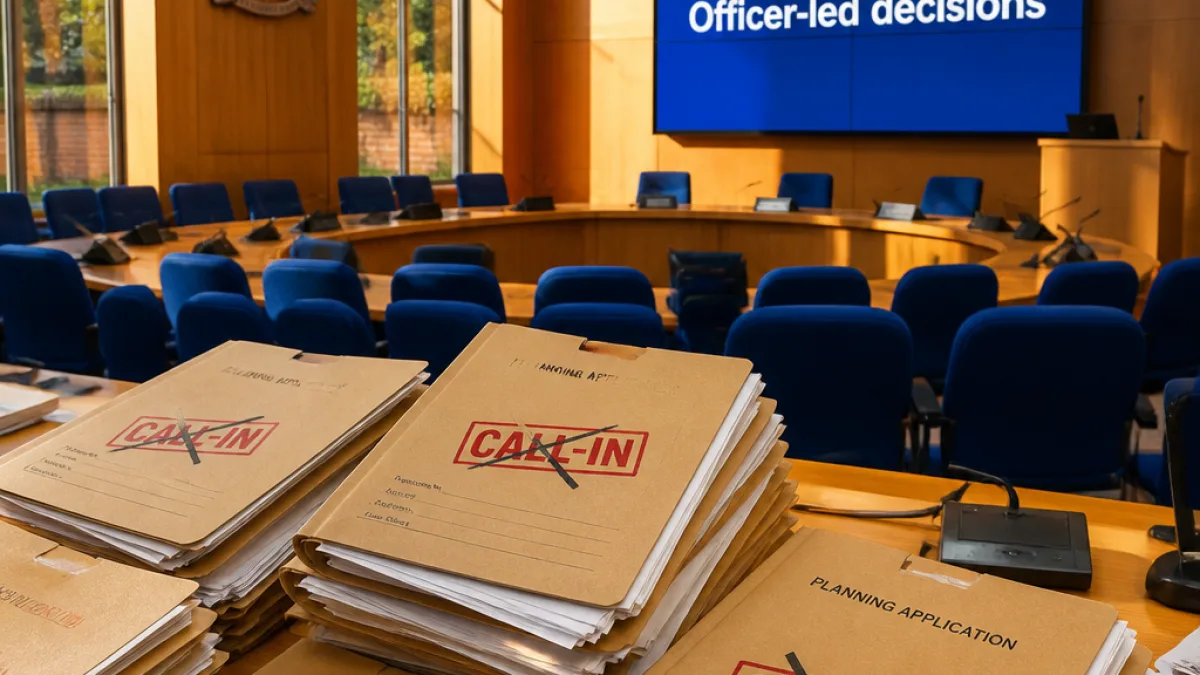
Changes will shift most planning decisions to officers from October 31
Dudley councillors have been told that, from 31 October, almost all planning applications will be decided by council planning officers rather than by elected members, under new mandatory national rules. The move removes councillors' automatic right to 'call in' applications for determination by planning committees, leaving member involvement restricted to a narrow set of circumstances and dependent on a senior planning officer's agreement.
The changes, announced by government, are intended to provide greater clarity about the role of councillors on planning committees so they concentrate on major or contentious proposals while routine, technical or minor matters are dealt with by officers. Council papers prepared locally by Michael Brereton, Dudley's director of development and regulation, note that "99 percent of decisions are already made by officers." Mr Brereton told councillors the reforms were a national requirement and that local authorities must comply.
The shift has drawn angry criticism from local political figures. The leader of Dudley's Reform UK group described the reforms in stark terms, warning they strip away councillors' ability to represent residents' concerns on planning matters.
"The government has pulled a fast one here, this is one of the biggest castrations of councillors in local government being able to represent residents."
At a meeting of Dudley councillors, concerns were raised about what the changes mean for community influence over planning decisions and the future of the council's recently adopted local plan. Officers said planning committees were originally designed to consider large, complex applications with significant public interest, and that in practice most routine applications are appropriately handled by trained planning professionals.
How the new arrangements will work in Dudley
- From 31 October a presumption exists that most planning applications are determined by officers.
- Councillors will generally not be able to 'call in' applications; member consideration will be limited to specific, defined circumstances and requires a senior officer's agreement.
- Change of use applications, including many applications related to houses in multiple occupation (HMOs), are among those likely to be decided by officers rather than committees.
Mr Brereton set out the council's position in a report explaining the revised arrangements. He argued the changes do not reduce the democratic role of elected members but aim to focus member input where it "adds the greatest value" and to reduce the risk of appeals, Ombudsman complaints, costs awards and legal challenge.
"These reforms do not diminish the role of elected members in the planning process. Instead, they seek to ensure member involvement is focused on matters where local democratic input adds the greatest value."
Despite the council director's reassurances, some councillors and local campaigners fear residents will have diminished influence over developments in their neighbourhoods. One prominent local councillor warned that people who care about what happens in their areas would "literally have no say whatsoever."
Local consequences and next steps
Council officers have indicated the authority must still operate within the framework of the local plan. Dudley's latest local plan was recently adopted, but officers acknowledge that the new delegation rules alter how that plan will be applied in practice. The council has begun work to ensure officers' decision-making aligns with the local plan and to set out the precise circumstances where member involvement will be warranted.
For Dudley residents, the immediate consequence is a change in where and how disputes over planning applications will be resolved: fewer public committee hearings, more officer-led decisions and reliance on administrative routes such as appeals where there is disagreement. Councillors and officers will need to explain clearly how public consultation and democratic accountability will be preserved under the revised arrangements.
| Item | Position under new rules |
|---|---|
| Call‑in by councillors | Removed except in limited cases and with senior officer agreement |
| Most planning decisions | Made by planning officers (presumption from 31 October) |
| Role of planning committees | Focus on major, complex or high‑interest applications |
As the new arrangements come into force at the end of October, councillors, officers and residents in Dudley will be watching closely to see whether the promised clarity and consistency materialises, and whether local democratic oversight is preserved in practice.













