
Relatives renew calls for a judge-led inquiry
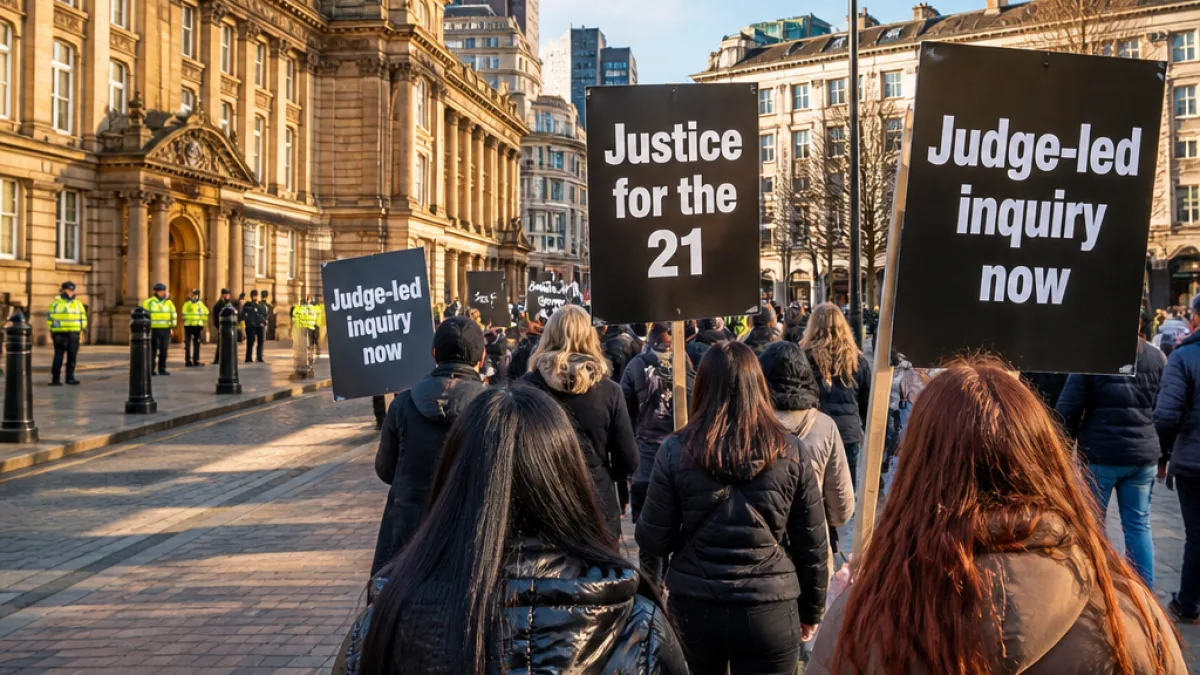
Relatives and campaigners marched through central Birmingham on Thursday to renew demands for a judge-led public inquiry into the 21 November 1974 pub bombings that killed 21 people and injured more than 200.
The demonstration, organised by the Justice 4 the 21 group, drew around 40 people who said they remained dissatisfied with the results of previous investigations and inquests. A coroner-led inquest in 2019 concluded the victims had been unlawfully killed by members of the Irish Republican Army (IRA) but did not identify those responsible.
Campaigners have repeatedly urged the government to open a full, judge-led public inquiry. The government has advised that the case is best pursued through the recently established Independent Commission for Reconciliation and Information Recovery (ICRIC), a legacy body created to investigate deaths and serious injuries connected to the Troubles in Northern Ireland.
"Only a judge-led public inquiry can give us the answers that we desire most," said Julie Hambleton, leader of Justice 4 the 21 and sister of one of the victims.
Julie Hambleton said successive governments had offered victims' families what she described as "empty platitudes" and that they needed actions rather than words. She remains unconvinced that the ICRIC can provide the detailed, legally enforceable findings and accountability a public inquiry could.
Generation of relatives keep campaign alive
Not all campaigners at the march were alive when the attacks took place. Lorna Evans, whose uncle Jimmy Craig was among those killed, told the gathering that it was important for younger relatives to keep the campaign going.
"It's about more than just identifying the perpetrators," she said. "It's about honouring the 21 victims."
She added the effort was also intended to expose and understand any failures within the criminal justice system, including the actions of the police and government, to try to prevent similar instances for other families in future.
What families want — and what the government proposes
Campaigners want a full public, judge-led inquiry that would have powers to compel testimony and documents. Ministers, while sympathetic, have pointed to the ICRIC as the route they consider most appropriate. Supporters of the legacy commission argue it can investigate historical cases, offer recovery of information, and provide a mechanism for reconciliation.
- Date of attacks: 21 November 1974
- Fatalities: 21 people
- Injuries: More than 200
| Event | Detail |
|---|---|
| Inquest (2019) | Concluded victims were unlawfully killed; identities of perpetrators not established |
| Current official route | Independent Commission for Reconciliation and Information Recovery (ICRIC) |
The debate over which mechanism is most suitable is not purely technical. Campaigners stress that a public inquiry, led by a judge, would carry formal powers to compel witnesses and produce a public record with potential legal consequences. Proponents of ICRIC say that a legacy body designed specifically to address Troubles-era cases can access information and support reconciliation processes in ways a traditional inquiry might not.
Former prime minister Sir Keir Starmer has said the legacy commission could deliver "the truth and accountability" families want. But for those who gathered in Birmingham, the key issue remains whether that body can match the legal authority and public transparency they believe a judge-led inquiry would bring.
The march brought into sharp focus how the wounds of the 1974 attacks remain raw in the city, more than half a century on. As relatives pressed their case, the central question remains whether government will be persuaded to open the formal, judge-led inquiry campaigners demand — or whether families must accept the ICRIC route as the government's final offer.
For Birmingham residents, the outcome will matter not only as a matter of historical record but as an indication of how the state responds to long-standing calls for truth and accountability in the face of past violence.















