
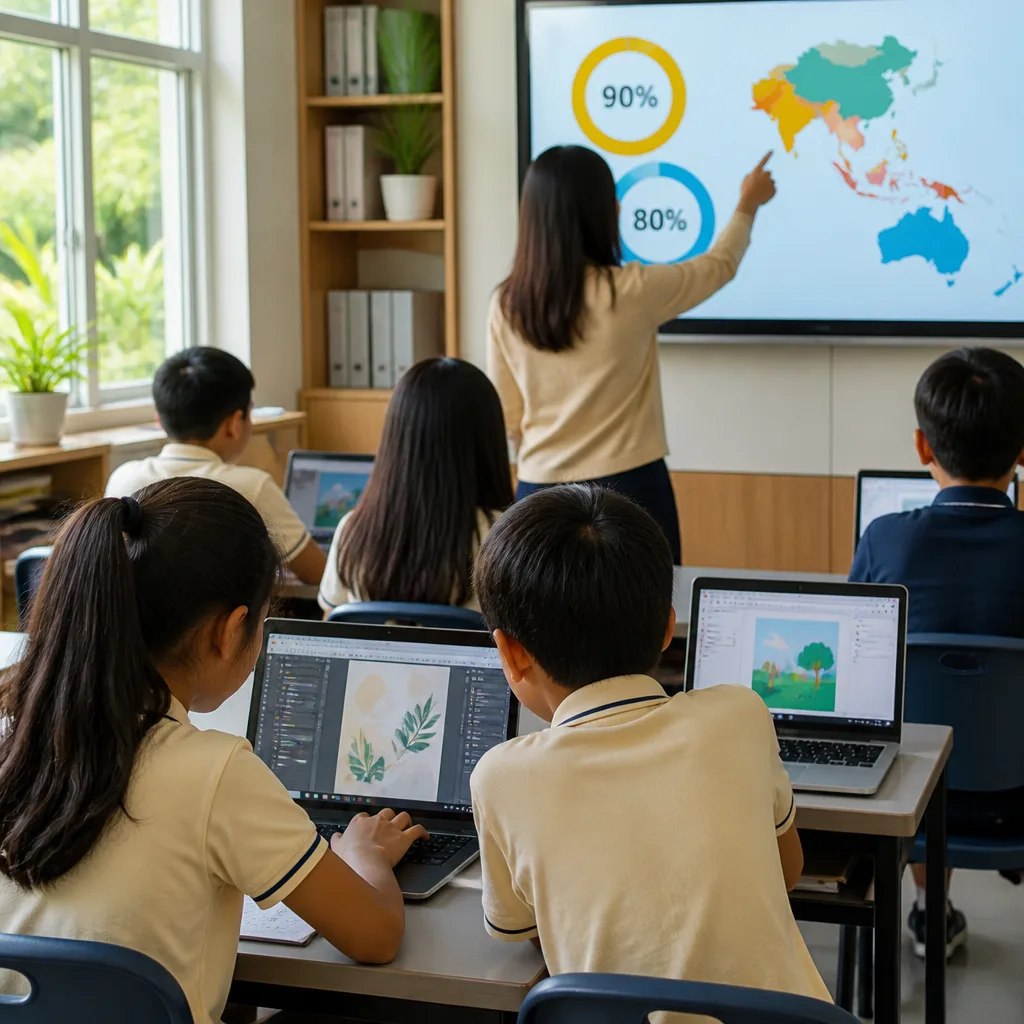
Teachers across the Asia‑Pacific region overwhelmingly judge Apple’s Mac to have a beneficial effect on their pupils, with large majorities saying it supports creativity and higher‑order cognitive skills, according to a recent online survey of educators.
Survey finds broad teacher endorsement
The study, carried out between 25 August and 1 October and involving 10,995 teachers in eight countries — Australia, Indonesia, Japan, Malaysia, Singapore, South Korea, Taiwan and Thailand — found that 90% of respondents believed the Mac had a positive impact on students. The research reported a five‑point advantage for the Mac over competing products in overall perceived impact.
More than 80% of teachers said the Mac positively contributed to both creativity and the development of higher‑order thinking skills, the study added. Those effects were recorded in responses from educators working in both private and public schools.
Industry framing and teacher enthusiasm
At a recent Apple Education event in Kuala Lumpur, the strong enthusiasm among teachers was plain to see, with an atmosphere that observers described as unusually celebratory for an education gathering. That public enthusiasm mirrors the survey results and underlines how the company’s brand appeal translates into the education sector.
Apple’s worldwide product marketing senior director for education, Dominic Liechti, cautioned that technology is intended to complement rather than replace fundamental skills such as reading, writing and arithmetic.
"Technology was not about replacing basic skills such as reading, writing or math, which are still critically fundamental to learning."
What the findings mean for classrooms and policy
The survey offers a snapshot of teacher perceptions rather than direct measures of pupil attainment. While teacher belief in a device’s value matters — influencing adoption, classroom practice and professional development — it should be considered alongside independent measures of learning outcomes and cost implications for schools and families.
Key points school leaders and policymakers will weigh include:
- How perceived benefits translate into measurable pupil progress across subjects.
- Whether advantages credited to one platform can be replicated with different devices or software ecosystems.
- Costs for hardware, maintenance and staff training, and equity of access in resource‑limited settings.
These practical considerations are particularly acute in countries where school budgets vary widely, and where families may be asked to provide devices for remote or blended learning. The survey did not present data on cost, device longevity or the presence of comparable resources in the classroom.
Data at a glance
| Metric | Result |
|---|---|
| Teachers surveyed | 10,995 |
| Countries covered | 8 (APAC) |
| Perceived positive impact of Mac | 90% |
| Perceived advantage vs competitor | +5 points |
| Positive effect on creativity & higher‑order thinking | >80% |
As with any industry‑commissioned or vendor‑related research, readers should note the methodological outline: the survey was conducted online via a third‑party research panel. That design produces large, rapid samples but can be shaped by who is accessible and motivated to respond.
Balancing enthusiasm with evidence
For headteachers and education officials, teacher endorsement is an important input but not a standalone justification for wholesale procurement decisions. The challenge remains to combine teacher insight with robust, independent evaluations that track attainment and classroom practice over time.
For teachers, the survey confirms what some already experience: devices can enable new modes of creativity and problem‑solving. For policymakers, the task is to ensure that recognised benefits are equitably available, cost‑effective and supported by professional development so that technology serves pedagogy, rather than the other way round.
Ultimately, the debate will hinge on evidence of learning gains and on ensuring access; positive perceptions are a promising start, but they are one piece of a larger policy and practice puzzle.