The spike in fuel prices caused by the war involving Iran is having a direct and immediate effect on school attendance and education funding in vulnerable communities, according to reporting from Cambodia’s Tonle Sap lake. Families reliant on fishing and small-scale labour are cutting journeys to school and children are being pulled into work to preserve household incomes.
Transport costs translating into lost learning
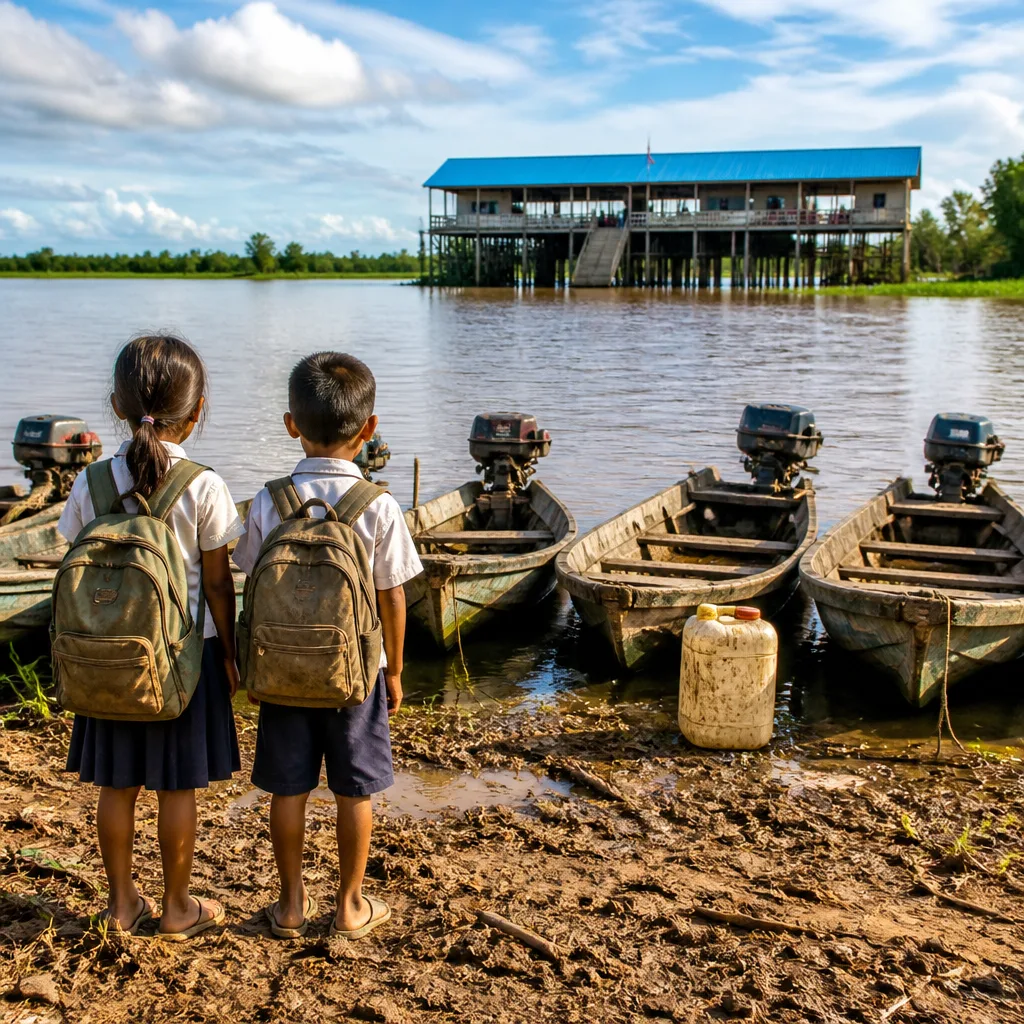
On the floating villages of Tonle Sap, where boats are the only way to reach classrooms, the extra cost of gasoline has become an added barrier to education. Children who once made short, daily crossings to attend class are now travelling less frequently or not at all because their families cannot afford the fuel. In many cases, parents and guardians are weighing the cost of a boat trip against food and medicines.
Teachers say the danger is compounded by environmental pressures: increasingly erratic floods and droughts have made journeys by water more hazardous, and school communities report that safety concerns — including the deaths of pupils in past years — also shape parental decisions about sending children to lessons.
Global ripple effects on poverty and schooling
Beyond Cambodia, the United Nations Children’s Fund has warned that if the Iran war endures it could push up to 23.4 million additional children into poverty by the end of the year. The agency says roughly 80% of those affected would be in Africa and Asia, regions already wrestling with fragile education systems and stretched public finances.
| Projection | Figure |
|---|---|
| Additional children pushed into poverty | 23.4 million |
| Share likely in Africa and Asia | ~80% |
For low-income households, higher fuel bills have multiplier effects. Transport becomes costlier for pupils and teachers alike; school meal and supply chains face higher delivery costs; and governments feeling the squeeze on energy-dependent budgets may have less capacity to protect education spending.
Classroom consequences and local realities
On the ground at Tonle Sap, the disruption is visible in small, practical ways that add up to lost learning. A 13-year-old who only started school at 10 because her mother feared the journey exemplifies how geography, safety and now global geopolitics combine to delay a child’s education. In that community, many children help with fishing, cleaning and other informal work — activities whose urgency rises when fuel-driven costs eat into household cash.
- Access: Higher transport costs reduce daily attendance for pupils and can deter teachers from travelling to remote schools.
- Safety: Environmental volatility on waterways increases parental reluctance to risk journeys to school.
- Finance: National budgets under fuel-price pressure may reallocate or cut education funding.
Those three strands — access, safety and finance — are interlinked. In classrooms already operating with limited resources, even modest drops in attendance can undermine teacher planning, peer learning and the continuity necessary for pupils to progress.
Policy implications and options
The situation makes clear that international conflicts can have far-reaching effects on education, even where there is no direct military involvement. Policymakers and donors face choices about how to prevent further erosion of learning for the most vulnerable.
Options to consider include targeted subsidies for school transport, emergency cash transfers to households, and additional funding to keep rural and remote teachers in post. On a macro level, sustaining education budgets and protecting school services during economic shocks will be crucial if countries are to avoid backsliding on learning gains achieved in recent years.
For pupils from the poorest families, the consequences are immediate: lost hours in the classroom, increased likelihood of dropping out and a longer-term risk of being trapped in low-income work rather than progressing to higher levels of education. In communities such as those on Tonle Sap, the choice between schooling and survival is becoming starker as global events push up local living costs.
As this crisis unfolds, classroom voices and community realities offer a reminder that international policy and local schooling are deeply interconnected. Protecting learning for the poorest children will require interventions that bridge global diplomacy, national budgeting and the everyday logistics of getting pupils and teachers safely to school.