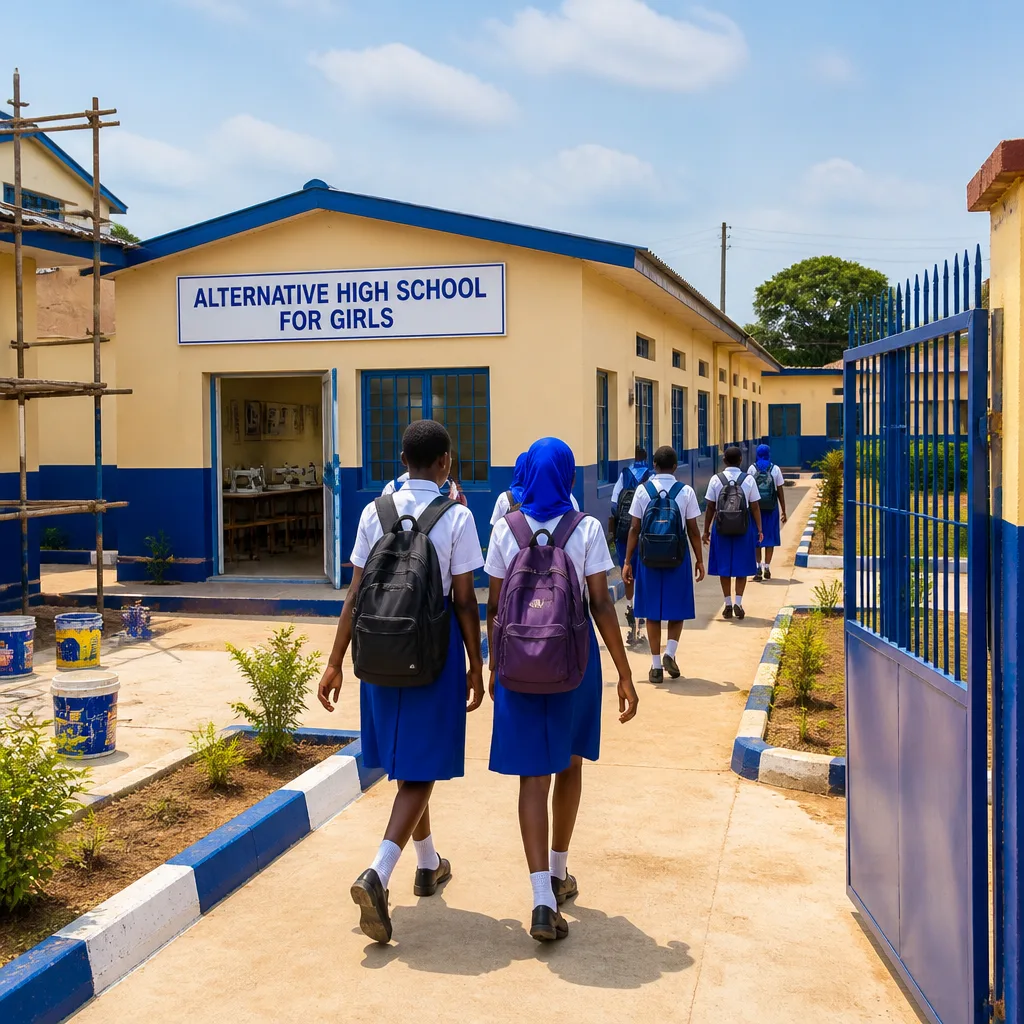
The Universal Basic Education Commission (UBEC) has signalled a fresh commitment to providing second‑chance education for girls and young women whose schooling was interrupted by poverty, early motherhood, displacement and other hardships, unveiling a refurbished Alternative High School for Girls in Agboju, Lagos State.
Speaking at the commissioning, the Commission’s Executive Secretary, Dr Aisha Garba, described the renovated facility as more than bricks and mortar: it is intended to offer returning learners the opportunity to resume study, acquire practical skills and rebuild life prospects.
“A girl whose circumstances prevented her from completing her education should be given another opportunity. Every child deserved an alternative pathway to acquire the education needed to succeed in life,”
Dr Garba said the project was funded through UBEC’s UBE direct intervention and forms part of broader efforts under the federal Government’s Nigeria Education Sector Renewal Initiative (NESRI) to expand access and enhance the quality of basic education.
Purpose and principles
The Agboju Alternative High School is explicitly targeted at learners who dropped out for a range of reasons, including economic hardship and forced displacement. UBEC framed the rehabilitation not simply as an infrastructural upgrade but as the restoration of a route back into education and skills development for girls who might otherwise be written off.
In her remarks, Dr Garba emphasised the moral and developmental imperative to offer returning students a genuine chance to progress, saying the school should be a place where “hope is restored, confidence is built and the future is renewed.” She also underlined that children affected by conflict and displacement still possess talents and aspirations that warrant support.
What the intervention aims to deliver
The UBEC-led initiative sets out several strands of support for out-of-school girls, including:
- Rehabilitation of learning facilities to create a welcoming and safe environment for returnees.
- Provision of alternative pathways that combine academic catch‑up with skills training.
- Support mechanisms to rebuild learners’ confidence and enable sustained reintegration into education.
UBEC presented the Agboju school as a model that could be replicated in other areas where girls’ education has been disrupted. However, the Commission also positioned the work as part of the Government’s wider NESRI reforms, which aim to ensure that no child is left behind.
| Element | Intended effect |
|---|---|
| Rehabilitation of facilities | Create a safe, functional learning environment |
| Alternative learning pathways | Enable academic catch-up and vocational skills development |
| Community support focus | Restore confidence and encourage sustained attendance |
Implications and questions for scale
The Agboju project illustrates a practical attempt to confront the long‑term consequences of interrupted schooling for girls. For policymakers and education managers the key challenge will be translating a single rehabilitated facility into a scalable programme that reaches girls across varied contexts — urban, peri‑urban and conflict‑affected settings — while ensuring quality of teaching and relevance of skills training.
Success will hinge on several factors that were signalled but not detailed in the commissioning remarks: the nature of the skills curriculum offered, teacher training and support for learners with complex social needs, mechanisms for re‑engaging families and communities, and how the initiative is financed and monitored under NESRI.
For parents and communities, the Agboju hub represents a tangible option for girls who previously faced limited choices. For the girls themselves, it promises more than classroom time: a renewed chance to develop capabilities that can underpin greater economic independence.
As the Government seeks to broaden the reach of such interventions, observers will be watching whether UBEC can replicate the Agboju approach at scale and how NESRI resources are marshalled to sustain both infrastructure and the wraparound support necessary for real reintegration into education.