
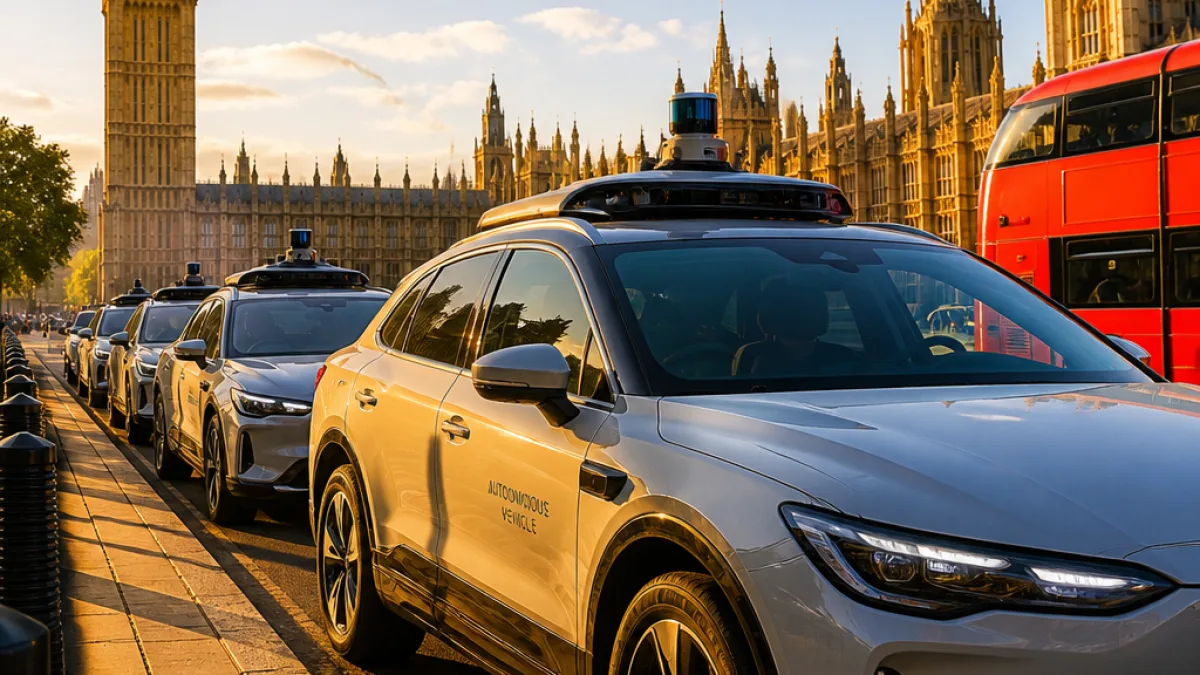
London will today see the UK’s first robotaxis when Uber places a fleet of 15 Ford Mustang Mach‑E electric vehicles fitted with British developer Wayve’s autonomous driving technology on the capital’s roads.
What is being launched
The rollout represents the initial commercial deployment of autonomous passenger services in the UK. The vehicles will operate through the Uber platform but will not be directly selectable by users — customers booking a regular Uber may be offered a Wayve‑equipped car, which they can accept or decline. Fares will match standard Uber prices, and passengers will not be prompted to leave a tip after a robotaxi journey, the company said.
Human oversight for now
Despite the autonomous systems aboard the cars, every journey will have a human safety driver behind the wheel. The driver will monitor the trip and can take control or apply the brakes if necessary, a precaution that reflects the UK’s cautious regulatory approach to self‑driving passenger services.
"That process is still playing out," said Sarfraz Maredia, Uber’s head of autonomous mobility, when asked about how long regulatory approval to remove safety drivers might take.
The government and regulators are developing a national framework for self‑driving vehicles. Operators are required to secure explicit approval before they can operate without a person behind the wheel; that approval has not yet been granted for these vehicles.
Why London is a difficult testbed
London’s driving environment is among the most complex in the world: narrow streets, heavy congestion, extensive bus and cycle lanes, pedestrians and the presence of electric rental bikes all combine to create a demanding setting for autonomous systems. Companies including Wayve and Uber say their technology has been developed with such challenges in mind, but the capital will be an exacting arena for public commercial operation.
Other operators and the wider picture
Wayve and Uber are among the first to move towards a commercial passenger service in Britain. Other operators, including Waymo and Chinese technology firm Baidu, are also preparing to offer autonomous services in London, signalling a crowded and competitive field if regulatory barriers are lowered.
- Fleet size at launch: 15 Ford Mustang Mach‑E electric vehicles
- Operator technology: Wayve autonomous driving stack
- Safety drivers: Present on every journey
- Booking: Robotaxis are offered via the standard Uber app; not directly requestable
- Fares and tipping: Same as standard Uber fares; no tip prompt for robotaxi trips
| Item | Detail |
|---|---|
| Number of vehicles | 15 |
| Vehicle model | Ford Mustang Mach‑E (electric) |
| Autonomy provider | Wayve |
| Safety driver | Yes — human behind the wheel |
| Booking method | Offered through standard Uber bookings |
For Londoners, the immediate change will be mostly invisible: users who accept an offered Wayve vehicle will ride a robotaxi at the same price as their usual Uber trip but with tech monitoring the drive. The more significant shifts — driverless operation without a human in the cab, wider fleet roll‑outs and new business models — depend on regulators granting permission to remove safety drivers.
Transport authorities and local policymakers will be watching closely. The capital’s transport network and its road safety considerations make any move towards full autonomy politically sensitive. Questions remain about liability, data sharing, interaction with cyclists and pedestrians, and the potential impact on professional drivers whose work could be affected if widespread driverless services arrive.
This limited launch nevertheless places London at the forefront of a new chapter in urban mobility. If the trials progress and regulators are satisfied with safety and performance, the city could see a faster uptake of autonomous services — but for now, human oversight and a measured regulatory timetable remain in place.
Reporting from London: this is the first public deployment in the UK and a close test of both technology and governance at the heart of the capital’s busy streets.










