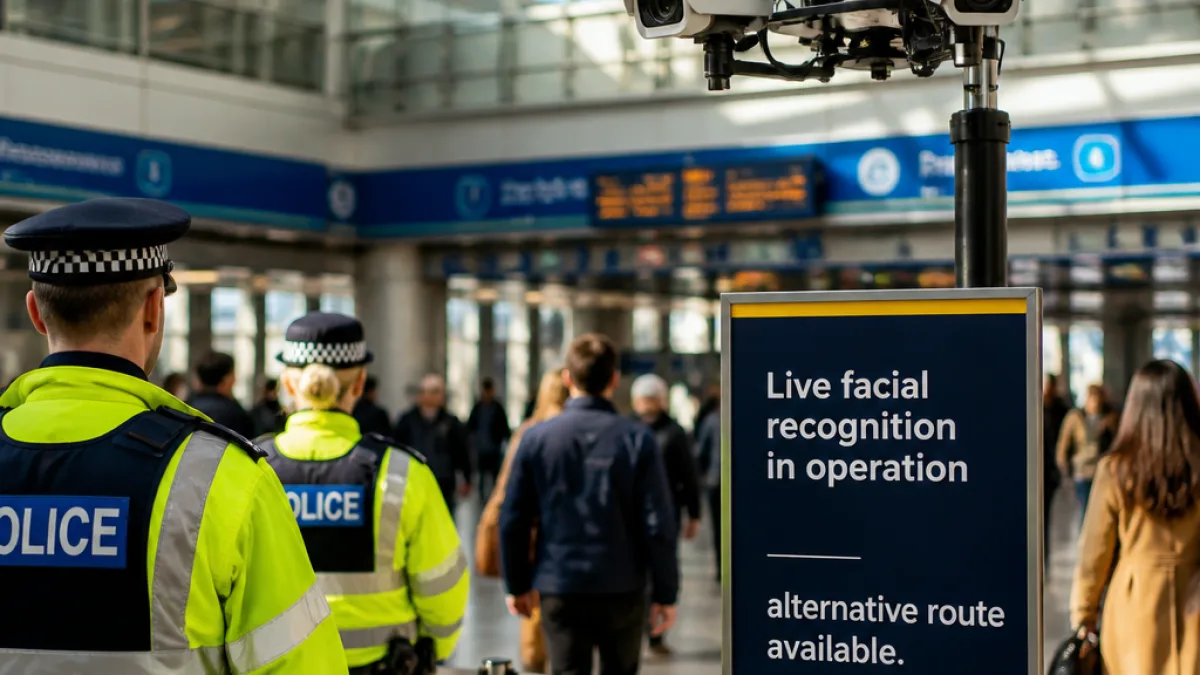
Live facial recognition cameras will be switched on at selected London Underground stations from Tuesday as Transport for London (TfL) and the British Transport Police (BTP) expand a controversial trial aimed at identifying people on a police watchlist.
What is being deployed and where
TfL announced the first Tube deployment will take place at Victoria station. The technology, known as Live Facial Recognition (LFR), will be used in signed areas where people will be able to see notices and choose an alternative route if they do not wish to pass through the system, the organisations said.
Siwan Hayward, TfL's director of security, policing and enforcement, said the tool was intended to help protect passengers from "high‑harm" offenders, including those wanted for sexual offences, robbery and knife crime. She said LFR could be "a powerful additional tool" to help police identify people quickly and enable early intervention.
Previous deployment and the results
The BTP has already used LFR at London mainline stations earlier this year. Between February and July the force recorded 18 deployments across major stations and scanned more than 530,000 faces, according to deployment logs published by the force.
| Metric | Figure |
|---|---|
| Deployments (Feb–Jul) | 18 |
| Faces scanned | 530,000+ |
| True matches | 0 |
| False identifications | 1 |
The force's logs show those earlier operations produced no confirmed matches and no arrests, with a single false identification recorded.
Privacy and civil liberties concerns
Campaign groups reacted swiftly. Big Brother Watch said the technology was "dystopian" and argued its use "treats the public like suspects". The group has previously questioned the effectiveness of LFR and raised concerns over mass surveillance of people in public spaces.
"It treats the public like suspects," said Big Brother Watch.
TfL stressed that images of people not matched to the watchlist would be "automatically and immediately deleted" and that the trial areas would be clearly signed so passengers can make an informed choice about whether to walk through them. BTP added there would be alternative routes available for passengers who wished to avoid the cameras.
How it will affect passengers
For commuters and visitors, the trial will mean:
- Some corridors or entrances at Victoria station will be signposted as part of the LFR area.
- Passengers who do not want to be scanned can use clearly marked alternative routes.
- TfL says non‑matches will have their images deleted immediately; the BTP will operate the system based on intelligence and crime data.
Despite reassurances, questions remain over how "alternative routes" will operate during busy periods, and how many passengers will see the signage in complex, crowded interchanges. Commuters I spoke to at street level expressed unease about being scanned without having to provide consent, though passengers also said they wanted safer journeys.
Accountability, oversight and next steps
Authorities say the rollout is intelligence‑led and focused where it will have the most impact. But the absence of confirmed matches in the earlier 18 deployments will be scrutinised by privacy campaigners and civil liberties groups as the technology moves onto the Tube network.
Campaigners and some politicians have called for clearer oversight arrangements and stronger public reporting on accuracy, deployment rationale and how the watchlist is compiled. TfL and BTP have pointed to their published deployment logs and say they will continue to publish details of operations.
This trial is the latest chapter in a broader national debate about the balance between new policing technologies and individual privacy. TfL argues LFR is one tool among many to tackle violence and sexual offending on the network; opponents say it risks normalising intrusive surveillance without clear evidence of benefit.
As the cameras switch on at Victoria, passengers and privacy groups will be watching closely — and asking whether the claimed gains in safety will match the cost to public confidence in being free from intrusive monitoring in public transport hubs.