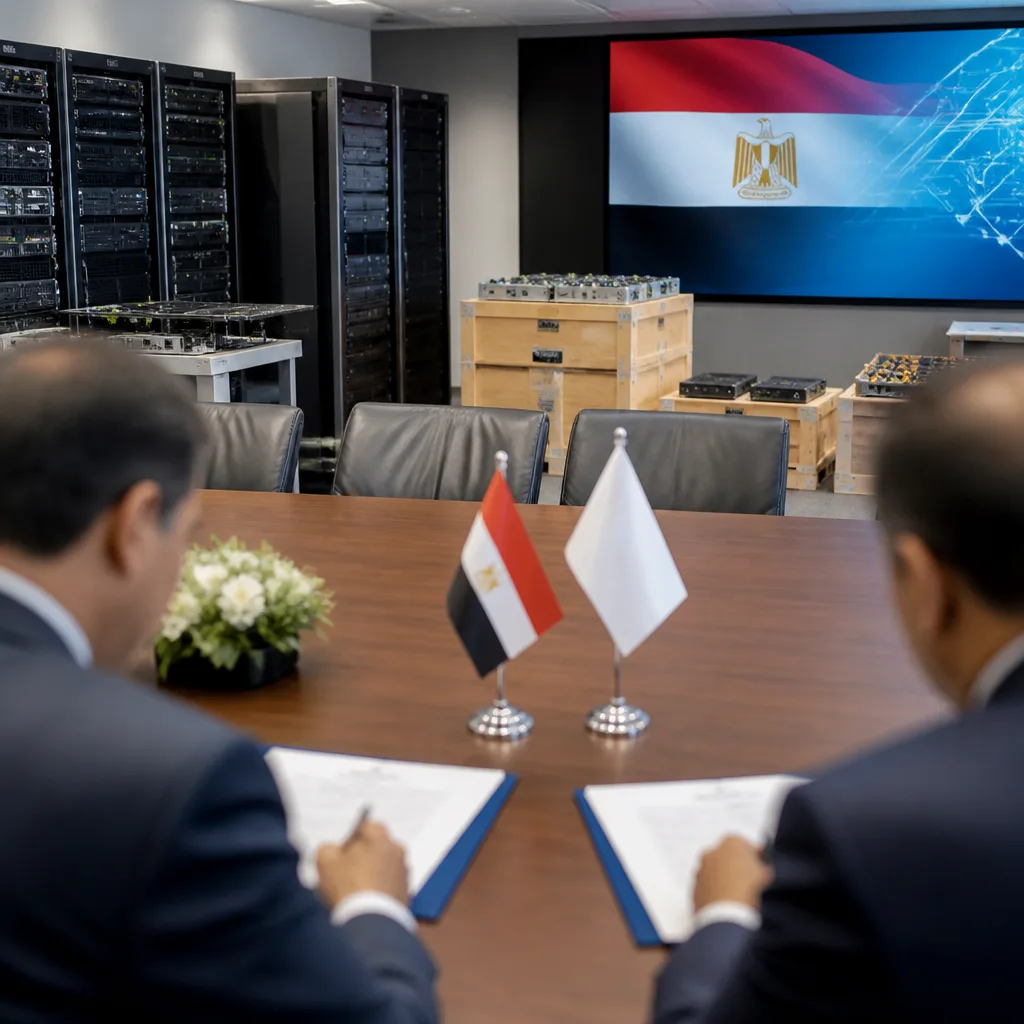
The Egyptian Ministry of Military Production’s affiliate Toya Technology has signed a memorandum of understanding (MoU) with Intel to pursue localisation of artificial intelligence technologies, officials said on Tuesday.
What was agreed
The MoU, signed by Khaled Mohamed Mahrous, Chairperson of Toya Technology, and Taha Mohamed Khalifa, Intel’s General Manager for the Middle East and Africa, was witnessed by Minister of State for Military Production Salah Gamblat and senior Intel executives including Gisselle Ruiz Lanza, Intel’s General Manager for Europe, the Middle East and Africa.
The agreement is presented as part of wider Egyptian state directives to expand cooperation with global technology firms and to deepen local manufacturing. According to the ministry, the MoU focuses on three broad objectives:
- Skills development and capacity building – training programmes and a Training of Trainers (TOT) initiative to develop professionals who can work with AI applications;
- Knowledge transfer and technical support – exchange of expertise and advisory support for training and deployment of AI solutions;
- Local assembly and deployment – exploring opportunities to deploy and locally assemble technological solutions in line with national plans to localise advanced technologies.
Officials frame agreement as part of national industrial strategy
Minister Gamblat described the MoU as supporting efforts to establish an “integrated artificial intelligence ecosystem” in Egypt, saying it would back the ministry’s push to translate cooperation into practical initiatives that strengthen human and technological capabilities. The ministry also framed the deal as a route to maximise existing resources within its affiliated companies and to raise the efficiency of production systems.
Intel and Toya Technology will reportedly examine a range of activities, including training courses, capacity-building, technical expertise exchange and advisory services linked to training programmes. The ministry said such activities are intended to prepare a workforce able to deploy AI across different sectors.
Signatories and participants
| Organisation | Representative | Role |
|---|---|---|
| Toya Technology (Ministry affiliate) | Khaled Mohamed Mahrous | Chairperson; signatory |
| Intel | Taha Mohamed Khalifa | General Manager, Middle East and Africa; signatory |
| Ministry of Military Production | Salah Gamblat | Minister of State; witness to signing |
| Intel EMEA leadership | Gisselle Ruiz Lanza | General Manager, Europe, Middle East and Africa; attendee |
Why the deal matters
The agreement touches on several strategic themes that governments and technology companies are prioritising globally: securing supply chains, developing local talent and shifting some manufacturing or assembly closer to end markets. For Egypt, the partnership with a major semiconductor and computing firm like Intel supports state objectives to substitute imports with locally produced or assembled technology and to build a domestic AI-capable workforce.
From a commercial and geopolitical perspective, deals of this type can be used to accelerate digital transformation in emerging markets while also aligning foreign investment with national industrial targets. The MoU’s emphasis on training and knowledge transfer indicates the ministry wants durable capability-building rather than short-term kit sales. That said, the announcement is a framework rather than a detailed project plan: the ministry said the MoU will "explore opportunities" to deploy and assemble solutions locally, and provide technical and advisory support related to training programmes.
For industry observers, the next steps to watch are the concrete pilot projects, the nature and scale of any local assembly operations, and timelines for rolling out training programmes. These elements will determine whether the agreement moves from headline to measurable impact on jobs, skills and industrial output.
While the ministry’s statement highlights alignment with presidential directives to deepen local manufacturing, the MoU itself – as described publicly – centres on cooperation areas rather than binding commitments or investment figures. That is typical for initial technology partnership agreements, which are often followed by more granular memoranda, contracts or investment announcements if both parties commit to implementation.
Observers seeking to assess progress should look for published details on curricula for the proposed Training of Trainers programme, procurement plans for locally assembled equipment, and timelines for pilot deployments. These will be the tangible indicators that the partnership is moving from intent to delivery.