
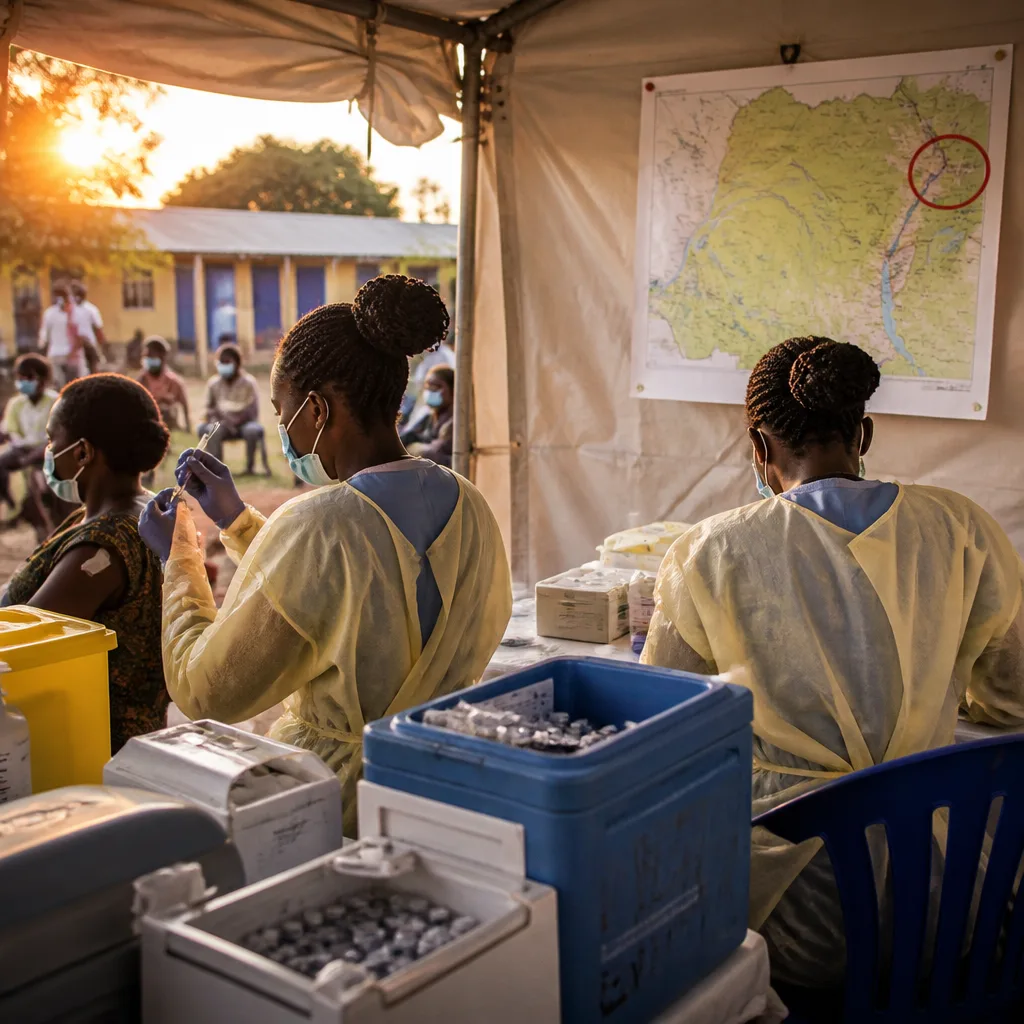
The Democratic Republic of the Congo (DRC) has launched an emergency vaccination programme for frontline health workers in response to the country’s rapidly escalating Ebola outbreak, health authorities said.
Targeting those at greatest risk
Health officials announced that 50,000 health and other frontline workers will be offered the Ervebo vaccine, which was developed for the Zaire strain of Ebola. The campaign began in Bunia, the capital of Ituri province, the epicentre of what authorities describe as the fastest‑growing Ebola outbreak in the nation’s history.
The vaccination drive is being supported by the World Health Organization and Médecins Sans Frontières (MSF). While Ervebo is licensed for the Zaire Ebola virus, its performance against the current outbreak — caused by the Bundibugyo virus — is unknown. To assess any protective effect, authorities plan to monitor 20,000 vaccine recipients for up to one year as part of an observational study.
“We don’t know to what degree it might be effective against the Bundibugyo strain,” Steve Ahuka, a member of the Congolese health task force, said.
What is known and what is uncertain
The decision to offer Ervebo to healthcare workers reflects a risk‑based approach: clinicians, nurses and emergency responders are at elevated risk of exposure during patient care and community outreach. Local leaders emphasised that health staff in the affected provinces are "particularly exposed and deeply involved in the response".
WHO experts have noted that early laboratory and animal data suggested possible cross‑protection of Ervebo against different Ebola species in some contexts, but robust human data are lacking for Bundibugyo. Clinical trials are ongoing to identify or licence vaccines specific to the current strain; at present, there is no approved vaccine or proven therapeutic targeted at this outbreak.
Operational and ethical considerations
Health workers in the field described the campaign as necessary. Dr Jeannot Elua, speaking at a Bunia health facility, said the vaccine was "beneficial" and noted that some colleagues had previously received the Zaire‑strain vaccine. He added that for many staff the jab was effectively mandatory as part of their role, underscoring ethical tensions between individual choice and protection of health services during an epidemic.
- Vaccination target: 50,000 frontline workers
- Monitored cohort: 20,000 recipients followed for up to one year
- Vaccine used: Ervebo (developed for Zaire Ebola virus)
Public‑health specialists will need to interpret subsequent data carefully. Observational monitoring can signal whether vaccinated individuals show lower rates of infection or milder disease, but such studies are susceptible to confounding: differences in exposure, use of personal protective equipment, testing access and health‑seeking behaviour can all influence outcomes.
| Item | Number | Notes |
|---|---|---|
| Frontline staff to receive Ervebo | 50,000 | Includes health and other frontline workers in Ituri and North Kivu |
| Monitored study cohort | 20,000 | Follow‑up planned for up to one year to assess effectiveness |
Implications for outbreak control
If Ervebo provides partial protection against Bundibugyo, even reduced effectiveness could help limit transmission among the workforce and preserve essential services. However, vaccine deployment is only one pillar of outbreak response. Case finding, isolation, contact tracing, infection prevention and control in health facilities, and community engagement remain central to containing spread.
International partners’ support, including logistics and surveillance, will be crucial as the DRC attempts to slow transmission and evaluate potential cross‑strain vaccine benefits. The coming months of monitoring should yield important information, but researchers caution that observational data cannot substitute for controlled trials designed to establish causality.
Authorities stress that the rollout is both a protective measure for those at highest risk and an opportunity to gather urgently needed evidence about vaccine performance against a different Ebola virus species.














