
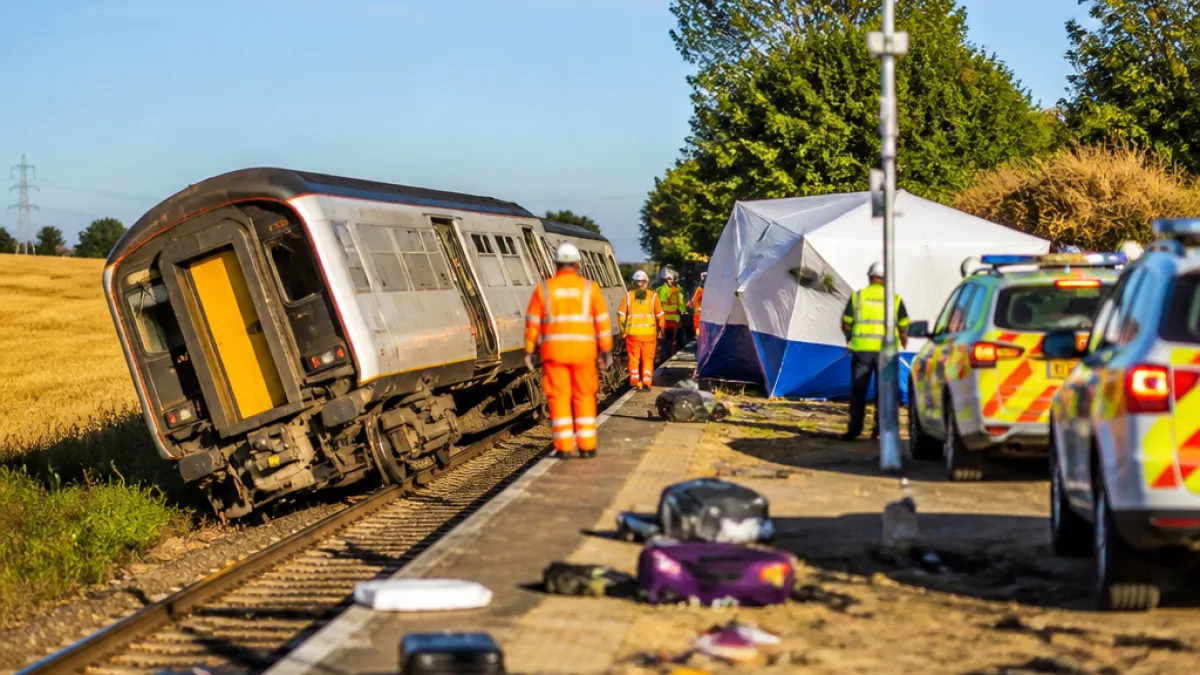
A passenger train derailed in Essex on Friday, prompting an emergency response and disruption to services on routes into London. The Rail Accident Investigation Branch (RAIB) and Network Rail have deployed teams to examine what happened, while health and emergency services treated and discharged those on board.
Passengers describe dramatic moments as train lurched
Passengers described a sudden, frightening movement before the train came to a halt. One traveller said the vehicle "swung wildly for around 10 seconds, like it was about to tilt over," adding that the carriage then continued for a short distance accompanied by a loud vibration.
"The train swung wildly for around 10 seconds, like it was about to tilt over," Jon Young told the BBC.
Witnesses reported smoke entering the rear carriage and scenes of confusion as people attempted to leave the train. Southend Airport, which is served by the same rail line, also experienced local disruption as passengers were unable to continue journeys from the station.
Emergency services, investigators and rail operators on site
Police, fire crews, paramedics and an air ambulance were mobilised to the scene near Salcott Crescent as a precaution. The RAIB has begun gathering evidence and specialist engineers from Network Rail are assisting the inquiry.
Network Rail acknowledged the operational challenges posed by recent high temperatures. Martin Frobisher, speaking to the BBC, said the summer weather had "presented exceptional challenges to the railway" and confirmed technical experts were working alongside the RAIB at the site.
Health services: no serious casualties reported
The East of England Ambulance Service said crews assessed 62 patients who had been on board the train. Following assessment, all were discharged at the scene and there were no casualties among those aboard, according to the service.
A second train that was unable to continue its journey was also evacuated with assistance from ambulance crews, the service added.
Investigation will examine possible role of heat
Officials have not reached a conclusion on the cause of the derailment. Mark Francois, the Conservative MP for Rayleigh and Wickford, said the probe would specifically assess "whether or not this was weather-related." The Department for Transport reiterated that Britain’s railways are "among the safest in the world" and described derailments as "incredibly rare".
Network Rail told the BBC its investigators were examining the incident thoroughly but said it was "too early to speculate on the full findings." Engineers will consider a range of factors, including track and rolling stock condition, signalling and environmental influences such as heat.
Practical impact on passengers and services
The incident has immediate implications for commuters and airport passengers. Southend Airport reported confusion as people could not reach onward destinations from the station; lines in the area are expected to face ongoing cancellations and delays while recovery and inspection work continues.
- Emergency response: police, fire, ambulance and an air ambulance attended.
- Investigation: RAIB and Network Rail on site; technical engineers deployed.
- Health: East of England Ambulance Service assessed 62 patients; all discharged at scene.
- Passenger impact: evacuations and disruption at Southend Airport station; further cancellations likely.
The RAIB will publish its findings once evidence has been collected and analysed. In the meantime, rail operators are advising passengers to check before travelling and allowing extra time for journeys. For those travelling to or from Southend Airport, alternative arrangements may be necessary while the affected line is recovered and inspected.
I spoke to commuters waiting at nearby stations who described frustration at the suddenness of the disruption. One local resident said the sight of emergency vehicles on the line had been alarming. As investigators work to establish the sequence of events, commuters and local communities will expect swift, transparent updates on both the safety conclusions and the timetable for restoring normal services.
| Agency | Role |
|---|---|
| RAIB | Lead investigator; evidence gathering |
| Network Rail | Technical assessment; engineers on site |
| East of England Ambulance Service | Medical assessment; 62 patients checked and discharged |
Further updates are expected as the RAIB and Network Rail complete their initial examinations and issue preliminary findings. Commuters should follow operator notices and official advice for the latest travel information.
















