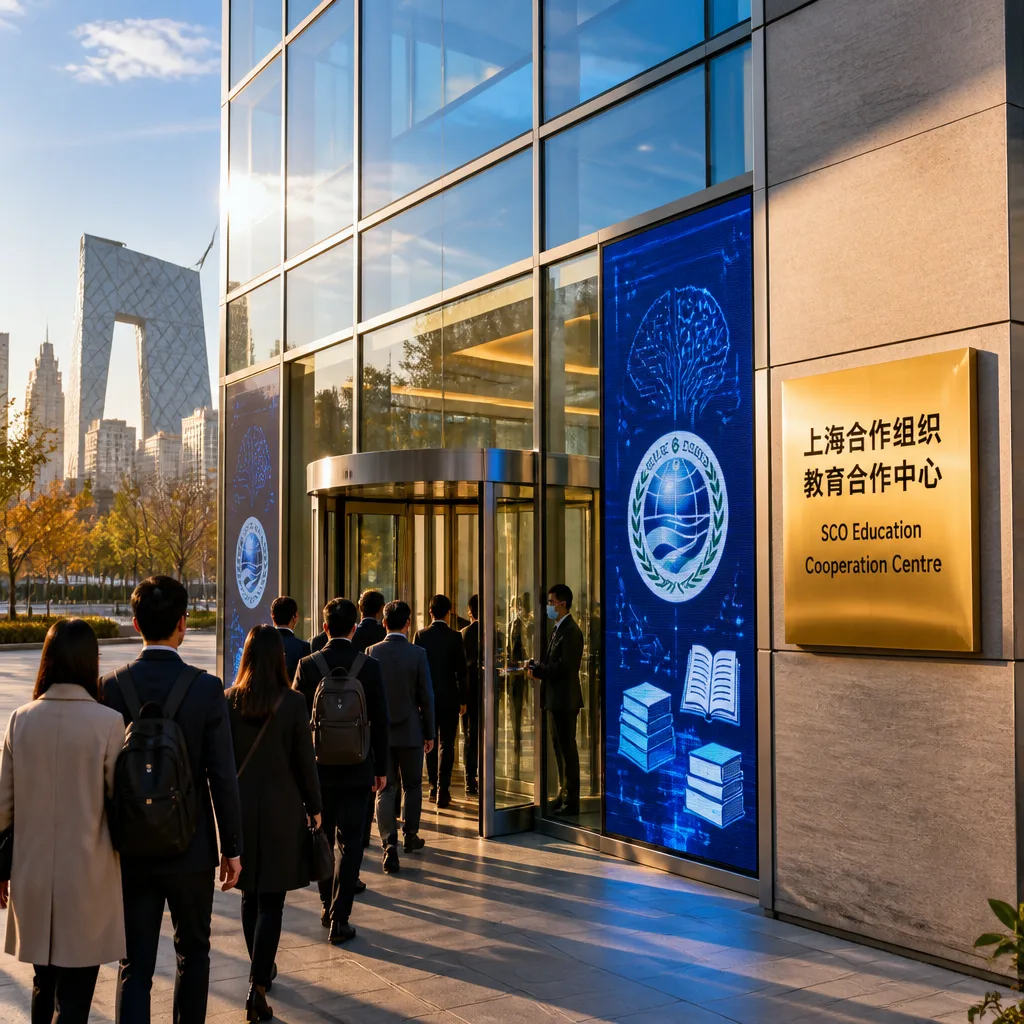
Beijing has launched a new centre to coordinate cooperation on basic education and the use of artificial intelligence among members of the Shanghai Cooperation Organization (SCO), Chinese authorities announced on 10 September. The China–SCO Basic Education Cooperation Center, established in Chaoyang District, aims to provide a formal platform for education officials and institutions across the SCO to exchange practice and develop joint activity in schooling, teacher development and digital education.
What the centre will do
Chinese education authorities say the centre will be used by SCO member states and basic education institutions in China to share experience and work together on a range of priorities. The areas singled out for attention include the adoption of AI and other digital tools in classroom settings, teacher training programmes, youth exchanges and cooperation related to science, technology and talent development.
- Exchange of practice: officials and institutions are expected to use the centre to compare approaches to curriculum, pedagogy and technology deployment.
- Teacher training: professional development and capacity building for educators is a stated focus.
- AI and digital tools: the initiative highlights digitally enabled and AI-powered education as mechanisms to deepen cooperation.
- Youth and talent exchanges: programmes for pupils and students, and links to science and technology development, are planned elements.
Institutional significance and classroom implications
At its most basic, the new centre creates an institutional channel through which SCO states can formalise educational partnerships. That framework could speed the coordination of pilot projects, teacher exchanges and joint research. However, officials and educators will judge its success by the concrete programmes that follow: a centre provides the structure, but classroom change depends on the design, funding and evaluation of specific initiatives.
How AI is deployed matters. The centre’s emphasis on AI-powered education raises potential benefits – adaptive learning, personalised feedback and improved administrative efficiencies – alongside risks that require management, including data protection, algorithmic bias and the uneven capacity of systems across different countries. The public details released so far do not set out governance arrangements for data sharing, procurement or oversight, which are likely to determine whether tools move beyond demonstration projects to sustained classroom use.
| Focus | Potential outcome |
|---|---|
| AI and digital education | New teaching tools, adaptive content, analytics for learning |
| Teacher training | Professional development models, cross-border training exchanges |
| Youth exchanges and talent | Pupil mobility, STEM collaboration, talent pipelines |
Questions for policymakers and practitioners
Several practical questions will shape the centre’s impact. These include how projects are prioritised and funded, what safeguards will govern student and teacher data, how learning outcomes will be measured, and whether member states will follow common standards or pursue differing local implementations. For headteachers and classroom teachers, the immediate concern will be how any tools or training translate into day-to-day practice and whether they relieve workload or add complexity.
There are also geopolitical and diplomatic dimensions. As an SCO-based institution hosted in Beijing, the centre provides China with a formal role in shaping regional education cooperation. For external observers, the centre’s activities will be a lens on how digital and AI technologies are disseminated across varied education systems and the norms that accompany them.
Ultimately, the centre’s significance will be measured less by its opening and more by the projects it sponsors, the transparency of its governance and the evidence it produces on what improves learning. Observers and education leaders will be watching to see whether pilots scale, how risks are addressed, and whether the promised exchanges yield tangible benefits for teachers and pupils in member countries.