Underground passage resembling Varanasi ghats flooded after intense rain
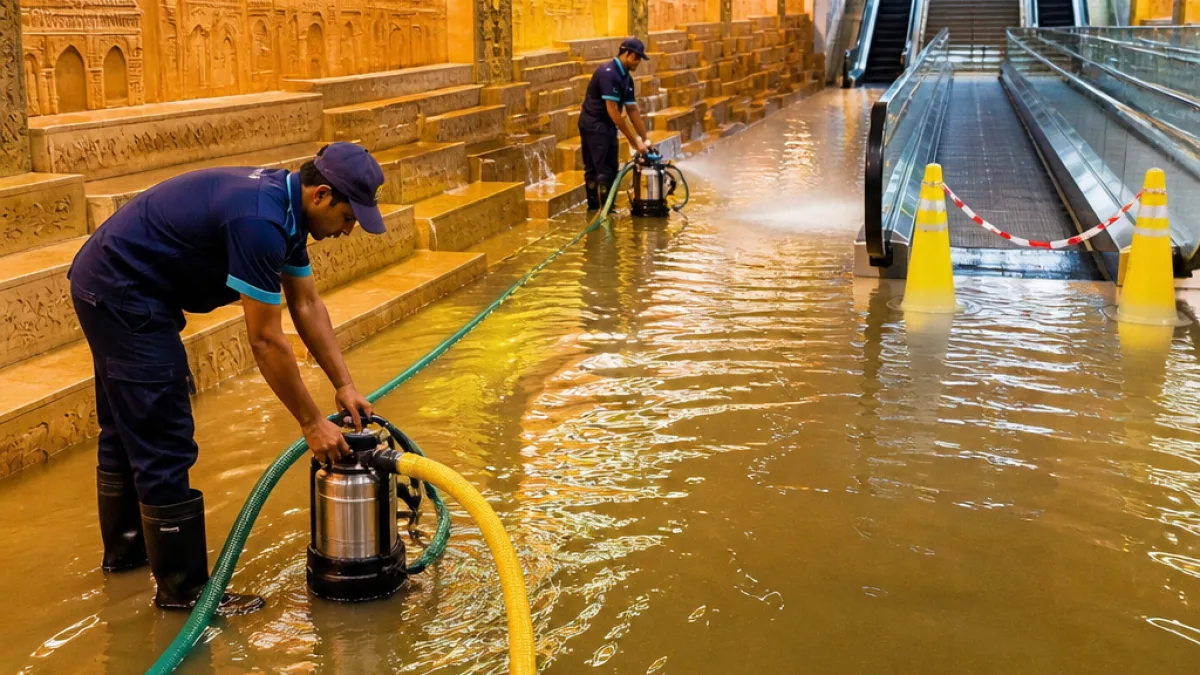
Noida International Airport at Jewar saw a section of its underground forecourt — intentionally modelled to recall the ghats of Varanasi — become waterlogged on Tuesday after an intense spell of rain, officials said. Videos of the ankle‑deep water circulating on social media prompted questions about drainage design even though the airport maintained that passenger services and flight operations continued without disruption.
The water accumulated in the underground passage that links the terminal building with the parking area and taxi stand, officials said. The route is an important pedestrian connection because the departure kerbside road runs above the passage; a travelator in the passage was switched off while staff cleared the water.
- Airport teams deployed pumps and removed the water within 30 minutes, according to an official statement posted on the airport’s handle.
- Passenger movement was rerouted through an alternative entry for a short period, and kerbside pickups were used as an interim arrangement.
- The airport said there was no impact on flight operations or the overall functioning of the facility.
“Noida International Airport experienced extremely heavy rainfall over a short period, following which rainwater temporarily entered the passage connecting the terminal with the parking area. Our teams responded promptly and cleared the water within 30 minutes,” the airport said.
Design choice draws local and online attention
The forecourt had been designed to evoke the appearance of Varanasi’s riverfront steps as part of the airport’s broader effort to blend Indian cultural elements with modern infrastructure. After the rain, the resemblance apparently fueled social media commentary and satire, with users making light of the juxtaposition of a newly opened airport and a flooded ghats motif.
While some posts were jocular — labelling the scene a combination of an airport and seaport — the incident has also prompted practical questions about drainage capacity in underground pedestrian areas that are covered by drop‑off roads. Airport officials attributed the water ingress to an exceptionally heavy downpour concentrated over a short period.
Operational response and next steps
According to the airport communication, staff acted immediately to pump out the water and switch off the travelator for safety. For a time, passengers were directed to an alternate route while the pumps operated. No flight schedules were reported delayed or cancelled as a result of the incident.
| Event | Action |
|---|---|
| Heavy rainfall | Water entered underground passage |
| Immediate response | Teams deployed pumps; travelator switched off |
| Passenger management | Traffic diverted; kerbside pickups used |
| Outcome | Water cleared within 30 minutes; no flight disruption |
Officials said the team will investigate and take corrective action where necessary. The airport began commercial operations only months earlier and has been promoted as a modern international gateway combining cultural motifs with contemporary engineering, a positioning that makes incidents such as this notable beyond routine operational matters.
For Varanasi residents, the episode underscores two linked points: the broad cultural influence of the city’s riverfront imagery beyond Uttar Pradesh, and the practical challenges of adapting traditional motifs in modern, high‑traffic infrastructure. As the airport and its operators assess drainage and design resilience, travellers and observers will watch for specific remedial measures and any formal findings about whether the water ingress exposed a design shortcoming or was an exceptional meteorological occurrence.
Noida recorded a short but heavy spell of rainfall on Tuesday, and the airport said its teams would implement corrective action where required, without providing a detailed timeline.