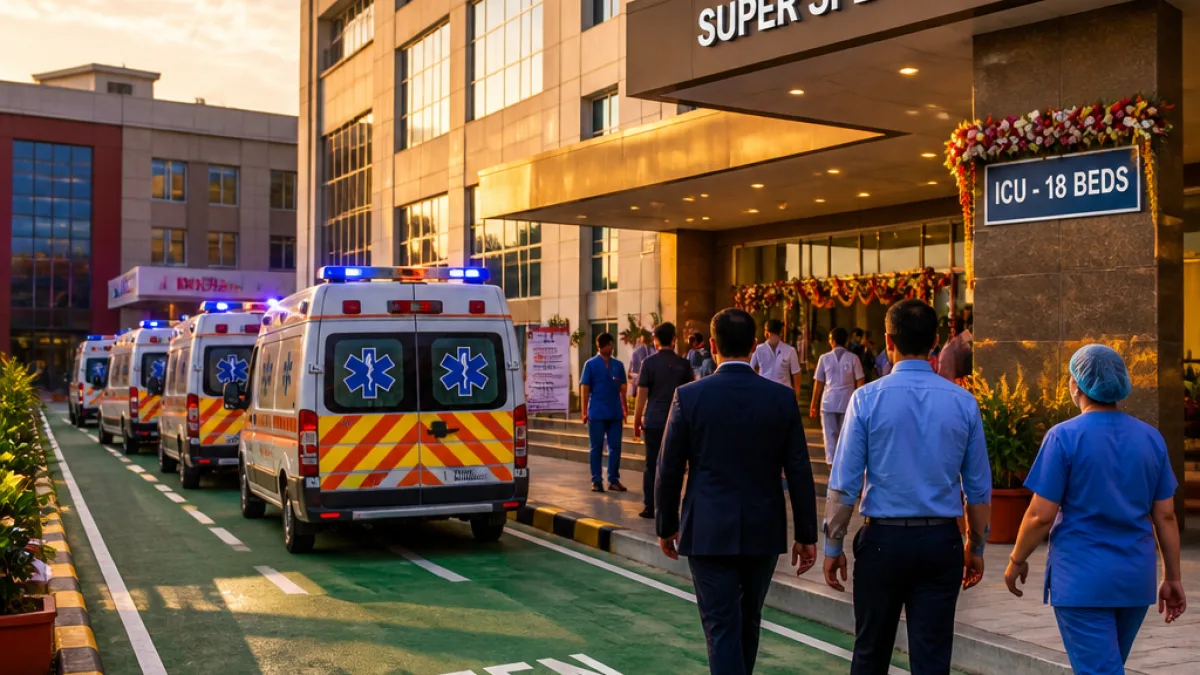
State moves to speed emergency transfers as critical-care capacity expanded in Agartala
Agartala: The Tripura government has announced plans to establish dedicated green corridors to ease ambulance movement for critically ill patients, alongside inaugurating a new intensive care unit (ICU) and a Central Sterile Supply Department (CSSD) at the Super Specialty Block of the Government Medical College and GBP Hospital in Agartala.
Chief Minister and Health Minister Prof. Dr. Manik Saha unveiled the facilities on Monday, underlining administrative efforts to prevent delays caused by traffic congestion and to reduce the number of patients referred outside the state for advanced care. He said the state has held several meetings aimed at improving ambulance logistics and operational coordination across agencies.
"Our goal is to bring referrals outside the state to zero,"
Saha also highlighted that referrals from Tripura to centres outside the state have already fallen markedly, and described the new infrastructure and training as part of a broader drive to deliver more complex treatment within Tripura.
The newly opened ICU offers 18 beds, configured as two separate nine-bed units for men and women, and the facilities have been commissioned at a reported cost of ₹13.5 crore. Officials said the CSSD will ensure sterilisation and supply of surgical instruments and consumables to meet increased demand from the expanded critical-care services.
| Facility | Specification |
|---|---|
| ICU | 18 beds (9 male, 9 female) |
| CSSD | Central sterilisation and supply unit for Super Specialty Block |
| Estimated cost | ₹13.5 crore |
Health Secretary Kiran Gitte and senior officials from the Health Department attended the inauguration, which the state described as part of an upgrade to the Super Specialty Block’s capacity to handle high-acuity cases locally.
What green corridors mean for patients
Green corridors are predetermined routes and protocols that ensure ambulances carrying critically ill patients can move with minimal delay. The state said the corridors will include traffic management measures and coordination between law enforcement and emergency services to clear pathways during transfers.
- Objective: Reduce delays in inter-facility or hospital transfers for time-sensitive emergencies.
- Key components: Traffic clearance protocols, pre-informed signal control, police escort where required, and real-time communication between hospitals and ambulance services.
- Short-term benefit: Faster transfer times for stroke, cardiac arrest, trauma and other critical conditions.
Officials said training sessions are being organised to familiarise ambulance crews and hospital staff with the corridor protocols. The Chief Minister noted that enhanced training for doctors and healthcare workers is already underway to ensure safe operation of advanced medical equipment and systems installed in the Super Specialty Block.
Broader implications for Tripura’s healthcare
By expanding in-state critical-care infrastructure and introducing operational measures such as green corridors, Tripura aims to lower dependence on tertiary centres in other states. The government framed these initiatives as steps towards a self-sufficient referral system where more complex diagnostics and treatments can be delivered within the state.
Authorities also said additional measures will include round-the-clock CCTV surveillance at GBP Hospital and ensuring uninterrupted availability of essential generic medicines — steps intended to improve hospital governance and patient safety.
While the state provided headline figures for bed strength and project cost, officials did not release a phased timeline for rolling out the green corridors across specific routes or detail the metrics that will be used to evaluate reduced referral rates. The Health Department will be responsible for operational coordination and monitoring progress.
As work continues on logistics and staff training, patients and families are likely to see a practical impact if transfer times decrease and more specialist care is available locally. The state’s next communications are expected to specify pilot routes and the agencies involved in implementing the green corridor model.