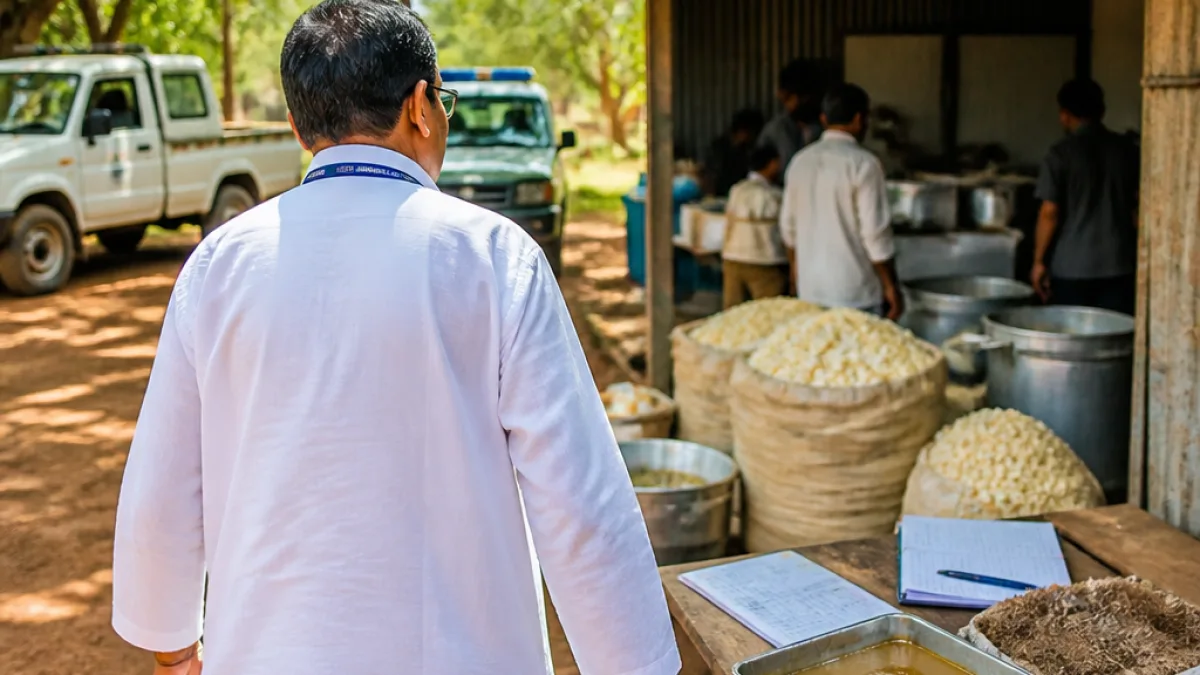
Churaibari/Kadamtala, Sep 17: A senior official of the Union Ministry of Development of North Eastern Region (DONER) visited Kadamtala in North Tripura on Thursday to assess agar cultivation and processing activities and discuss measures to simplify trade for growers and traders, an official report said.
Focus on value‑addition and market access
Srinivas Katikithala, Secretary in the DONER Ministry, inspected an agar plantation and observed processing of agar products, including chips and oil, at a unit run by Mamon Enterprise in North Phulbari village under Kadamtala block. He also toured the Kadamtala agar market and interacted with workers and traders involved in the value chain.
Officials from the Forest Department, the district administration and the concerned forest range office accompanied Katikithala during the visit, the report said.
Traders present three key demands
The All Tripura Agar Association outlined a three‑point set of demands to the DONER secretary. Among the principal requests was provision of low‑interest loans of ₹25 lakh to agar traders. The association also sought structured training for workers through the traders’ body to improve processing quality and compliance.
"I will discuss measures with the government to ensure that agar traders can conduct their business in a smooth and streamlined manner," Katikithala said.
The association highlighted that agar produced in Tripura attracts demand beyond the domestic market, noting that traders from other parts of India and international buyers from Dubai and Bangkok have previously visited the Kadamtala region in connection with the trade.
- Main site visited: Mamon Enterprise, North Phulbari village (Kadamtala block)
- Products inspected: Agar chips and agar oil among other processed items
- Primary demands: low‑interest loans, worker training, market facilitation
Why the visit matters for Tripura
Agar (commonly known as agarwood or oud when referring to resinous wood) forms part of small‑scale agroforestry and processing activities in several pockets of Tripura. Strengthening processing units, easing working capital constraints and improving product standards can directly affect incomes in producing communities and boost export potential, industry stakeholders say.
Trade facilitation measures and access to affordable credit could enable local enterprises to scale up processing, meet compliance standards for interstate and international buyers, and capture higher value through refinement rather than selling raw material alone.
What traders requested — at a glance
| Demand | Intended impact |
|---|---|
| Low‑interest loans of ₹25 lakh | Provide working capital for procurement and processing |
| Training for workers | Improve processing quality and product standards |
| Measures to streamline trade | Facilitate market linkages and reduce transaction barriers |
The DONER secretary's pledge to take the traders’ concerns to the government does not specify a timeline or the form such interventions would take. Follow‑up will be required to see whether finance, training programmes or regulatory changes are mobilised in response.
Local and external demand cited
During the visit, traders emphasised that Tripura's agar has buyers within India as well as in overseas markets. The association said that international traders from Dubai and Bangkok had earlier visited Kadamtala, underlining export interest for processed agar products.
Senior state forest and district officials present during the tour are expected to coordinate with central agencies on any proposals requiring inter‑departmental action, such as plantation support, value‑chain financing, and capacity building for processors.
Further details on any concrete schemes, eligibility criteria for the requested loans, or timelines for training initiatives were not available immediately. Stakeholders in Kadamtala said they will await formal communication from the Ministry and the district administration regarding next steps.
The visit underscores growing attention from central agencies on agroforestry products in the Northeast and highlights policy priorities around credit access, skill development and market facilitation for small and medium processors in the region.