
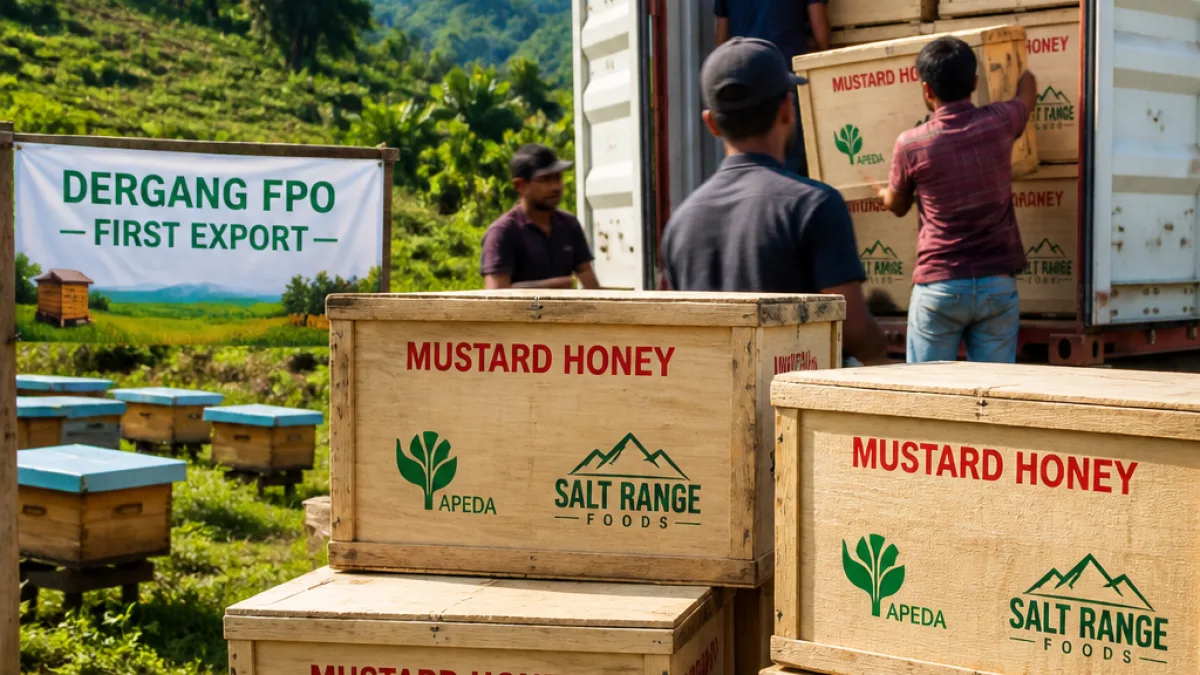
Tripura has recorded its first international sale of mustard honey after the Dergang Farmer Producer Organisation (FPO) dispatched a one-metric-tonne consignment bound for Dubai, officials said. The shipment was coordinated with the Agricultural and Processed Food Products Export Development Authority (APEDA) and carried with support from a private partner, marking a step towards building an export-oriented honey value chain in the state.
Export details and institutional support
The consignment — aggregated by the Dergang FPO — was facilitated by APEDA, which helps producers meet export quality standards and market access requirements. Salt Range Foods Pvt. Ltd. provided technical and supply-chain backing to the FPO, assisting in production scaling, collection and compliance processes necessary for international trade.
State Agriculture Minister Ratan Lal Nath flagged off the consignment in a ceremony attended by senior officials from the agriculture and commerce ecosystems, including APEDA representatives, the Agriculture and Horticulture Secretary and members of the local beekeeping community.
"The Government of Tripura remains committed to strengthening apiculture and organic agriculture while supporting Farmer Producer Organisations in accessing wider markets," Minister Nath said.
Why this matters for Tripura's farmers
For local beekeepers and farmer groups, the export could open a higher-value market than many domestic channels currently offer. Officials and stakeholders view the Dubai shipment as an opportunity to achieve better price realisation for honey producers and to incentivise adoption of organised, quality-focused production practices.
The Ministry of Commerce and Industry noted that such initiatives are expected to create an additional income stream for apiarists and encourage the uptake of standardisation, value addition and organised aggregation among small producers. The move aligns with state efforts to diversify agricultural incomes and promote organic and high-quality produce from the Northeast.
Supply-chain partners and capacity building
Salt Range Foods Pvt. Ltd.'s role involved strengthening bee production techniques and helping the FPO build an export-ready supply chain. The partnership enabled the FPO to aggregate the required volume and navigate regulatory and logistical steps for international shipment.
APEDA's facilitation typically includes guidance on quality testing, packaging standards, export documentation and market linkages — elements crucial for small producers seeking to enter overseas markets. The involvement of an exporter and logistics partners suggests an emerging corridor for Tripura honey to reach Gulf markets.
Potential economic impact and next steps
While the initial volume — one metric tonne — is modest, it carries symbolic and practical importance. Officials said the shipment demonstrates that Tripura can produce honey meeting export specifications and that local FPOs can aggregate produce to volumes that attract overseas buyers.
Key next steps highlighted by stakeholders include:
- Scaling production while maintaining traceability and quality controls
- Training beekeepers on hygiene, processing and labelling requirements for export
- Expanding aggregation through more FPOs to secure regular consignments
| Parameter | Detail |
|---|---|
| Quantity exported | 1 metric tonne |
| Commodity | Mustard honey |
| Destination | Dubai |
| Facilitator | APEDA |
| Private partner | Salt Range Foods Pvt. Ltd. |
Challenges and considerations
Sector stakeholders and officials will need to address a few constraints to convert the milestone into a sustained export programme. Critical challenges include ensuring consistent volumes across seasons, meeting international residue and pesticide limits, and building cold-chain or appropriate storage and processing infrastructure for honey destined for premium markets.
Regulatory compliance around labelling, traceability and organic certification (where applicable) will be essential to retain buyer confidence. Continued institutional support, both technical and financial, will be important if FPOs are to scale up without compromising quality.
The export also raises wider questions about how northeastern agricultural produce can be positioned in global markets. Officials present at the flag-off emphasised coordinated effort among farmers, FPOs, exporters and government agencies to broaden Tripura's presence in international trade for niche, organic and high-quality crops.
If replicated and scaled, the approach could provide tangible income gains for rural producers while showcasing Tripura's apiculture potential on international shelves.