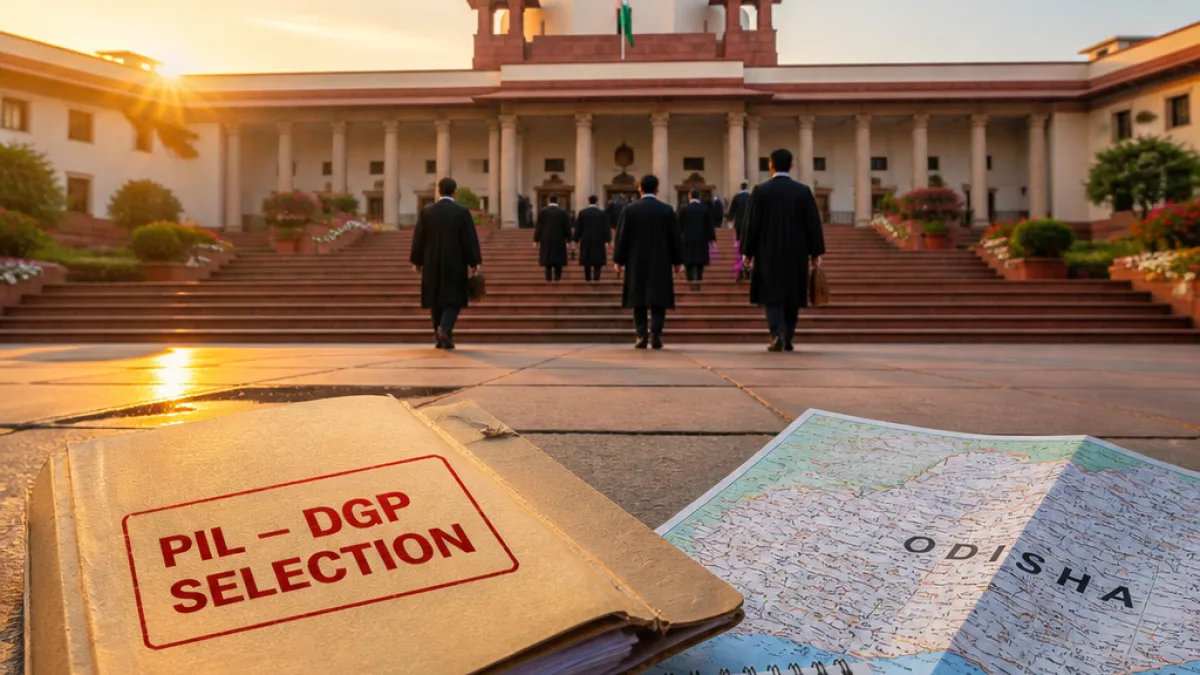
Bhubaneswar: The controversy over the selection of Odisha's next Director General of Police (DGP) reached the Supreme Court on Tuesday after a Public Interest Litigation (PIL) alleged that the State government was attempting to circumvent the apex court's directions by including ineligible officers in the panel sent to the Union Public Service Commission (UPSC), according to reports.
What the petition says
Senior advocate P. Chidambaram, appearing for the petitioner, drew the bench's attention to what he described as manoeuvres by the State in the run-up to the retirement of the incumbent DGP, Y. B. Khurania, who is due to demit office on 16 August. The petition contends that the State initially sent a limited panel of names to the UPSC, later withdrew it and prepared a fresh list that would include an officer who was not eligible under the Prakash Singh framework, reported local media.
“They (UPSC) are well aware of who is eligible and who can be considered. If a panel of ineligible officers is being sent, we expect the UPSC to act in accordance with our directions,”
— Chief Justice of India Surya Kant, as reported.
Legal framework at issue
The challenge turns on the 2006 Prakash Singh verdict and subsequent orders which prescribe that a State's DGP must be selected from among the three senior-most officers empanelled by the UPSC for that rank. The judgment also provides for a minimum tenure of two years for the selected DGP, irrespective of the officer's superannuation date. The petitioner argues that the State's actions run afoul of these requirements by seeking to promote an Additional DGP (ADGP) to the DGP rank and then place that officer on a fresh panel for UPSC consideration.
Supreme Court response and next steps
The bench — Chief Justice Surya Kant and Justices Joymalya Bagchi and V. Mohana — agreed to list the matter for hearing on Wednesday, as reported. The CJI observed that the UPSC should be mindful of eligibility criteria and follow the court's directions if an ineligible list is sent for consideration.
Timeline and procedural points
| Event | Date / Detail |
|---|---|
| UPSC meeting originally scheduled | 7 August — to consider a panel of three eligible DGP-level officers, reported accounts state |
| Incumbent DGP retirement | 16 August — Y. B. Khurania to superannuate |
| Supreme Court listing | Listed by the bench for urgent hearing; to be taken up on Wednesday |
Allegations and countervailing procedural facts
According to reporting, counsel for the petitioner submitted that the State first sent three names to the UPSC, then forwarded a wider panel of 11 senior IPS officers before withdrawing that list and preparing yet another panel. The petition claims the fresh list seeks to include an officer by promoting an ADGP to the DGP rank and placing that officer on the UPSC panel — a step the petitioner describes as an attempt to sidestep established eligibility norms.
Why this matters for Odisha
Leadership of the State police affects law-and-order strategy, administrative continuity and ongoing policing reforms. The Prakash Singh directions were framed to promote transparency and stability in top police appointments; any perceived non-compliance raises concerns about institutional impartiality. With the incumbent due to retire imminently, the process has heightened urgency and public interest.
Practical note for citizens
- Citizens and stakeholders seeking clarity on the selection process can look for court orders once the matter is heard and published by the registry;
- Transparency in senior police appointments is intended to ensure continuity — disruption or prolonged vacancy at the top can affect policing outcomes in the short term;
- Those concerned about compliance with judicial directions can pursue remedies through appropriate forums; the Supreme Court will determine whether directions have been breached in this instance.
The matter was reported by regional and national outlets that covered the hearing before the Supreme Court bench and the submissions made by senior counsel. The court is expected to examine whether the State's actions contravene the Prakash Singh framework and whether the UPSC must act on any non-compliant lists sent for consideration.
Note: The reporting on the PIL, the bench composition and the dates referenced above are based on contemporaneous media coverage of the Supreme Court listing.