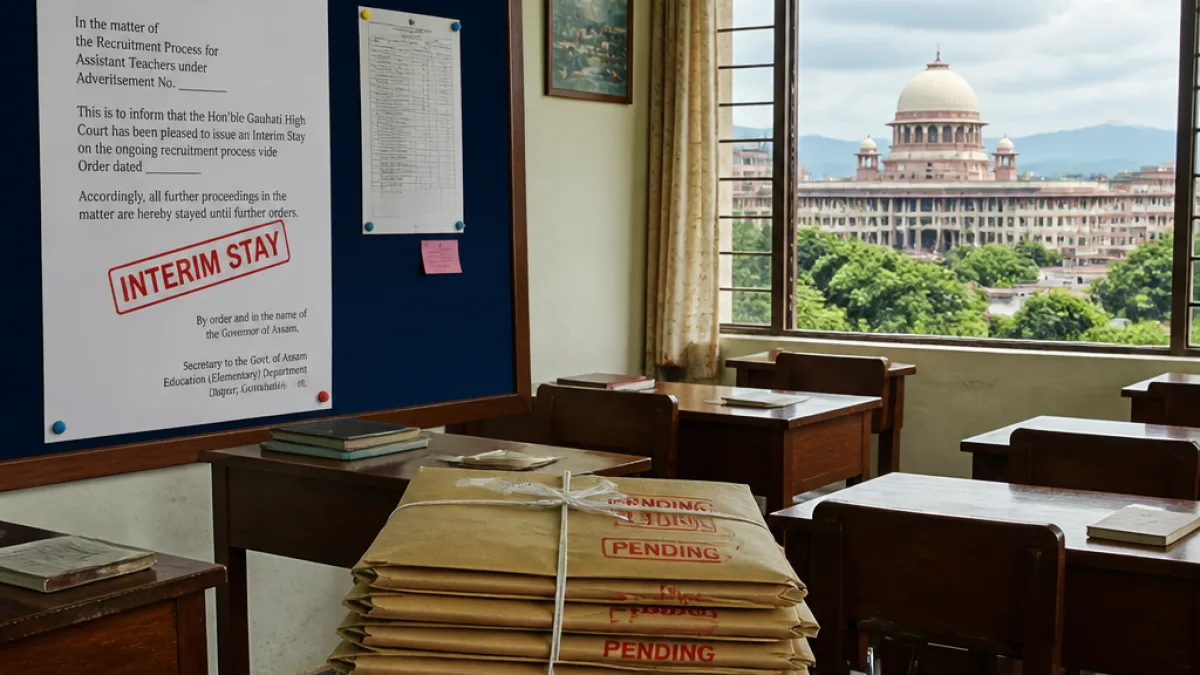
New Delhi/Guwahati: The Supreme Court on Tuesday directed that no teacher shall be appointed or absorbed into government service in Assam under the state’s provincialisation scheme until further orders, issuing notices to the Union and the Assam government on a public interest litigation challenging the 2017 law.
Interim order halts provincialisation process
A bench comprising Chief Justice Surya Kant and Justices Joymalya Bagchi and V. Mohana passed the interim restraint while considering a petition by Assam residents Rajesh Chauhan and Madhab Mukunda Pujar. The petitioners contend that the Assam Education (Provincialisation of Services of Teachers and Re-organisation of Educational Institutions) Act, 2017, permits teachers of privately run institutions to be absorbed into government service without undergoing a fair, competitive recruitment process and without meeting minimum qualifications laid down by central laws.
The court’s interim direction covers appointments and absorptions under the applicable statutory framework, explicitly including the Right of Children to Free and Compulsory Education Act, the National Council for Teacher Education Act, 1993, and the University Grants Commission Act, 1956, until the issues raised are examined further.
Bench emphasises minimum statutory qualifications
The petition alleges that the 2017 law provides a route for teachers from so-called venture educational institutions to enter government employment without open advertisement, competitive selection or merit-based assessment — processes the petitioners say are required under Articles 14 and 16 of the Constitution, which guarantee equality and equal opportunity in public employment.
“Why are they appointing unqualified teachers…We will destroy our future generations if this is permitted,”
The court adopted a strict stance on the matter, observing that allowing persons lacking qualifications prescribed by Parliament-enacted laws to be provincialised would jeopardise educational standards.
What the petition challenges
The PIL, argued on behalf of the petitioners, questions specific provisions of the 2017 Assam Act that, it is alleged, enable the provincialisation of teachers and tutors who do not satisfy the minimum criteria under central statutes and regulations governing teacher eligibility. The plea sought a declaration that the impugned provisions are unconstitutional insofar as they permit absorption of persons lacking statutory qualifications and asked that future government teaching posts be filled by transparent, merit-based recruitment in accordance with Articles 14 and 16 and prescribed teacher eligibility norms.
Immediate implications for Assam’s education sector
The interim order halts any ongoing or planned absorptions or fresh appointments under Assam’s provincialisation framework. The decision affects state education administrators, private institutions that had sought provincialisation of staff, and candidates awaiting absorption under the 2017 law. The court has issued notices to both the Centre and the Assam government and will take the matter up after responses are filed.
- Legal focus: Whether a state statute can permit absorption of teachers who do not meet qualifications under central education laws.
- Administrative effect: Suspension of fresh appointments and absorptions under the provincialisation scheme for the duration of the proceedings.
- Constitutional issue: Alleged violation of Articles 14 and 16 relating to equality and fair recruitment.
Acts cited by the court
| Statute | Relevance |
|---|---|
| Right of Children to Free and Compulsory Education Act | Prescribes norms for teacher eligibility and standards in schools |
| National Council for Teacher Education Act, 1993 | Sets professional qualifications and regulatory framework for teachers |
| University Grants Commission Act, 1956 | Governs qualifications for faculty in higher education |
By staying the provincialisation pathway, the court has placed central statutory qualifications at the centre of the dispute, signalling that state-level measures cannot undercut Parliament-enacted standards for teaching personnel.
Background and regional context
Assam has seen growth in privately managed educational institutions, particularly in rural areas, where provincialisation has been used to regularise staff from private venture schools into government employment. Petitioners argue that such a mechanism, without requisite checks, bypasses transparent public recruitment and risks lowering educational quality. The state, which is responsible for school education, had enacted the 2017 provincialisation law to reorganise institutions and regularise services of teachers; the challenge now raises questions about balancing administrative expediency with constitutional guarantees and statutory minimums.
The Supreme Court will proceed after hearing responses from the Centre and the Assam government. Meanwhile, the stay remains in force and no fresh appointments or absorptions under the provincialisation scheme may be made until the court’s further orders.
Reporting from the national capital with a focus on Assam's education governance and legal affairs.