Hyderabad: The Election Commission of India’s Special Intensive Revision (SIR) exercise in Telangana has resulted in the deletion or classification as uncollectable of roughly 73.39 lakh entries from the electoral rolls, officials in the Chief Electoral Officer’s (CEO) office said.
Scale of the revision and digitisation status
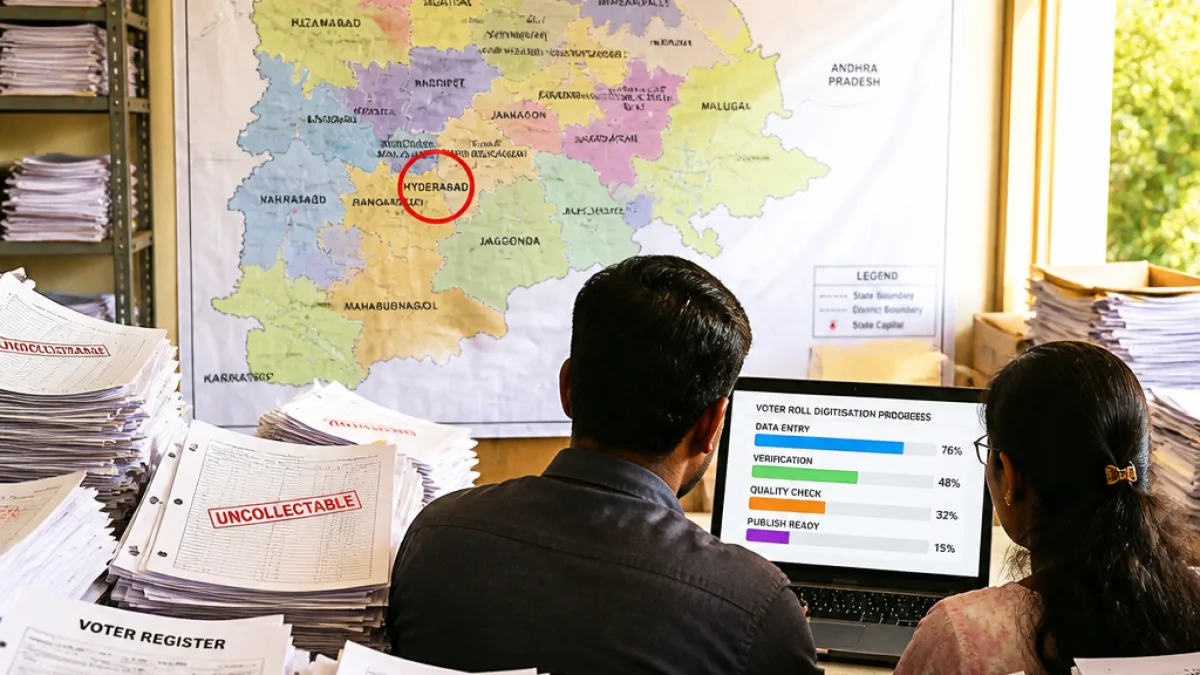
Telangana’s total electorate is reported as 3,38,26,448. Of these, forms for 2,64,87,214 electors — or 78.3% — have been digitised so far, the CEO’s office said. The remaining entries, amounting to around 73.39 lakh, were classified as uncollectable after the enumeration phase of the SIR.
Category-wise breakdown
The CEO’s statement and accompanying data show the largest single category among the uncollectable entries as voters marked permanently shifted. Other classifications include deaths, duplicate enrolments and absent or untraceable electors.
- Permanently shifted: 45,18,961
- Absent / untraceable: 11,25,546
- Deaths: 9,22,230
- Duplicate entries (already enrolled): 6,70,203
- Others: 1,02,294
Officials explained that the shifted category covers a range of situations: electors who have moved within Telangana, those who have relocated to other states, temporary residents in Telangana for work who return home during elections, and migrants into Telangana from states such as Karnataka, Andhra Pradesh, Maharashtra, Bihar, Chhattisgarh and Odisha.
Chief Electoral Officer C. Sudharsan Reddy said the state has 3,38,26,448 electors, of whom enumeration forms for 2,64,87,214 (78.30 per cent) have been digitised.
District-level impact
Deletion numbers vary markedly across districts. Hyderabad recorded the highest number of removals, with approximately 19.40 lakh entries deleted, followed by Medchal at 10.73 lakh. At the other end, Yadadri Bhuvanagiri and Mulugu saw the fewest deletions — about 26,000 and 27,000 respectively.
| District | Approx. deletions |
|---|---|
| Hyderabad | 19.40 lakh |
| Medchal | 10.73 lakh |
| Yadadri Bhuvanagiri | 26,000 |
| Mulugu | 27,000 |
Processes, safeguards and potential consequences
The SIR process involves scrutiny for deceased voters, individuals who have shifted residence, duplicate entries and untraceable electors. Officials said the Election Commission is giving special attention to cases where persons are enrolled at two locations and to instances of multiple enumeration forms being submitted from different addresses.
ECI officials have warned that criminal action could be pursued against people found deliberately holding duplicate registrations. The office of the CEO has been working to identify bona fide movers versus duplicate or fraudulent entries before the final rolls are published.
Local implications and what voters should know
The large number of entries marked as shifted — more than 45 lakh — underscores high mobility among sections of the electorate, particularly in and around urban centres such as Hyderabad and Medchal. Voters who change residence within the state or move across state lines are advised to check their enrolment status and pursue corrections or transfer of their entry to the correct constituency.
Officials did not provide a timeline for publication of the final revised rolls. Electors concerned about their status are expected to consult the CEO’s portal or local electoral registration offices for guidance on re-enrolment or transfer procedures.
With several lakh entries under close scrutiny, the SIR exercise in Telangana is likely to influence future electoral preparedness and logistics, including polling station lists and voter facilitation plans in the run-up to upcoming polls.
Reporting: Office of the Chief Electoral Officer, Telangana; input from official SIR enumeration data.