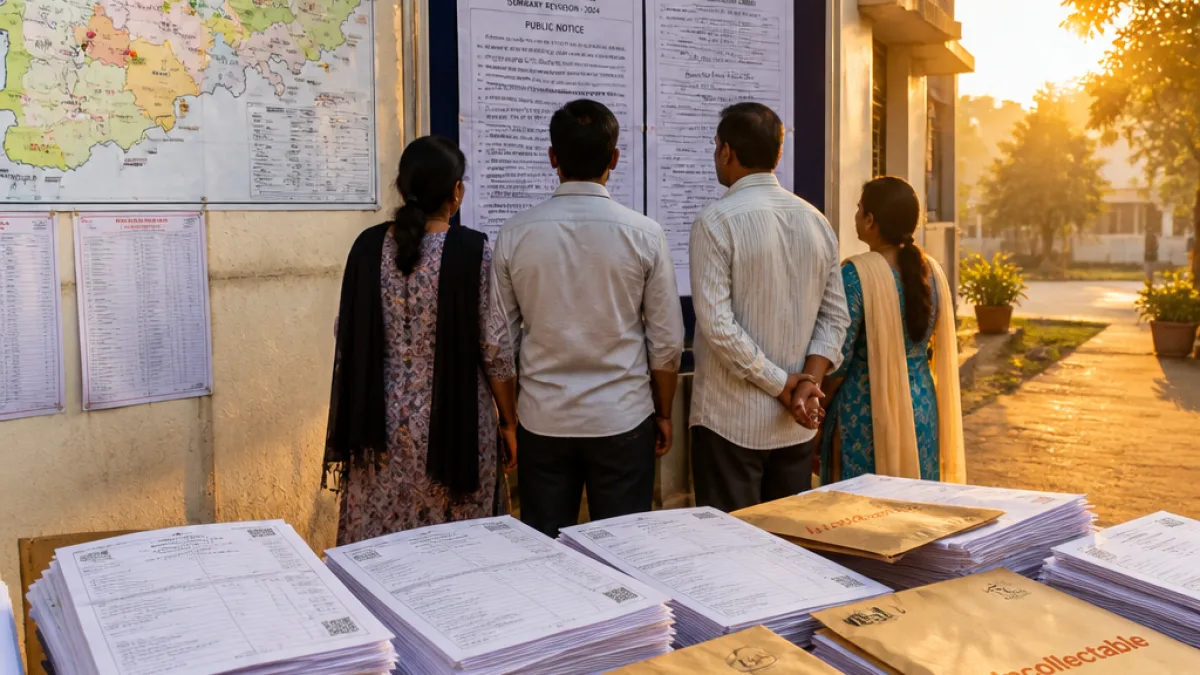
Hyderabad: The Special Intensive Revision (SIR) of electoral rolls in Telangana is set to remove more than a fifth of the State's electors from the draft rolls to be published after the enumeration phase, the office of the Chief Electoral Officer (CEO) reported on Monday.
Scale of deletions and notices
As the enumeration window closed at midnight on August 10, a total of 73,47,075 enumeration forms were categorised as “Uncollectable” — forms not returned by electors. The CEO, C. Sudharshan Reddy, said these constitute close to 22% of the State electorate and will not appear in the draft rolls to be published on 17 August 2026.
In addition to the uncollectable forms, officials identified 2,85,571 electors as Absent, Shifted and Dead, and 3,21,151 entries as Demographically Similar (indicating likely duplication). These categories will also be excluded from the draft electoral rolls.
Forms returned and anomalies found
Of the 3,38,26,448 electoral forms reportedly distributed across Telangana, 2,64,73,616 forms were returned to Booth Level Officers (BLOs), amounting to 78.26% return. This tally includes 11,33,692 online submissions by electors.
Among the forms collected, electoral officials found 60,69,065 anomalies or logical discrepancies — nearly 23% of the returned forms. The CEO said all electors involved in these anomalies will receive notices from the Electoral Registration Officers (EROs) from 17 August, and hearings will be conducted up to 15 October 2026. Final rolls are scheduled for publication on 19 October 2026.
District-level variation
The distribution of issues is uneven across districts. Adilabad recorded the highest anomalies at 28.49% when measured against the total electorate, and nearly 33% when calculated on the forms collected. Wanaparthy followed with anomalies affecting 27.83% of the total electorate and 32% of the forms collected.
The State capital, Hyderabad, topped the chart for uncollectable forms at 41.09%, though its anomaly rate was lower at 14.18%. Medchal Malkajgiri recorded 36.01% uncollectable forms.
- Draft rolls publication: 17 August 2026
- Notice issuance and hearings: Notices from EROs from 17 August; hearings through 15 October 2026
- Final rolls: 19 October 2026
How electors are affected
Electors whose forms were not returned (uncollectable), or who have been marked absent, shifted or dead, or whose entries appear duplicated, will not find their names in the draft rolls. Those with logical discrepancies will receive formal notices and must respond or attend hearings to claim or defend entries.
The CEO's office has framed the process as a necessary administrative step to ensure accuracy of the rolls before next year’s electoral cycle. The SIR exercise began on 24 July 2026 and received two extensions before the final enumeration deadline.
Data snapshot
| Metric | Number |
|---|---|
| Forms distributed | 3,38,26,448 |
| Forms returned | 2,64,73,616 (78.26%) |
| Uncollectable | 73,47,075 (≈22%) |
| Absent/Shifted/Dead | 2,85,571 |
| Demographically similar (duplicates) | 3,21,151 |
| Anomalies/logical discrepancies | 60,69,065 (≈23% of returned) |
Practical steps for voters
Electors who submitted forms should check the draft rolls published on 17 August and respond promptly to any notice from their ERO. The CEO’s schedule gives nearly two months for hearings and settlement of claims and objections, after which the rolls will be finalised. Non-response during the hearings period may lead to deletion from the rolls.
District election offices and BLOs are likely to remain focal points for resolution. Electors who used the online option should retain submission receipts and be prepared to follow up with local EROs if their names are omitted or flagged.
The SIR exercise is part of the Election Commission’s routine revisions to maintain accurate and current electoral registers. The scale of deletions and anomalies in Telangana, however, underscores operational and outreach challenges in ensuring full participation and correct record-keeping across urban and rural pockets alike.