Panipat will be the western terminus of a 750-kilometre access-controlled expressway to Gorakhpur, a project whose alignment has been finalised and whose construction is expected to begin within the current financial year, the National Highways Authority of India (NHAI) has said, according to a report in Hindustan Times.
Project layout and phases
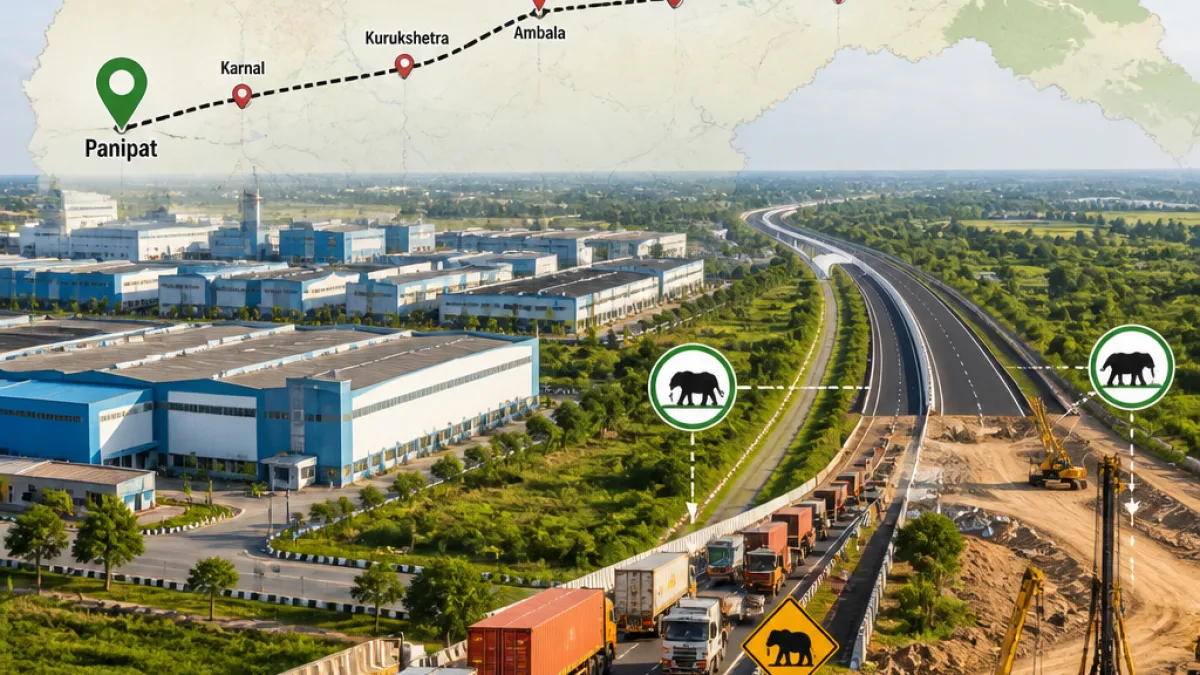
The expressway is conceived as a high-speed greenfield corridor and will be built in two phases. Phase one, measuring 348.039 km, will link Shamli, Muzaffarnagar, Saharanpur, Haridwar (Uttarakhand), Bijnor, Moradabad, Rampur, Bareilly, Pilibhit and Shahjahanpur. Phase two, of 397.137 km, will connect Lakhimpur Kheri, Sitapur, Bahraich, Shravasti, Balrampur, Siddharthanagar, Sant Kabir Nagar, Gorakhpur and Kushinagar.
NHAI regional officer Gautam Vishal said the alignment is finalised and work is expected to commence in the current fiscal year, the report added. In total, the expressway will traverse approximately 600 km across 18 districts in Uttar Pradesh, while one district en route lies in Uttarakhand.
Design features and local safeguards
The corridor will be access-controlled and feature grade-separated interchanges intended to speed traffic flow and reduce congestion. The project documentation, as reported, also includes specific measures to reduce wildlife and livestock collisions:
- Phase one will include three animal underpasses at locations with high animal movement.
- Phase two will have one animal underpass.
These design elements aim to preserve normal animal movement patterns while maintaining expressway safety and operational efficiency.
Implications for Panipat industry and workforce
Panipat hosts over 4,000 industrial units, spanning textile, agro-based, wood/furniture and paper sectors, the report noted. Large numbers of labourers from Uttar Pradesh currently commute or relocate to Panipat for employment in these units. Improved road connectivity to the eastern districts is expected to have the following local effects:
- Reduced travel time for migrant workers and better logistics for goods movement between Panipat and eastern production/consumption centres.
- Potential opening of new trade avenues for Panipat’s textile and allied industries, by easing access to markets and suppliers in eastern Uttar Pradesh and beyond.
- Enhanced competitiveness for perishable and time-sensitive agro-based products through faster transit.
Officials and industry bodies have not been quoted directly in the report beyond NHAI’s statement; the Hindustan Times carried the initial coverage of the alignment and schedule.
Regional trade and 'One District, One Product'
The expressway is being promoted as a booster for trade across east Uttar Pradesh, where districts specialise in handicrafts, textiles and agro-products under the state and central promotion schemes such as 'One District, One Product'. The report specifically mentions products like Kala Namak rice from Siddharthnagar, which already finds demand and export markets; faster road links are expected to widen market access for such goods.
| Phase | Length (km) | Notable districts / features |
|---|---|---|
| Phase one | 348.039 | Shamli, Muzaffarnagar, Saharanpur, Haridwar, Bijnor, Moradabad, Rampur, Bareilly, Pilibhit, Shahjahanpur; 3 animal underpasses |
| Phase two | 397.137 | Lakhimpur Kheri, Sitapur, Bahraich, Shravasti, Balrampur, Siddharthanagar, Sant Kabir Nagar, Gorakhpur, Kushinagar; 1 animal underpass |
The construction start date is contingent on statutory clearances, land acquisition and tendering processes that NHAI will follow. The agency has confirmed alignment completion and a target to begin work this fiscal, but the report does not provide an exact date for ground-breaking or a project cost estimate.
"The alignment is done. We expect the work on the project will begin within this fiscal," Gautam Vishal, chief general manager and regional officer, NHAI, was quoted as saying in the Hindustan Times report.
For Panipat residents and businesses, the expressway could shorten freight transit times to eastern markets and provide improved road access for labour mobility. However, detailed timelines, cost projections and the precise impact on tolling, local roads and feeder infrastructure will become clearer only after tendering and project sanction documents are published by NHAI.