MUMBAI: The Chief Electoral Officer's office on Monday said that 2,06,88,487 electors — or 21.14% of Maharashtra's registered voter base — were not included in the draft electoral rolls following the Special Intensive Revision (SIR).
What the numbers show
Before the SIR exercise, Maharashtra had 9,78,54,049 registered electors. The draft roll published after the revision contains 7,71,65,562 electors, equivalent to 78.86% of the pre-SIR total. The draft list comprises 3,95,89,905 male electors, 3,75,72,570 female electors and 3,087 third-gender electors, according to figures released by the CEO's office.
The office said the names of 2,06,88,487 electors could not be included in the draft rolls because their enumeration forms were not collected. The reasons cited include absence from the registered address, relocation, death, registration at another address and duplicate entries. The category also covers electors who refused to fill and submit the enumeration form.
Districts with largest numbers of uncollected forms
Pune recorded the highest number of uncollectable enumeration forms at 28.6 lakh, followed closely by Thane with 28.5 lakh and Mumbai Suburban with 26.5 lakh. Nagpur, Nashik and Mumbai City also reported substantial figures.
| District | Uncollected enumeration forms |
|---|---|
| Pune | 28.6 lakh |
| Thane | 28.5 lakh |
| Mumbai Suburban | 26.5 lakh |
| Nagpur | 14.43 lakh |
| Nashik | 10.27 lakh |
| Mumbai City | 9.5 lakh |
Claims, objections and corrections — how electors can respond
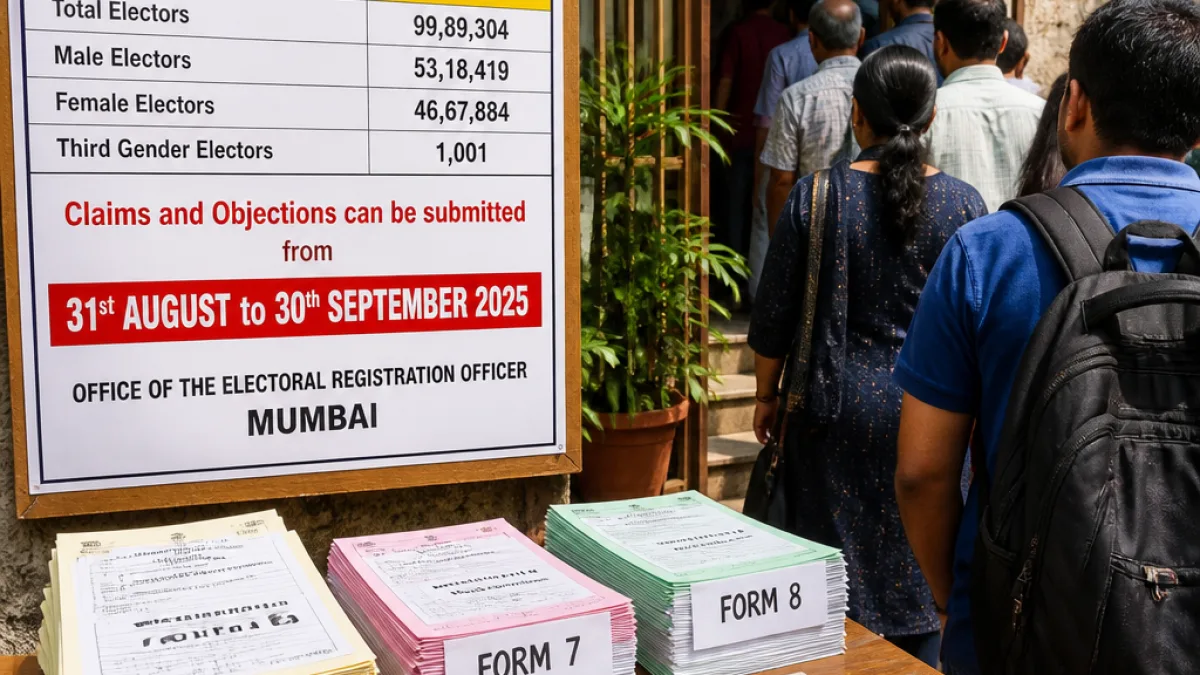
The Election Commission has opened a period for claims and objections for those whose names have not been included in the draft rolls. The window is open from August 31 to September 30.
- To seek inclusion of a missing name, eligible electors should submit Form 6 along with the prescribed declaration.
- To object to an entry in the draft roll, submit Form 7.
- To request corrections to details such as name, address, age or gender, submit Form 8.
The CEO's office said that district-level offices will make the draft rolls available to representatives of recognised political parties in both soft and hard copies. It will also provide lists of electors who were in the rolls before the revision but have not been included in the draft, along with the stated reasons for exclusion — absence, shifting, death or duplicate registration.
Implications for voters and the administration
Election officials said the uncollected enumeration forms reflect mobility, demographic change and data-quality issues that arise during intensive revision drives. Large urban districts such as Pune and Thane account for a substantial share of the missing forms, signalling challenges in reaching residents who may be migrant workers, students, long-term renters or otherwise not present at their registered addresses.
The high number of exclusions will require administrative follow-up and public awareness so that eligible electors can exercise their franchise. The claims and objections process is the formal remedy; without successful inclusion before final publication, the electors will not appear on the rolls for the upcoming electoral cycle.
What electors should check
Electors are advised to verify their names on the draft rolls at their local electoral office or via the CEO's online portal (details provided by the CEO's office). Those who have attained 18 years of age by 1 October 2026 and are not on the draft roll should submit Form 6 with the required declaration to be included.
District electoral officers have been asked to expedite outreach in areas with large numbers of uncollected forms, and political party representatives will be given access to the draft rolls to raise claims and objections as per the statutory process, the CEO's release said.
This report is based on data and statements issued by the Chief Electoral Officer's office and procedural guidelines published by the Election Commission.