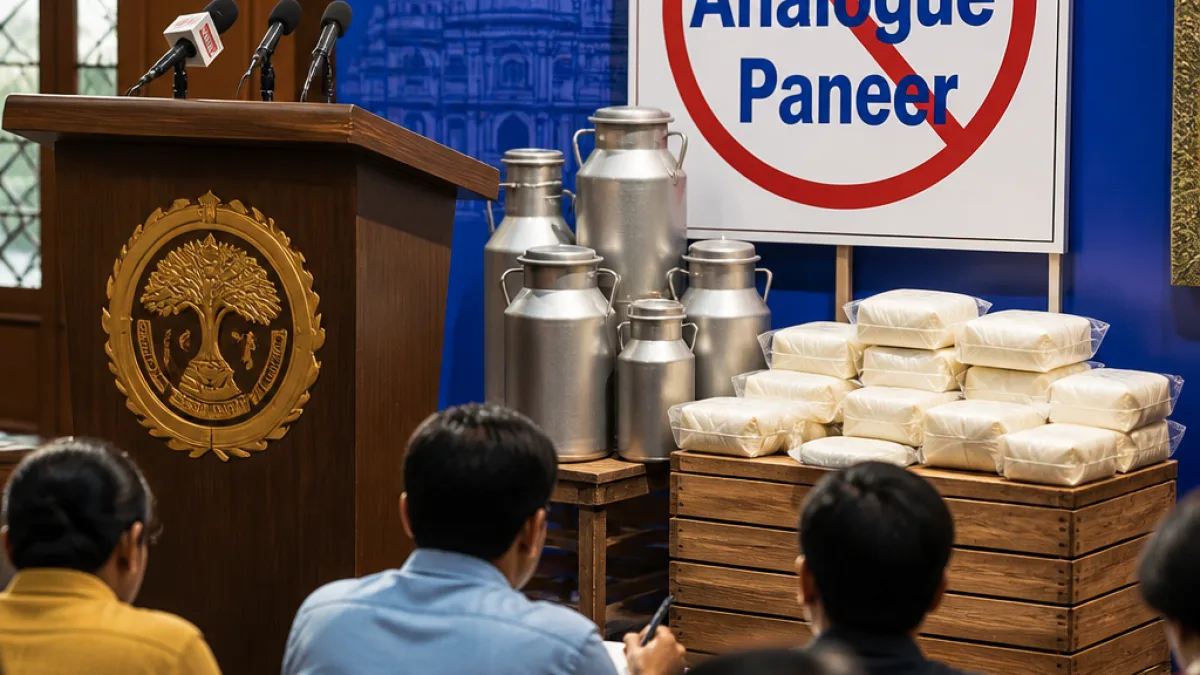
Bhopal: Madhya Pradesh on Wednesday moved to prohibit the sale of analogue paneer within the state, Chief Minister Mohan Yadav said, signalling a push to protect the dairy sector and promote products made from natural milk.
Policy and rationale
Announcing the decision, the Chief Minister said the government would not encourage cheaper non-dairy substitutes and would instead focus on expanding milk production and building the state's identity on natural dairy produce.
"We have decided that in Madhya Pradesh, the sale of analogue paneer will be discouraged. We will impose a ban on it. Other states in the country have also banned it," the Chief Minister said.
Yadav underlined that Madhya Pradesh has "natural milk products" and that authorities would ensure those goods gain market prominence rather than allowing substitute products to displace them.
What is analogue paneer and regulatory context
Analogue paneer, sometimes called imitation paneer, is manufactured to resemble conventional paneer but may use non-milk ingredients such as vegetable fats, starches and other additives instead of milk fat and milk proteins.
- It is intended to substitute dairy paneer in appearance and texture.
- Concerns centre on consumer confusion when non-dairy products are labelled or sold as "paneer".
- The Food Safety and Standards Authority of India (FSSAI) has issued guidance for correct labelling of cheese analogues and warned against selling such products as paneer.
On April 22 this year, FSSAI issued a public notice directing food service establishments and manufacturers to ensure accurate labelling of cheese analogues and stating that selling a cheese analogue as "paneer" is a serious violation of the law.
Regional context and impact on producers
The Madhya Pradesh decision follows similar statewide prohibitions imposed in at least three other states: Maharashtra, Gujarat and Chhattisgarh. By aligning with neighbouring states, MP aims to protect traditional dairy makers and the livelihoods linked to milk production and processing.
| State | Action on analogue paneer |
|---|---|
| Madhya Pradesh | Ban announced by Chief Minister |
| Maharashtra | Statewide prohibition in place |
| Gujarat | Statewide prohibition in place |
| Chhattisgarh | Statewide prohibition in place |
Officials say the measure is part of a broader effort to increase milk yields and protect the market for conventional paneer, a staple in many households across urban and rural MP. The state government has emphasised expanding milk production rather than permitting lower-cost alternatives to erode demand for locally made dairy.
Consumer clarity and enforcement
Regulators are now likely to sharpen labelling and market surveillance to prevent misbranding. The FSSAI notice already directs manufacturers and food service providers to avoid ambiguous or misleading names for cheese analogues.
Key enforcement questions include how the ban will be implemented across urban retail chains, local kirana stores and food outlets, and what penalties will apply for violations. The announcement did not set out an implementation timeline or specific enforcement mechanisms.
Implications for rural and tribal dairy sectors
Tribal and rural households that depend on dairy for supplementary income could be among the intended beneficiaries of a policy that emphasises natural milk products. By safeguarding demand for traditional paneer, the government expects to support farmers, cooperative dairies and small processors who rely on milk sales.
However, the actual benefit to producers will depend on effective enforcement, market access for milk producers, and any measures to scale up milk collection and processing facilities.
Officials have so far framed the ban as part of a strategy to "build the state's identity" on dairy strength while increasing milk output, but operational details remain to be published.
Consumers and industry stakeholders will be watching for implementing notifications from the state food safety department and any supplementary guidance from FSSAI clarifying the legal definition and permissible names for paneer and its substitutes.