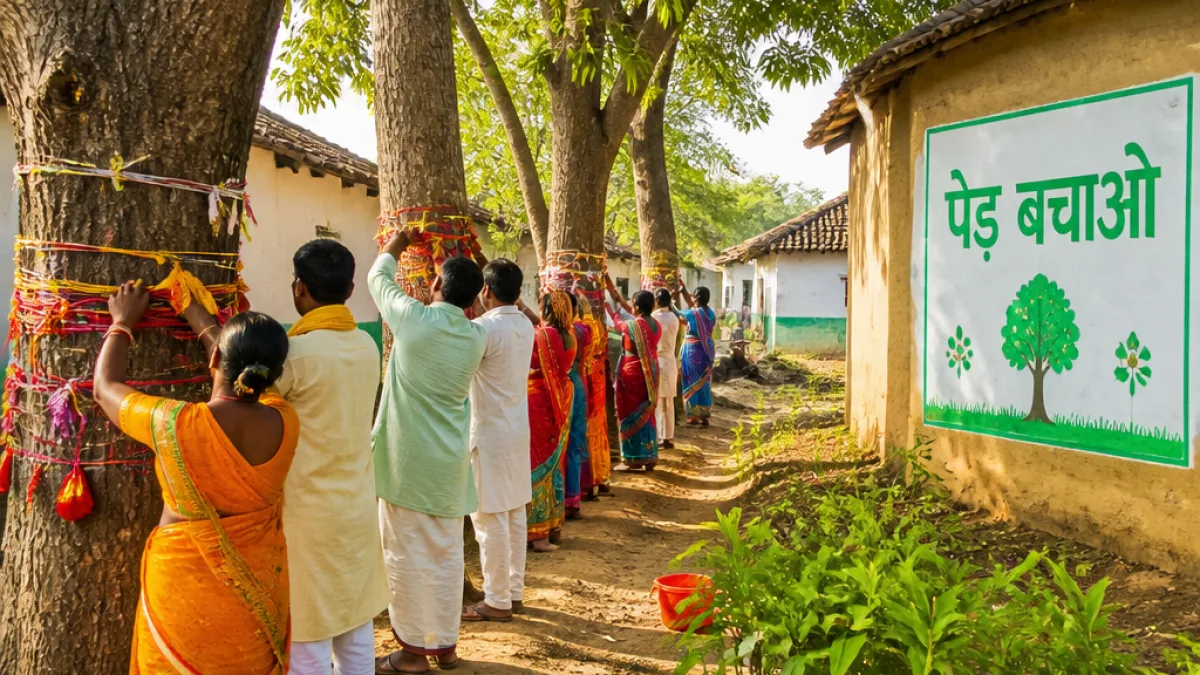
Jharkhand's forest department will launch a month-long campaign on Raksha Bandhan to tie rakhis to about 1 lakh trees across nearly 700 villages, officials said on Thursday. The initiative forms part of a broader state plan to cover 3 lakh trees across all 24 districts, using the festival ritual to bolster community stewardship of local forests.
From ritual to resource protection
Principal Chief Conservator of Forests Sanjiv Kumar is leading the drive, which seeks to create an emotional and social bond between villagers and the trees on which they depend for fuel, food and income. By tying rakhis to trees, residents symbolically pledge to protect them — a tradition organisers say can translate into practical measures for forest conservation, groundwater recharge and sustaining minor forest produce livelihoods.
The campaign is not new to the state. It began in 2004 in Lukaiya village in Dhanbad district and has since expanded to thousands of habitations, according to department records. One early success cited by officials is the protection of more than 20,000 Mahua trees in Lukaiya, which now contribute to local incomes through collection and sale of minor forest produce.
Scale and objectives
Officials say the current drive will intensify efforts already underway across rural Jharkhand. The stated objectives include:
- Strengthening local protection of existing trees and saplings;
- Encouraging water conservation linked to tree cover and watershed measures;
- Supporting households that rely on non-timber forest products for seasonal income.
| Parameter | Target |
|---|---|
| Trees to be tied with rakhis (initial wave) | 1 lakh (across ~700 villages) |
| Overall trees targeted in campaign | 3 lakh (statewide) |
| Districts covered | 24 |
| Programme origins | Started in 2004, Lukaiya, Dhanbad |
Link to livelihoods and conservation
Officials emphasise that the campaign goes beyond symbolism. In several villages where the practice took root, protection of key species such as Mahua has allowed communities to harvest sustainable quantities of flowers and seeds, providing supplementary income. Organisers also say that preserving tree cover helps with groundwater recharge and reduces soil erosion, especially important in the plateau and upland areas of Jharkhand.
While the department frames Raksha Bandhan as an entry point, follow-up measures will determine the campaign's ecological payoff. Conservation experts note that tree protection must be paired with monitoring, community agreements and incentives for alternate livelihoods to reduce pressure on forests.
History and expansion
According to the forest department, what began in one village more than two decades ago has now reached thousands of habitations. The programme reportedly linked over 12,000 villages to tree protection activities over the years. Organisers point to Lukaiya as a case study where concerted local action helped reclaim forest resources previously threatened by illicit felling and other pressures.
Practical considerations for villages
Implementation at scale will require basic planning and coordination. Officials have highlighted several practical steps being promoted while rolling out the drive:
- Mapping of target trees and public places where rakhis will be tied;
- Engagement of panchayats, women’s self-help groups and schoolchildren to ensure local ownership;
- Plans to monitor tree condition and register incidents of damage or illegal felling with local forest staff.
Authorities say the campaign will use the emotional resonance of Raksha Bandhan to instil a sense of responsibility, but the department also intends to follow up with technical support where required, including planting drives and community forest management training in select villages.
As the drive begins, the state will seek to convert festival goodwill into sustained action to preserve tree cover, shore up water resources and secure incomes derived from non-timber forest products across rural Jharkhand.