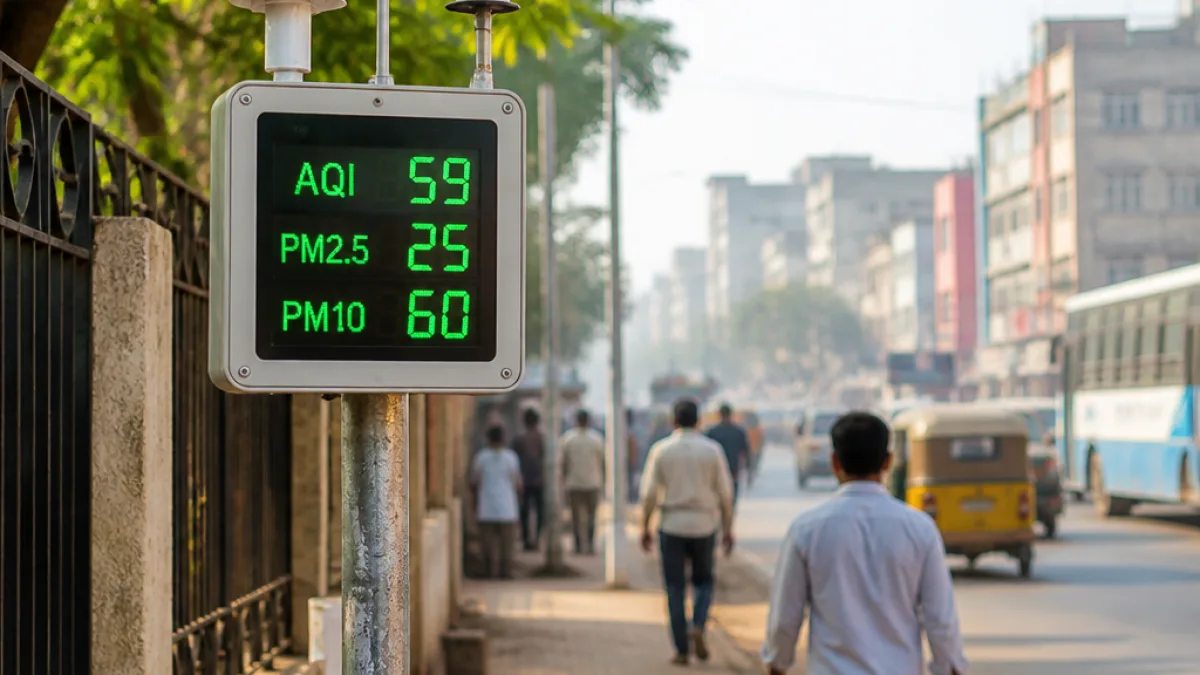
Hubballi recorded a Moderate Air Quality Index (AQI) of 59 on 18 August, with monitoring at Deshpande Nagar reporting particulate matter concentrations of PM2.5: 25 and PM10: 60, India Today reported.
Current readings and immediate guidance
The real‑time tracker cited by India Today showed the highest and lowest AQI values in Hubballi were both measured at Deshpande Nagar on the day, indicating localised monitoring at that station. The publication also noted that the Air Pollution Index recorded for Hubballi on 17 August was reported as 0.
- AQI (18-08-2026): 59 (Moderate) — Deshpande Nagar
- PM2.5: 25
- PM10: 60
- Most polluted area (today): Deshpande Nagar
- Cleanest area (today): Deshpande Nagar
What 'Moderate' means for residents
According to the explanatory categories published alongside the readings, an AQI in the 51–100 range is classed as Moderate. The guidance states air quality is generally acceptable for the majority of the population but that sensitive individuals — including people with asthma, respiratory allergies, or other chronic lung conditions — may experience mild discomfort and should consider reducing prolonged or heavy outdoor exertion, particularly during peak pollution hours.
"Air quality is acceptable, but sensitive people may feel mild discomfort. Those with asthma or allergies should reduce prolonged outdoor exertion, especially during peak pollution hours," the India Today tracker guidance stated.
Local context and implications
Hubballi, as a major urban centre in north Karnataka, faces episodic variation in air quality driven by local emissions, vehicular traffic, construction dust and regional weather patterns. While the single‑station reading from Deshpande Nagar indicates a Moderate status on the day, residents should note that pollution levels can vary across neighbourhoods and change rapidly with wind and traffic conditions. The published data emphasises the value of real‑time monitoring in planning outdoor activity for schools, elderly care and those with pre‑existing respiratory conditions.
Public health implications at these levels are modest for the general population, but local health clinics and general practitioners should remain attentive to spikes that could aggravate symptoms for patients with chronic respiratory or cardiovascular illness. Employers and schools in Hubballi may prefer to stagger outdoor work or exercise sessions during times when AQI is lower.
How residents can respond
Actions recommended by the tracker and common public health practice include:
- Limiting prolonged or heavy outdoor exertion for children, elders and people with respiratory or cardiac conditions.
- Checking real‑time AQI notifications before planning outdoor sports, construction work or long commutes.
- Using masks with particulate filtration if extended outdoor exposure is unavoidable for sensitive persons.
- Keeping windows closed during peak pollution hours if indoor air quality is poor, and using available air purifiers where possible.
| Parameter | Value (Deshpande Nagar, 18 Aug) |
|---|---|
| AQI | 59 (Moderate) |
| PM2.5 (µg/m³) | 25 |
| PM10 (µg/m³) | 60 |
The India Today realtime tracker, which supplied the figures cited here, also offers day‑to‑day pollution trends and forecast features that can help Hubballi residents identify recurring high‑smog windows. For updated readings and alerts, the publication maintains an online AQI page for the city.
Given the dynamic nature of air pollution, residents and institutions in Hubballi are advised to consult live monitoring data regularly and follow the guidance targeted at sensitive groups to reduce exposure and health risks.