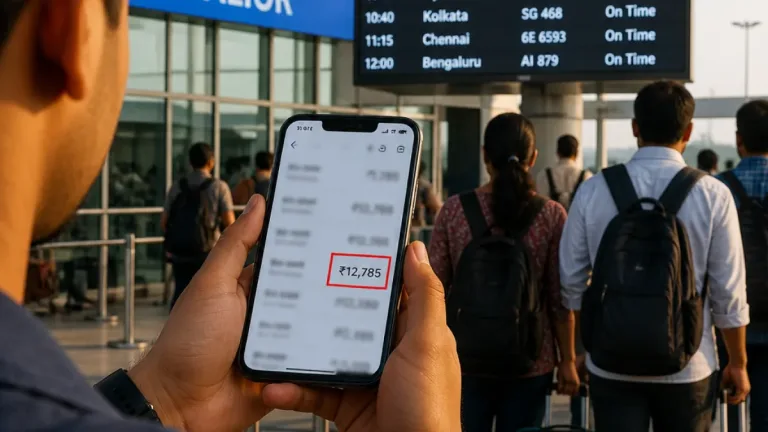

Howrah, 22 August: Jewellery buyers and small investors in Howrah are being reminded to verify purity marks, making charges and statutory taxes when purchasing gold, as market prices and final showroom costs vary according to purity, design and dealer levies. Industry guidelines and consumer advisories circulating locally reiterate that the base gold rate quoted by traders is only a starting point; the final bill normally includes making charges and a flat 3% GST.
Know what you are buying
Gold purity is measured in karats and the most commonly traded forms in Howrah's retail market are 24K (pure), 22K and lower-karat alloys used in contemporary jewellery. Each karat grade implies a different gold content and therefore a different per-gram valuation. A concise reference for buyers is below:
| Grade | Purity | Usual use |
|---|---|---|
| 24K | 99.9% | Investment bars/coins — soft for intricate jewellery |
| 22K | 91.6% | Traditional Indian jewellery — balance of purity and durability |
| 18K / 14K | Lower gold content | Contemporary jewellery with greater strength |
Price components and authenticity
Buyers must note that the final showroom price comprises several elements beyond the quoted metal rate. As consumer guidance summarises:
"The Final Price Calculation: Base gold price + making charges (which vary by design and are often negotiable) + 3% GST."
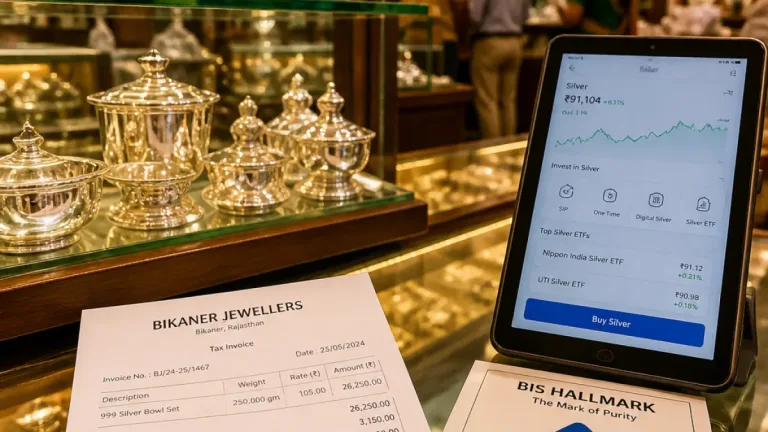
In studded jewellery, the weight of stones is deducted when calculating net charged gold weight. The BIS hallmark and the six-digit HUID remain the primary markers of purity and authenticity; customers are advised to check the mark and verify the HUID on the BIS Care portal or app before purchase.
- Making charges: Vary by design complexity and retailer — ask for a clear breakup on the invoice.
- GST: A flat 3% is applicable on gold jewellery transactions across India.
- Stone deductions: Ensure the net weight excludes the embedded stones in studded pieces.
Regulatory and tax points
Regulatory thresholds remain relevant for Howrah shoppers and investors. PAN submission is mandatory for purchases exceeding ₹2 lakh, and stringent KYC rules apply for large cash purchases. The guidance reiterates that cash purchases above ₹10 lakh attract tighter compliance requirements. For sellers, capital gains tax outcomes depend on holding period when gold is disposed of later.
Alternatives to physical gold
For residents of Howrah who want exposure to gold without the logistics of storage or making charges, paper and digital instruments are highlighted as viable options:
- Digital gold: Buy small quantities online (platforms allow purchases from Re 1), with the convenience of storage and later physical delivery in many cases.
- Gold ETFs and mutual funds: Traded on exchanges — offer liquidity and track market prices without physical handling.
- Sovereign Gold Bonds (SGBs): Government-backed instruments that pay an additional fixed interest on top of gold-price returns and carry capital-gains tax advantages if held to maturity.
Local jewellers in Howrah's Babu Ghat and Santragachi markets routinely advise customers to compare the total outlay — metal rate, making charge and GST — across a couple of shops before committing. Consumers focused on investment rather than ornamentation are encouraged to weigh storage costs and resaleability when considering physical purchases.
With festivals and wedding season often driving local demand, transparency on paperwork and hallmarking is likely to become more important in the coming weeks. Buyers should seek itemised invoices and retain documentation, including HUID and PAN copies where applicable, to ensure smooth future transactions or claims.
Practical checklist for Howrah buyers:
- Verify BIS hallmark and HUID via the BIS Care app.
- Ask for an itemised invoice showing metal rate, making charges and 3% GST.
- Confirm stone deductions in studded pieces.
- Consider digital gold or ETFs if you want small-ticket or paper exposure.