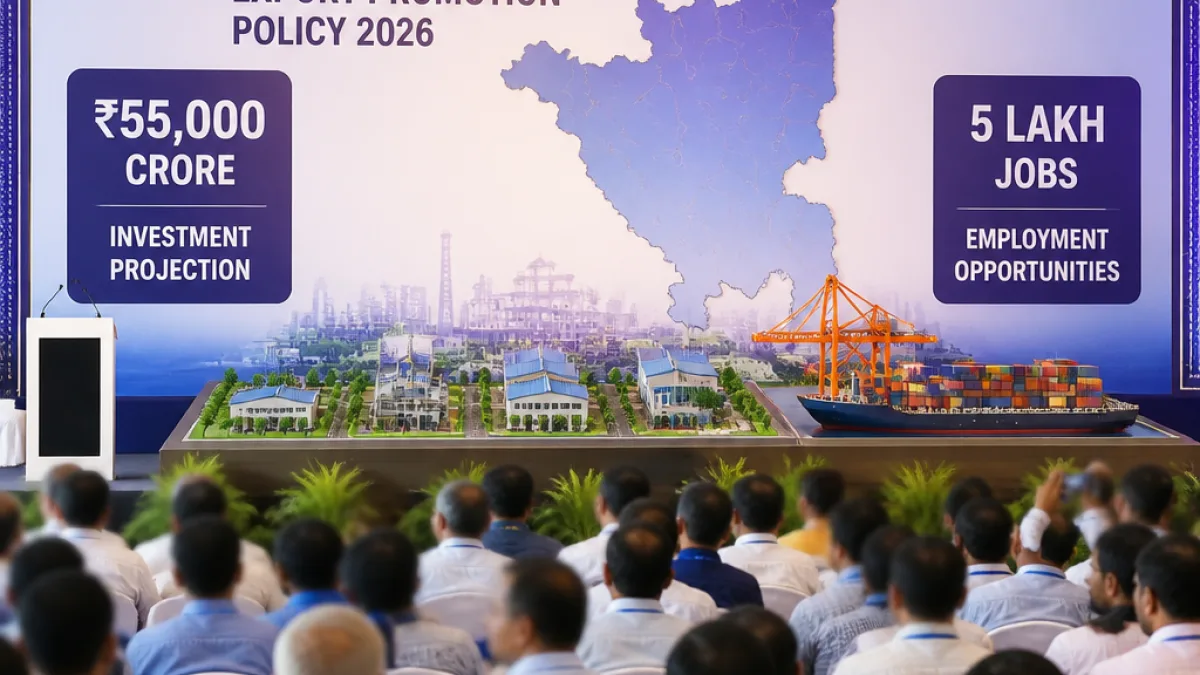
Karnal: The Haryana government on Monday unveiled the Haryana Progressive MSME and Export Promotion Policy 2026, setting an ambitious target of attracting more than ₹55,000 crore in manufacturing investment, generating over 5 lakh jobs and doubling the state’s exports by 2031.
Policy focus and targets
Launched by Chief Minister Nayab Singh Saini in Karnal, the five-year policy positions the state’s roughly 15 lakh MSMEs as the centrepiece of its next growth phase. Officials described the measure as a package of 60 initiatives spanning finance, infrastructure, technology, innovation, exports, sustainability and skills development.
"The policy has been prepared with 'Make in India' and 'Make in Haryana' at its core," the Chief Minister said at the launch.
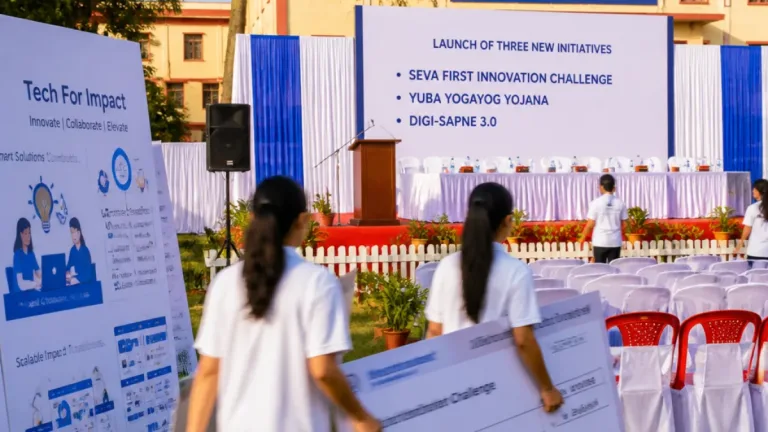
Vidhan Sabha Speaker Harvinder Kalyan and Industry and Commerce Minister Rao Narbir Singh were present at the event. The government said the policy seeks to convert the state’s manufacturing potential into tangible investment and job creation over the coming five years.
Key institutional reforms and support measures
Among the structural changes proposed is the establishment of a dedicated MSME Directorate to provide focused institutional support and coordination. The policy also envisages a new Haryana Udyam Vikas Mission that will offer incentives to enterprises in identified thrust sectors.
- Incentives under the mission will include capital investment and interest subsidies, stamp duty reimbursements and employment assistance.
- Support for testing, automation, artificial intelligence and research will be provided to improve competitiveness.
- Financial access measures include a proposed State Venture Capital Fund and a Sectoral Credit Guarantee Fund to facilitate institutional finance and collateral-free lending.
The package is aimed at improving both credit availability and technological upgradation for MSMEs, with the explicit goal of making smaller enterprises more investment-ready and export-capable.
Measures to boost exports
The policy includes a suite of interventions designed to ease entry into international markets. Assistance will be provided for international quality certifications, export credit and insurance, freight subsidies, registration on e-commerce platforms and participation in global trade fairs.
To help first-time sellers reach overseas buyers, the government has announced the Mukhya Mantri Pratham Niryatak Protsahan Yojana. A dedicated Haryana Niryat Centre will operate as a one-stop facility for export documentation, compliance, logistics and market intelligence, while a programme called Udaan Dwaar is meant to facilitate international partnerships.
Digital and AI tools for entrepreneurs
At the event the Chief Minister also launched Haryana Udyog Saathi, an AI-powered multilingual policy assistant designed to help entrepreneurs navigate schemes and procedures. The tool is intended to lower information barriers for business owners across the state.
Summary of commitments
| Item | Target / Feature |
|---|---|
| Investment target | ₹55,000 crore (manufacturing) |
| Employment | Over 5 lakh jobs by 2031 |
| MSMEs covered | 15 lakh enterprises in Haryana |
| Policy period | Five years (2026–2031) |
Officials framed these measures as aiming not only to attract fresh investment but also to modernise existing small and medium units through technology adoption, quality certification and market linkages.
What this means locally
For Haryana’s industrial towns and smaller manufacturing clusters, the policy could translate into subsidised interest on investment loans, reimbursement of stamp duty on capital projects and targeted help to meet export standards. If the proposed credit guarantee and venture funds materialise, smaller firms that lack collateral may find it easier to secure institutional finance.
However, the effective rollout of incentives, the operationalisation of the new directorate and the scale-up of the export support mechanisms will determine how much of the announced ambition converts into on-the-ground results for entrepreneurs and workers.
The government has highlighted the policy’s alignment with national and state manufacturing drives. Implementation timelines and specific sectoral lists for thrust areas are expected to be issued by the Industry and Commerce Department in subsequent notifications.