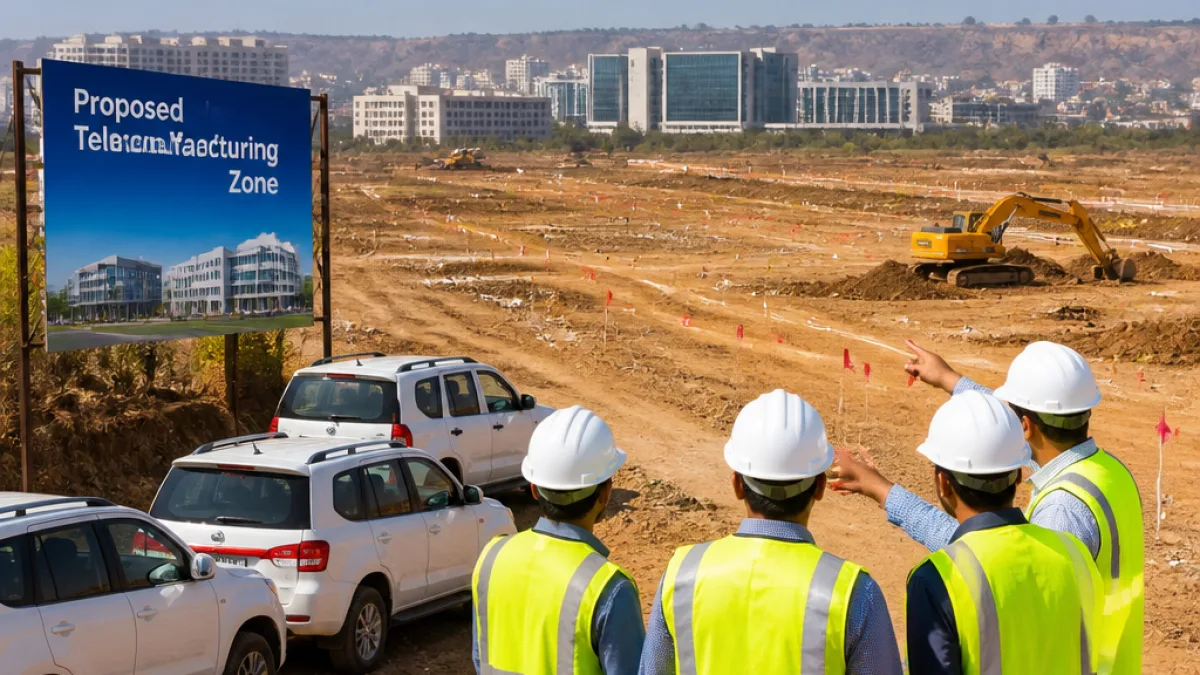
GWALIOR: The Union government and the Madhya Pradesh administration have moved a step closer to establishing what they describe as Asia's first dedicated Telecom Manufacturing Zone (TMZ) in Gwalior, following a site inspection by Union Communications Minister Jyotiraditya Scindia. Officials said proposals from 24 companies amounting to about ₹5,500 crore have been received and the project is expected to generate more than 18,000 direct employment opportunities.
Site, scale and investor response
The land identified for the first phase of the TMZ lies within the Shrimant Madhavrao Scindia Counter Magnet City (SADA) and the adjacent IT Park. Authorities said roughly 170 acres — comprising around 90+ acres in SADA and 70+ acres in the IT Park — have been marked for the initiative. Interest from industry, however, reportedly exceeds available land, and officials indicated that additional acreage will be identified to accommodate expansion.
- Investment proposals: ₹5,500 crore from 24 companies
- Employment potential: over 18,000 direct jobs
- Planned industrial ecosystem: 24–25 telecom manufacturing units
- Land identified (phase 1): ~170 acres (SADA + IT Park)
Government steps and prior outreach
The Department of Telecommunications and the Government of Madhya Pradesh signed a memorandum of understanding in July 2026 to establish the TMZ. Following the MoU, joint investor roadshows in Delhi and Mumbai in August were led by the Union minister and the Chief Minister of Madhya Pradesh. According to official figures, investor interest formalised at the roadshows included commitments of about ₹3,500 crore from the Delhi event and roughly ₹2,000 crore from the Mumbai event.
"Project is not about setting up a single industrial unit, but about creating a complete industrial ecosystem comprising 24-25 telecom manufacturing units in Gwalior."
The statement underlines the plan to develop an integrated manufacturing cluster rather than standalone factories — with units expected to produce telecom equipment and related components that can feed into domestic and export supply chains.
Local implications and planning considerations
For Gwalior, the TMZ represents both an opportunity and a planning challenge. The counter-magnet city (SADA) was conceived to relieve pressure on Delhi by evolving Gwalior into a new industrial centre; the TMZ would extend that vision into a focused sectoral cluster. Local economic benefits could include jobs for skilled and semi-skilled workers, ancillary services, and supply-chain linkages for small and medium enterprises.
However, authorities will need to manage land allocation, infrastructure provision and environmental safeguards as the project scales. Officials have already signalled that land allocations may be increased to match investor demand, which will require coordination between state agencies, SADA authorities and the Department of Telecommunications.
| Item | Detail |
|---|---|
| Investment proposals | Approximately ₹5,500 crore from 24 companies |
| Employment (direct) | Over 18,000 jobs |
| Planned units | 24–25 telecom manufacturing units |
| Land identified (phase 1) | ~170 acres (90+ acres in SADA; 70+ acres in IT Park) |
Officials emphasised that the investment figures reported at the roadshows were not mere declarations of intent but were accompanied by formal application processes tied to land allotment. Companies expressing interest have reportedly begun the application process for plots within the zone.
As the TMZ moves from planning to implementation, local stakeholders, including municipal bodies and firms in the region, will watch closely for announcements on infrastructure timelines, skill-development initiatives and incentives. The Madhya Pradesh government has been credited in official statements for offering special incentives to support the project, a factor the Union minister acknowledged during the site visit.
For Gwalior's economy, the proposed zone could mark a shift toward higher-technology manufacturing and supply-chain development, but realising those gains will depend on timely land clearances, infrastructure delivery, labour-skill alignment and environmental compliance.