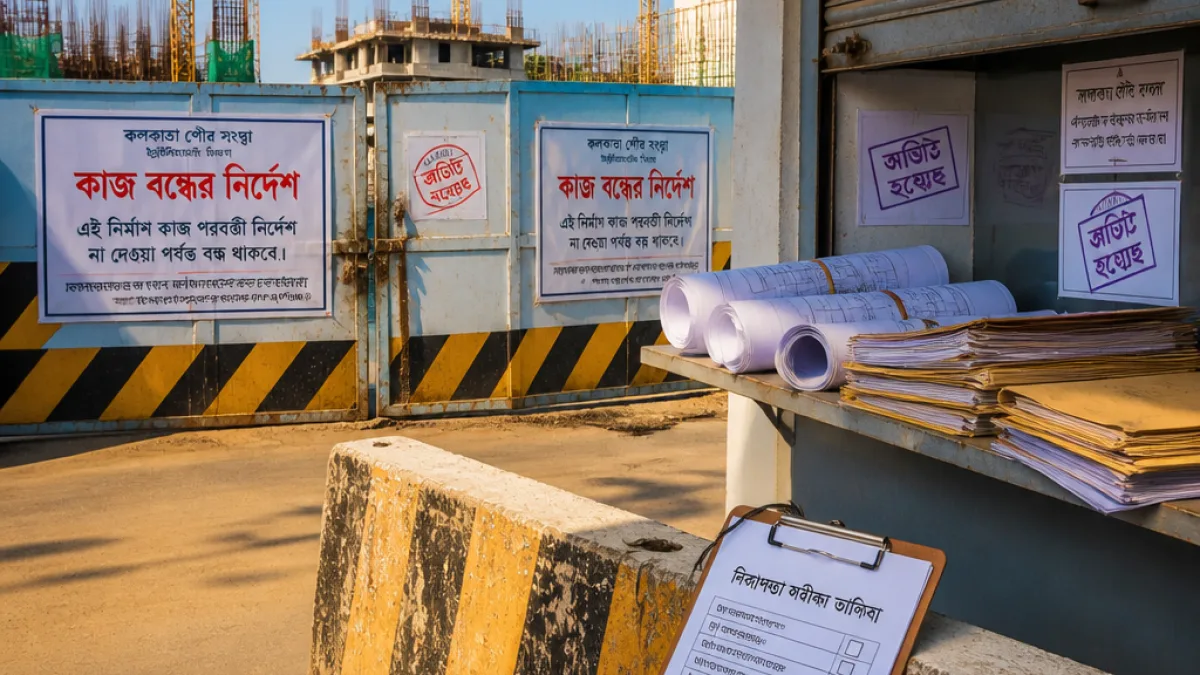
Kolkata: The Confederation of Real Estate Developers' Associations of India (CREDAI) West Bengal on Monday welcomed the state government's push to tighten building-safety norms and regulatory compliance, but urged that developers be granted an eight-month force majeure relief after a mandatory audit halted construction work on identified projects.
Audit, clearances and violations — the current tally
The mandatory audit, initiated after the collapse of a warehouse in Taratala in June, identified 706 projects for scrutiny. According to CREDAI West Bengal officials, as of last Saturday:
- 595 projects have submitted audit applications;
- 115 projects are yet to apply;
- 204 projects have been granted clearance;
- 89 projects received conditional clearances;
- 26 projects were found to have major violations.
The technical committee overseeing the review has convened eight meetings to examine the submissions, CREDAI said.
Developers seek temporary relief citing multiple disruptions
CREDAI West Bengal president Sushil Mohta said the developers' body has formally sought an eight-month extension of approvals and completion validity. The request, the association argued, stems from a string of external disruptions that have impacted project timelines.
"We welcome the state government's proposed Standard Operating Procedure (SOP) to improve building safety and regulatory compliance. The government has made significant progress in a short span of time. We have asked for an eight-month extension of approvals and completion validity," Mohta said.
CREDAI cited the combined impact of the international conflict in West Asia, Supply-Chain Interruptions and Restrictions (SIR), election-related disruptions and the stop-work orders imposed while the mandatory audit proceeded. The association invoked the principle of force majeure — unforeseen events beyond parties' control that delay contractual obligations — as the basis for the extension plea.
State reforms and industry co-operation
CREDAI's statement welcomed the government's proposed Standard Operating Procedure (SOP) intended to strengthen building safety and regulatory oversight. The SOP, officials said, aims to standardise inspections and compliance checks across projects so that safety concerns identified during the post-Taratala audit can be addressed uniformly.
Developers and officials are treading a delicate path: balancing urgent safety checks in the aftermath of a structural failure with the need to limit prolonged commercial disruption that affects buyers, contractors and labourers. The mandatory audit itself required a temporary stop-work order on the projects identified for review.
Practical implications for buyers and contractors
For homebuyers, delays in clearances can mean shifting possession dates and extended interest costs. Contractors and labourers face work stoppages that hit incomes, while developers confront mounting carrying costs for stalled projects. CREDAI’s appeal for an eight-month force majeure window seeks to provide temporary regulatory certainty so that projects can resume once compliance is cleared.
Officials associated with the audit have not released a consolidated public timetable for final clearances; CREDAI’s figures are current up to last Saturday, the association said. The presence of 26 projects with major violations indicates some sites will require substantive remedial work before resumption.
| Item | Number |
|---|---|
| Projects identified for audit | 706 |
| Applications submitted | 595 |
| Clearances granted | 204 |
| Conditional clearances | 89 |
| Major violations | 26 |
Next steps and oversight
With the technical committee continuing its meetings, the pace of clearances will determine how soon halted projects can restart. CREDAI’s call for an eight-month force majeure period will now be considered against the state administration’s mandate to ensure public safety. Any extension, if granted, would set a precedent for handling industry-wide disruptions arising from safety audits and external crises.
The Taratala incident has sharpened public and official attention on construction standards in Kolkata and adjoining municipal areas. As the state rolls out its SOP, developers and regulatory bodies will be watched closely by homebuyers and civic watchdogs alike for transparency and expedience in resolving safety concerns.
For now, the twin objectives — robust safety checks and minimal prolonged disruption to housing projects — remain at the centre of negotiations between CREDAI West Bengal and the state machinery.