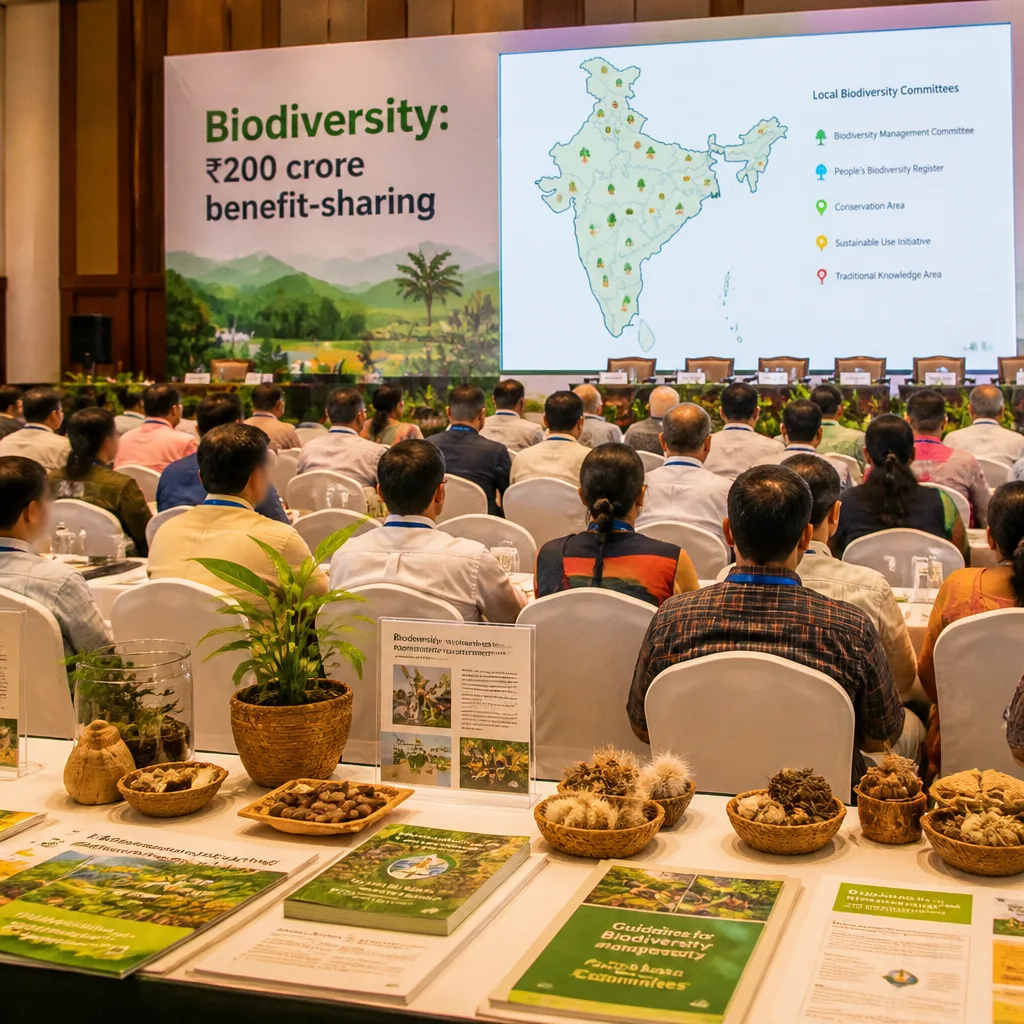
Chandigarh: The Union Government on Sunday pressed state governments and Union Territories to bolster biodiversity governance, urging them to operationalise locally constituted institutions and align rules with recent national reforms. Speaking at the opening of the 16th National Meet of State Biodiversity Boards (SBBs) and Union Territory Biodiversity Councils (UTBCs), the Union Environment Minister highlighted the National Biodiversity Authority's (NBA) distribution of ₹200 crore in benefits to local communities and states as a demonstration of the Access and Benefit Sharing (ABS) mechanism in practice, an official statement said.
Emphasis on functional local bodies
The Minister called for making more than 2.76 lakh Biodiversity Management Committees (BMCs) fully functional and effective, saying these grass‑roots bodies are central to equitable benefit-sharing, biodiversity documentation and local stewardship. He underlined that the Biological Diversity (Amendment) Act, 2023 and the updated Biological Diversity Rules, 2024, provide an improved legal framework that states should adopt in their own rules and implementation processes.
Delegates at the two‑day meeting reviewed implementation challenges and exchanged best practices, with the goal of translating policy into on‑the‑ground outcomes for conservation and livelihoods. The Minister reiterated the need for benefit‑sharing to produce tangible results for communities while simultaneously supporting conservation objectives.
Alignment with international commitments
The event also showcased India's reporting and planning progress under global biodiversity frameworks. The Minister pointed to the submission of the 7th National Report to the Convention on Biological Diversity and the country's first report on the Nagoya Protocol on ABS as markers of progress. He framed the Updated National Biodiversity Strategy and Action Plan (NBSAP) 2024–2030 as being aligned with the Kunming‑Montreal Global Biodiversity Framework, and called for measurable targets in ecosystem restoration, species and habitat protection, agro‑biodiversity and climate‑resilient landscapes.
According to the official release, the NBA used the meeting to release knowledge products, including a digest of its achievements over the last year that outlines the ABS scheme and the distribution process of funds among stakeholders.
Implementation priorities and practical steps
Speakers and attendees discussed practical measures to strengthen governance at multiple levels. Key priorities identified in the official programme included capacity building for SBBs and BMCs, transparent channels for benefit distribution, and harmonisation of state rules with the amended national framework.
- Operationalise BMCs: Make the 2.76 lakh committees effective for local management and benefit-sharing.
- State rule alignment: Revise state/UT regulations to be consistent with the 2023 Amendment and 2024 Rules.
- Measurable outcomes: Set targets for restoration, species/habitat conservation, agro‑biodiversity and climate resilience.
The meeting provided a platform for states and UTs to present innovations and identify bottlenecks in implementation. The official statement said organisers expected deliberations to inform improved coordination between central and state institutions and to help translate national strategies into local actions.
| Aspect | Figure/Status |
|---|---|
| Benefits shared by NBA | ₹200 crore |
| Registered Biodiversity Management Committees | 2.76 lakh |
| Key legal instruments | Biological Diversity (Amendment) Act, 2023; Biological Diversity Rules, 2024 |
Participants included senior functionaries from state biodiversity boards and Union Territory councils. The Minister emphasised that ABS schemes must deliver benefits that support sustainable livelihoods and conservation simultaneously, signalling continued central emphasis on both governance reform and community rights.
As states consider revising their frameworks, the outcomes of the meeting are likely to shape how benefit‑sharing revenues are distributed at the local level and how biodiversity strategies are implemented across landscapes. The official note concluded that the two‑day meet would help chart practical steps for strengthening biodiversity governance going forward.