Mumbai: A Bombay High Court judge on Monday recused himself from hearing petitions challenging the constitutionality of the Maharashtra Special Public Security Act, 2025, which the petitioners say grants the state sweeping powers to declare organisations unlawful and take coercive measures.
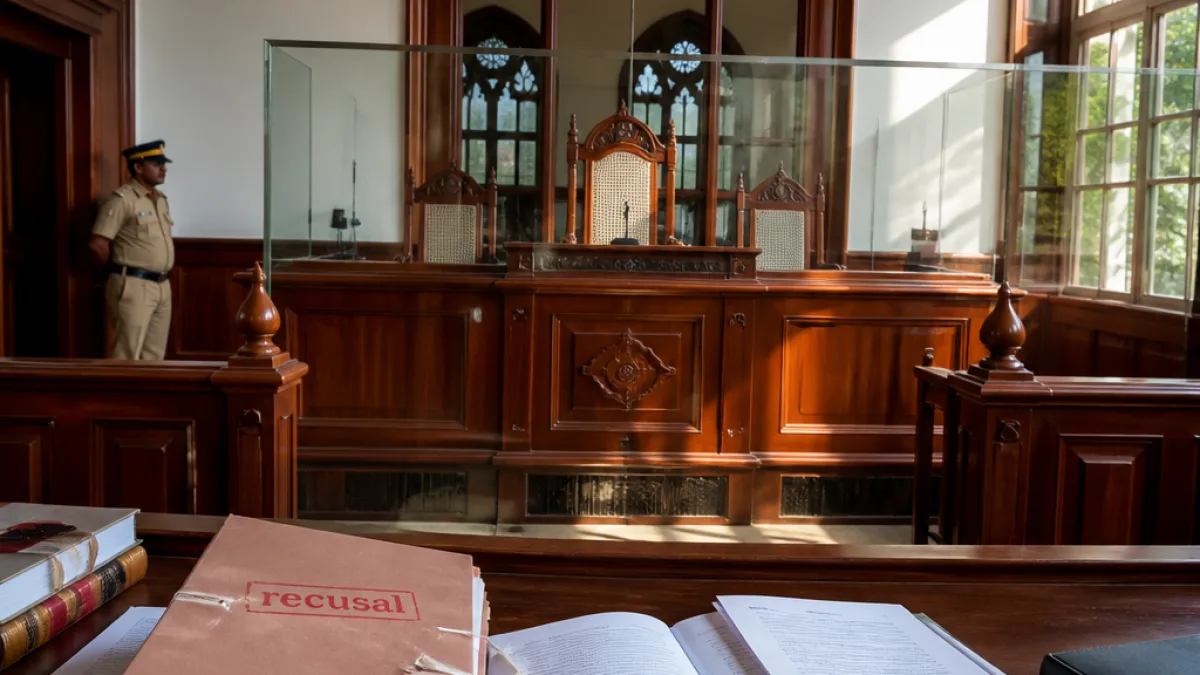
The case, filed by the Indian National Congress and the Communist Party of India, was listed before a division bench that included Justice Gautam A. Ankhad and Acting Chief Justice Ravindra Ghuge. Justice Ankhad withdrew from the matter; the proceedings record does not give a reason for the recusal.
What the petitions say
The petitions seek to strike down several provisions of the Act or, at the least, restrain authorities from taking coercive action under the law while the constitutional challenge is pending. According to the petitions, the Act allows the government to:
- Declare organisations unlawful without adequate prior notice.
- Attach properties of declared organisations.
- Initiate criminal proceedings on the basis of administrative declarations.
- Rely on an advisory board whose members are appointed by the government, raising questions about independence.
The petitioners contend these powers are broad and arbitrary and could be used in ways that curtail lawful dissent and legitimate political activity.
Legislative history and stated purpose
The Act was passed by the Maharashtra Assembly on 10 July 2025 and by the Legislative Council on 11 July 2025. It received the President's assent on 15 December 2025. The statute frames its purpose as preventing what it describes as unlawful activities by Left Wing Extremist organisations and similar groups.
| Key milestone | Date |
|---|---|
| Assembly passage | 10 July 2025 |
| Legislative Council passage | 11 July 2025 |
| President's assent | 15 December 2025 |
Overlap with existing laws
The petitions argue the Act overlaps with central and state laws, including the Unlawful Activities (Prevention) Act (UAPA) and the Maharashtra Control of Organised Crime Act (MCOCA), and in certain provisions extends beyond them. The petitioners have raised specific concerns about procedural safeguards such as notice, opportunity to be heard and access to the material on which a decision to declare an organisation unlawful would be based.
They have also questioned the composition and role of the statutory advisory board constituted under the Act, asserting that appointments made by the government mean the board is not an independent judicial or quasi-judicial body.
Legal stakes and public interest
At issue is the balance between the state’s stated security objectives and protection of civil liberties. If enforced, the Act gives administrative routes to proscribe organisations and to attach assets, potentially bypassing processes available under criminal law, the petitioners say. They want the High Court to stay enforcement of the statute or to restrain authorities from exercising coercive powers while their constitutional challenge runs.
Legal experts note that questions of overlap with central law — such as UAPA — may raise jurisdictional and federal considerations. Courts will also consider whether procedural safeguards in the new law meet standards of natural justice and constitutional protections for freedom of association and expression.
What happened in court
When the matter came up on Monday, Justice Ankhad recused himself without stating reasons. The bench retained by the court record included Acting Chief Justice Ravindra Ghuge; subsequent listing of the matter will determine the next stage of hearing and any interim orders on enforcement sought by the petitioners.
Attempts to obtain comment from the petitioners and from the state government were not part of the court record seen on Monday. The petitions remain pending and the High Court will now decide whether to post the matter before a different bench for hearing on its merits.
The outcome of the petitions will be watched closely by civil liberties groups, political parties and law enforcement agencies, given the law’s potential to reshape how the state views and responds to organisations it deems a security threat.
Sameer Joshi is the Maharashtra correspondent reporting from Mumbai.