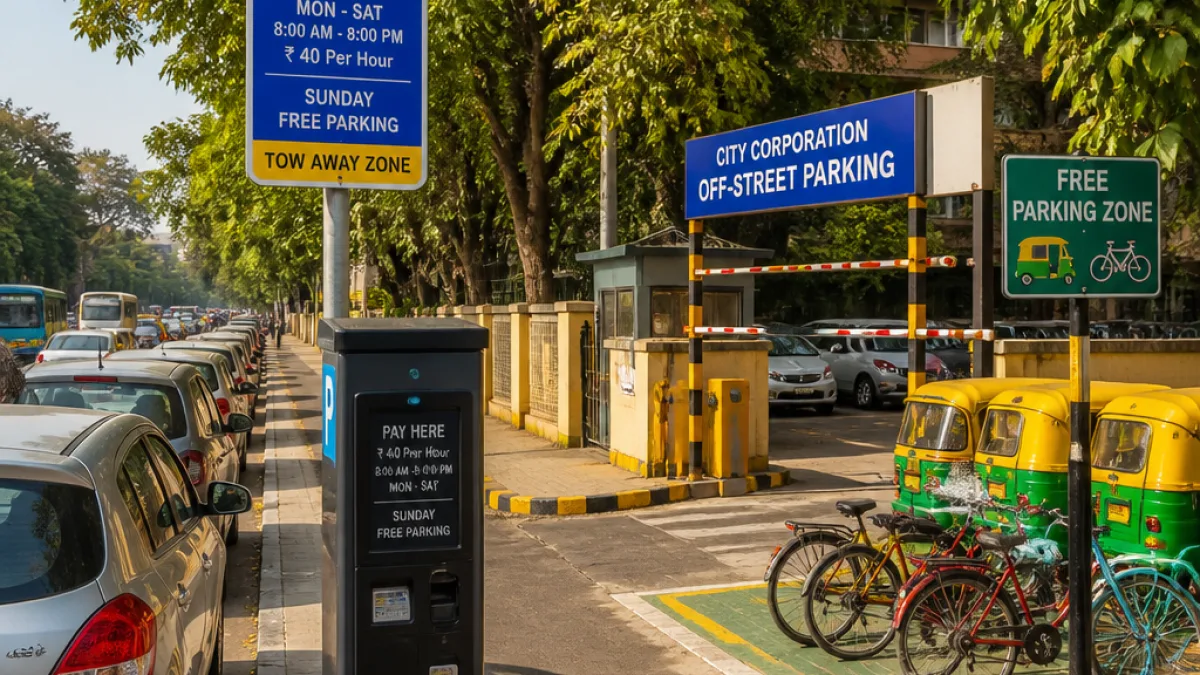
State draft seeks to free carriageways by pricing on-street parking and promoting off-street lots
The Karnataka urban development department has notified a draft of revised vehicle parking rules that would make most on-street public parking chargeable in Bengaluru and introduce a significant push toward off-street parking. The draft, reported by media outlets, envisages residential car parking permits costing between ₹15,000 and ₹25,000 per year to discourage long-term roadside parking near homes and to keep carriageways clear in dense corridors.
Under the proposed regulations, only bicycle and autorickshaw stands would remain free of charge. The policy prioritises reclaiming road space for moving traffic while using land owned by the city corporations to create off-street parking, or by incentivising owners of vacant plots to develop parking — including multi-level facilities — to meet rising demand.
“The high parking demand seen on roads, especially in business areas, is not only due to the sustained spurt in vehicle ownership and population over the past decade, but also because of the inefficient public transport system, poor pedestrian infrastructure, inefficient last and first mile connectivity and absence of demand management measures such as pricing of parking,”
said the Parking Policy 2.0, drawn up in 2020 by the Directorate of Urban Land Transport (DULT), as cited in the draft.
Bengaluru already shows steep growth in vehicle ownership. The city has around 2.5 million personal cars and 8.67 million two‑wheelers registered locally; the total number of Bengaluru-registered vehicles across categories stands at 12.81 million, according to figures cited in the draft. The city continues to add vehicles rapidly: in the first three months of FY2026‑27, there were 40,840 new car registrations and 142,491 new two-wheeler registrations.
| Category | Number |
|---|---|
| Personal cars | 2.5 million |
| Two‑wheelers | 8.67 million |
| Total Bengaluru-registered vehicles | 12.81 million |
| New car registrations (Q1 FY2026‑27) | 40,840 |
| New two‑wheeler registrations (Q1 FY2026‑27) | 142,491 |
The draft notes that previous attempts to expand off-street parking — including multi-level lots built by civic agencies or private entities — did not succeed in curbing on-street parking because roadside spaces remained unmanaged, free and unenforced. The proposed rules therefore emphasise pricing and enforcement as demand management tools.
What the proposal would change for residents and businesses
- Residential parking permits: The draft envisages annual fees of ₹15,000–₹25,000 for residents who park cars on public roads near their homes, signalling a shift from free long-term roadside parking to paid access.
- Public parking charges: Except for bicycles and autorickshaw stands, all on-street public parking would be chargeable, affecting commuters, shoppers and visitors in business districts and residential areas alike.
- Off-street infrastructure: The draft proposes leveraging land owned by the five city corporations and incentivising private vacant-plot owners to develop structured parking, including multi-level facilities.
City mobility experts have long argued that pricing parking is an essential instrument to manage demand and encourage the use of public transport or shared mobility. The draft echoes those recommendations, pointing to gaps in public transport, pedestrian infrastructure and first‑/last‑mile connectivity as contributing to persistent on-street demand.
The move could have wide consequences across Bengaluru neighbourhoods. Charging residents for permit parking may provoke opposition in areas where off-street parking alternatives are limited, while the success of the policy will depend on the availability, affordability and enforcement of newly created off-street spaces. The draft also raises logistical questions around permit administration, enforcement mechanisms and revenue allocation between city bodies.
The draft parking rules were notified by the Karnataka urban development department and reported by india today. Implementation would require detailed regulations, coordination among the five city corporations and investments in off-street facilities and enforcement systems to ensure roads are freed up for moving traffic without displacing parking problems to other neighbourhoods.
As Bengaluru planners seek to tackle congestion in Asia’s fast-growing tech hub, the parking draft signals a shift toward demand management and user-pays principles. How residents, traders and local elected representatives react will shape the next stage of consultations and any final rule changes.