Greater Bengaluru draft would monetise on-street residential parking
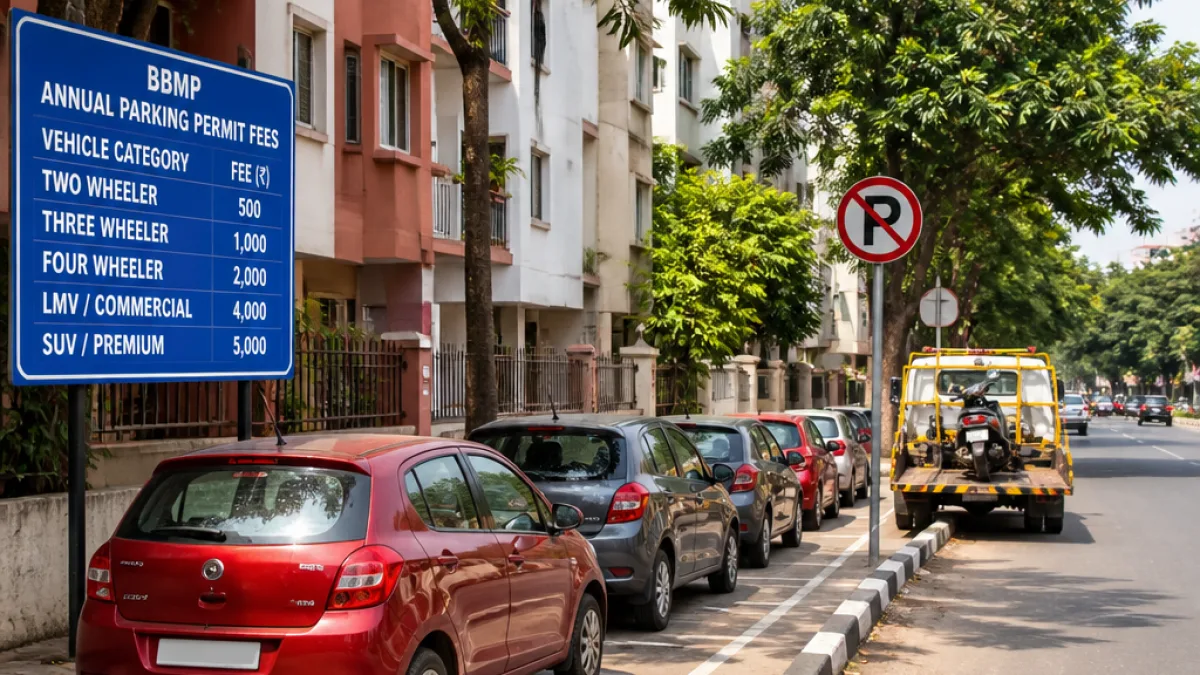
A draft of the Greater Bengaluru Authority (GBA) (Parking) Rules, 2026 proposes annual residential on-street parking permits of up to ₹25,000 depending on vehicle type, and lays down detailed conditions governing where and when such parking will be permitted.
The draft, reported by PTI on Aug 14, seeks to regulate the long-running conflict over public road space in the city by linking eligibility for a residential parking permit to compliance with prescribed building bye-laws and to the width and function of the road where parking is sought.
- Permit fees: The draft proposes an annual fee of ₹15,000 for hatchbacks, ₹20,000 for sedans and ₹25,000 for sports utility vehicles (SUVs).
- Validity and issuance: A permit would be issued only to the registered owner of a specific vehicle, valid for one year and renewable after verification of continued residence and compliance.
- Eligibility: Only residents of buildings that meet minimum on-site parking requirements under building bye-laws would be eligible for a residential parking permit.
Where parking will — and will not — be allowed
The draft differentiates between arterial, sub-arterial, collector and local roads. It proposes a ban on residential on-street parking on arterial and sub-arterial roads, allowing permits only on designated residential parking streets within walking distance of the applicant's home.
Specific road-space clearances for permitting on-street residential parking are included. For collector (non-arterial) roads, parking will be allowed only if at least six metres of road space remains for traffic and a 1.8-metre clear walking space is maintained on both sides. For local roads, at least four metres of road space must remain (the draft’s text in the PTI report was truncated on the exact local-road requirement in available excerpts).
Restrictions near transit and public facilities
The rules propose strict no-parking zones around transit hubs: initially, on-street parking would be prohibited within 150 metres of Metro and suburban railway station boundaries, with city corporations authorised to extend this up to 500 metres. The draft also seeks to prohibit parking near junctions, bus stops, transit hubs, pedestrian crossings and footpaths, applying specified setback requirements.
Enforcement, penalties and private operator role
The draft makes provision for treating unauthorised residential parking as illegal and attracting penalties. It also proposes introducing an additional administrative fee for issuing permits, to be fixed by the chief commissioner of the GBA.
In a notable shift, the draft authorises private operators, once formally designated by city corporations, to issue violation notices, collect parking-related charges, clamp and tow vehicles. Such operators would be required to record video evidence before towing, and towing operations would be overseen by traffic police, according to the draft reported by PTI.
Implications for residents and urban policy
If implemented, the proposal would impose significant recurring costs on households that currently rely on kerbside parking. Linking permit eligibility to compliance with building bye-laws potentially disadvantages older houses or mixed-use buildings that do not meet contemporary on-site parking norms. The draft attempts to balance the need for pedestrian clearways and traffic movement against demand for doorstep parking, but it also raises questions about enforcement capacity and equity.
"Parking vehicles on public roads outside their homes without a valid permit could be treated as illegal parking and attract penalties," the PTI report said, summarising the draft rules.
| Vehicle type | Proposed annual permit fee |
|---|---|
| Hatchback | ₹15,000 |
| Sedan | ₹20,000 |
| SUV | ₹25,000 |
City planners and civic authorities in Bengaluru (Bengaluru Mahanagara Palike areas and surrounding corporations now under the GBA framework) will need to consider how the proposed fees, eligibility conditions and enforcement mechanisms interact with commuting patterns, last‑mile connectivity and parking supply near Metro stations and commercial corridors.
Residents’ groups, housing associations and traders near transit nodes are likely to scrutinise the proposed 150–500 metre restrictions around Metro and railway stations, since many commuters currently use nearby streets for short- and long-duration parking. The draft also opens the door to developing public parking on leased private vacant plots, and to incentivising private landowners to convert vacant land into paid parking — a policy that could alter local land-use economics in many wards.
The draft rules are in the proposal stage; any final policy will be subject to statutory procedures, public consultations and approval by the Greater Bengaluru Authority and concerned city corporations. The PTI report is the primary source for the details described in this article.