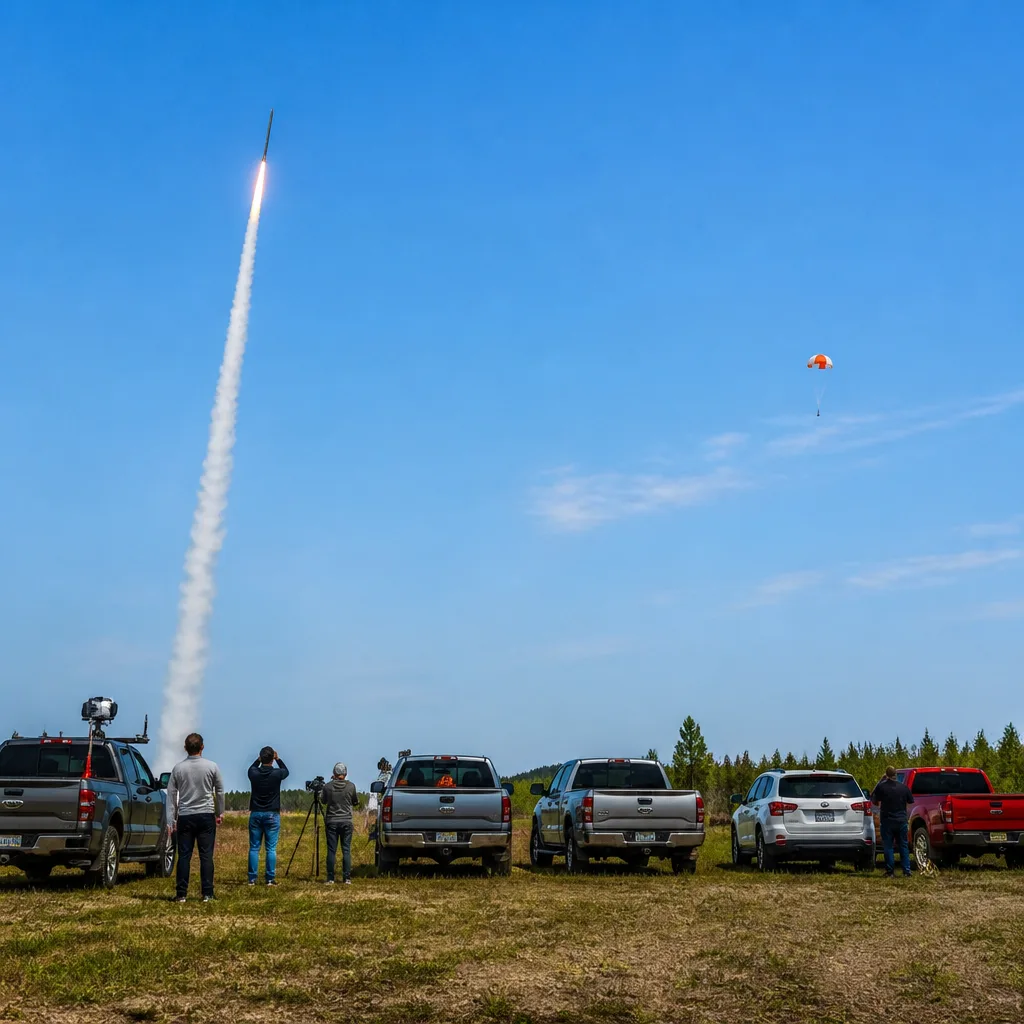
A student team from the University of Waterloo has broken the world record for the highest-flying amateur liquid-fuel rocket, sending their 17-foot Polaris rocket to a measured altitude of 63,497 feet during the 2026 Launch Canada Challenge in Timmins, Ont.
Record and recovery
The flight surpassed the previous record of 56,590 feet, held by the Yellow Jacket Space Program at Georgia Tech, by nearly 7,000 feet. The achievement capped a year of design, construction and testing by Waterloo Rocketry students, who built Polaris as a 17-foot vehicle that weighs about 300 pounds when fully fuelled.
Beyond altitude, the team emphasised the rocket's recoverability. Polaris was fitted with an extensive parachute system intended to return the vehicle intact — a goal the team said was as important, or more important, than breaking the altitude record itself after earlier failures to recover prior rockets.
“We started this year with the goal that we are going to break the world record,” said Waterloo Rocketry’s integration lead Niva Patel.
Students watched from the ground as the rocket climbed. Patel said emotions ran high when the vehicle surpassed its target, and team lead Luca Scavone described tension giving way to jubilation once the flight unfolded as planned.
Why this matters to Canada
The feat is notable for several reasons beyond the headline figure. It highlights the hands-on, student-driven engineering training occurring at Canadian universities, and it puts a spotlight on smaller-scale, grassroots rocketry programs that serve as training grounds for future aerospace professionals. The Launch Canada Challenge — where the flight took place — brings together amateur teams and fosters competition and knowledge exchange that can influence Canada’s broader innovation ecosystem.
- Educational impact: University-led rocketry projects provide practical experience in systems engineering, propulsion and avionics.
- Industry pipeline: Students trained on such projects often transition into aerospace firms or research roles, strengthening Canada’s talent pool.
- Safety and recovery: Emphasis on successful recovery practices advances reliable test methodologies and reduces environmental and financial risks.
While the Polaris flight is an obvious public-relations success, it also offers concrete technical takeaways. Designing a parachute system capable of safely recovering a 300-pound, 17-foot rocket presents non-trivial engineering and operational challenges — from deployment sequencing to payload integrity on descent. Successfully addressing those challenges is an important step for teams aiming to conduct repeated, higher-performance tests.
Context and next steps
University rocketry teams are part of an international amateur and university-level movement that has produced notable technical advances and trained engineers who go on to work in commercial space, defence and research sectors. For Waterloo, the record represents both validation of this team’s processes and a public demonstration of capability.
The immediate next steps for the Waterloo Rocketry team will likely include post-flight analysis of telemetry and hardware, publishing lessons learned, and preparing for future competitions. These activities are essential for turning a one-off achievement into sustained programme growth and further technical progress.
| Item | Polaris / Waterloo | Previous record |
|---|---|---|
| Altitude | 63,497 ft | 56,590 ft |
| Rocket length | 17 ft | — |
| Fully fuelled weight | ~300 lb | — |
| Event | Launch Canada Challenge, Timmins, Ont. | — |
For Canadians watching the national research and innovation landscape, the story underscores how student programmes contribute to technological readiness. The practical skills developed by these teams—propulsion, avionics, structural design and flight operations—feed into a domestic supply of engineers and innovators that industry and government increasingly value.
Whether Polaris’s record will spur more university rocketry projects, attract sponsorship from industry partners or lead to collaboration with established aerospace firms remains to be seen. What is already clear is that a group of students in Waterloo have placed Canada on the map in the amateur liquid-fuel rocketry world and demonstrated that disciplined, team-based engineering can produce world-beating results.