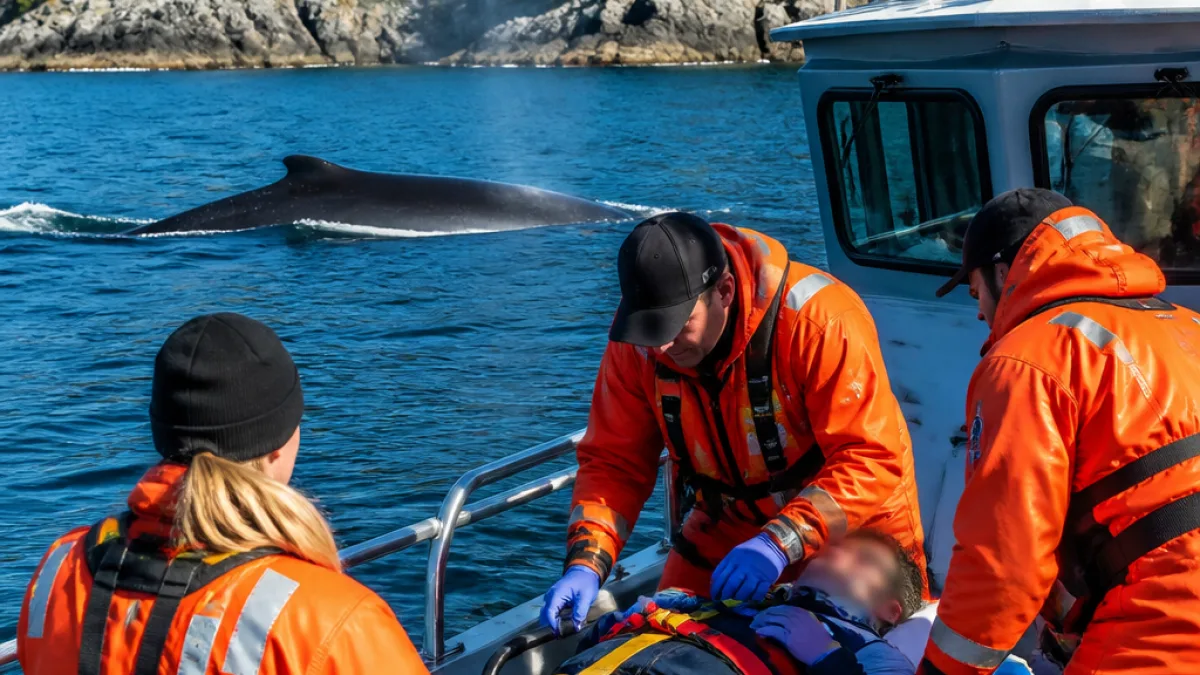
Two officers with the federal fisheries department were injured after the agency's boat struck a humpback whale on Sunday near Calvert Island, roughly 100 kilometres north of Port Hardy on Vancouver Island's central coast, the department said in a statement.
Incident and immediate response
The department did not release the officers' names or the extent of their injuries for privacy reasons. It also said the identity of the humpback involved has not been determined. Fisheries officials are working with the B.C. Marine Mammal Response Network to locate the animal and record any evidence of harm.
"The department encourages people to report possible instances of whales being disturbed, whale collisions, or whale entanglements."
The collision underscores the risks faced by crews operating in waters where large whales are increasingly common. Humpback whales, once heavily depleted by industrial whaling, have been returning to B.C. coastal waters in growing numbers, a recovery scientists attribute to a richer food supply and past conservation measures.
Where it happened
The strike took place in coastal waters near Calvert Island, located along B.C.'s central coast. The nearest town referenced in the department's statement is Port Hardy on northern Vancouver Island. The area is part of a network of fjords and channels where feeding humpbacks are often sighted.
| Detail | Information |
|---|---|
| Location | Near Calvert Island, ~100 km north of Port Hardy |
| Date | Sunday (department statement) |
| Parties involved | Fisheries department vessel; humpback whale; B.C. Marine Mammal Response Network |
Context: humpbacks returning to B.C. waters
Marine biologists have noted humpback populations rebounding along the coast, with the Salish Sea and outer coastal channels becoming more frequented by feeding whales. Recovery is tied to legal protection and improved ocean productivity, which have bolstered prey such as herring and krill. That comeback, while positive for biodiversity, increases the potential for ship-whale interactions.
Why collisions happen
Collisions can occur for multiple reasons: whales surfacing unexpectedly, high vessel speeds in areas of dense marine traffic, limited visibility, or whales being distracted while feeding. Investigations usually look at environmental conditions, vessel speed and manoeuvres, and whether appropriate lookout measures were in place.
- Increased whale presence raises collision risk in coastal channels.
- Fisheries and marine-response teams often coordinate to find and document injured animals.
- Reporting by the public helps responders locate whales quickly and assess injuries or entanglements.
Reporting and public safety
The fisheries department's advisory urged members of the public to report possible whale disturbances, collisions or entanglements so responders can act swiftly. Prompt reporting helps organisations such as the B.C. Marine Mammal Response Network document injuries, disentangle animals when necessary and collect data that can guide future safety measures.
For mariners, the incident serves as a reminder to maintain a vigilant lookout in coastal feeding grounds and to follow recommended vessel speeds in areas where whales are known to congregate. Local communities and commercial operators who travel these waterways are likely to watch for any follow-up notices from the department or response network.
What comes next
The department and the response network are continuing efforts to locate the whale involved in the collision and to document any signs of injury. Details about the injured officers were withheld, and the department did not provide further operational specifics in its statement.
The collision highlights the balancing act on B.C.'s coast between protecting recovering marine mammals and ensuring the safety of those who work at sea. As humpback sightings rise, officials and mariners will need to keep adapting precautions to reduce future incidents.