
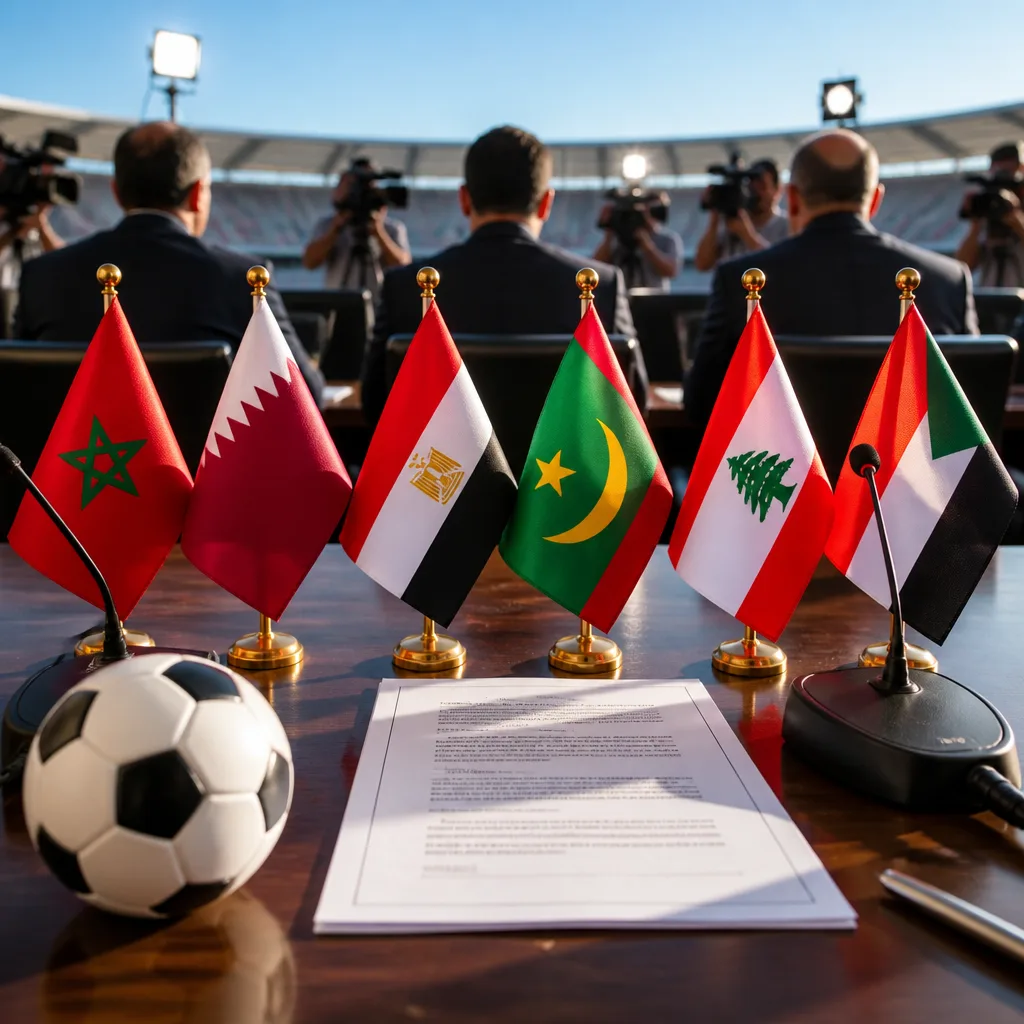
Six Arab football associations have formally declared their support for FIFA president Gianni Infantino as he faces mounting opposition following the collapse of a proposal to bring private equity into the World Cup’s financing.
Regional backing counters wider revolt
The federations representing Morocco (a 2030 World Cup co-host), Qatar, Egypt, Mauritania, Lebanon and Sudan signed a joint communiqué expressing “full support” and confidence in Infantino’s leadership. Four of the six signatories are serving members of FIFA’s ruling council.
“We, the undersigned leaders of our respective football associations, express our full support for Mr. Gianni Infantino, President of FIFA, and reaffirm our confidence in his leadership and continued commitment to the development of football worldwide,”
The statement praised Infantino’s work to broaden football’s reach and to strengthen the sport’s role in uniting communities, and it pledged continued cooperation aimed at enhancing Arab football’s contribution to the global game.
What prompted the crisis
The show of support comes after Infantino withdrew a controversial plan that would have seen FIFA sell stakes in the World Cup to private-equity investors — a proposal with an initial price tag widely reported as around $20 billion. The plan sparked immediate and vociferous opposition from several major confederations.
UEFA — the European governing body — led the charge in condemning the proposal, describing it as a fundamental breach of trust and warning of a possible boycott of FIFA events. UEFA aligned with CONCACAF (North, Central America and the Caribbean) and the AFC (Asia) in issuing a sharply worded open letter that accused Infantino’s plan of being deceptive.
Fault lines within world football
By publicly supporting Infantino, the Arab federations — notably Qatar and Lebanon — positioned themselves at odds with the Asian Football Confederation, deepening the existing rift within the sport’s governance. The dispute exposes widening regional and political divides over how global football should be financed and run.
- Signatories: Morocco, Qatar, Egypt, Mauritania, Lebanon, Sudan
- FIFA council members among them: Qatar, Egypt, Morocco, Mauritania
- Opposition alliances: UEFA joined by CONCACAF and the AFC
The backing of Infantino by those federations follows a pattern in which his office has circulated and publicised letters of support from various member associations. Infantino’s official Instagram account had previously posted endorsements from federations including Morocco, Qatar and the United Arab Emirates.
Implications and next steps
The immediate effect of the joint statement is political: it bolsters Infantino’s claim to continued legitimacy among a bloc of member associations. But the controversy over the aborted financing plan leaves unresolved questions about governance, transparency and the balance of power among FIFA’s regional confederations.
Key unknowns include whether the public rebuke by UEFA and its partners will translate into formal moves to remove or constrain the president’s authority, and how member associations outside the current flashpoint will cast their lot. For countries hosting major tournaments, the stakes are high: the structure of financing and commercial rights affects long-term revenue, infrastructure decisions and relationships with broadcasters and investors.
| Federation | Role noted in statement |
|---|---|
| Morocco | 2030 World Cup co-host; signatory |
| Qatar | Signatory; FIFA council member |
| Egypt | Signatory; FIFA council member |
| Mauritania | Signatory; FIFA council member |
| Lebanon | Signatory |
| Sudan | Signatory |
For Canadian observers, the episode is a reminder that global sport is not insulated from geopolitical and financial contestation. Decisions made in FIFA’s corridors will shape the commercial and competitive landscape of football for years — with knock-on effects for broadcasters, sponsors and national associations worldwide.
As the matter develops, attention will centre on further responses from FIFA’s member confederations, any formal governance proceedings, and whether alternate financing proposals or reforms to FIFA’s commercial model are proposed.