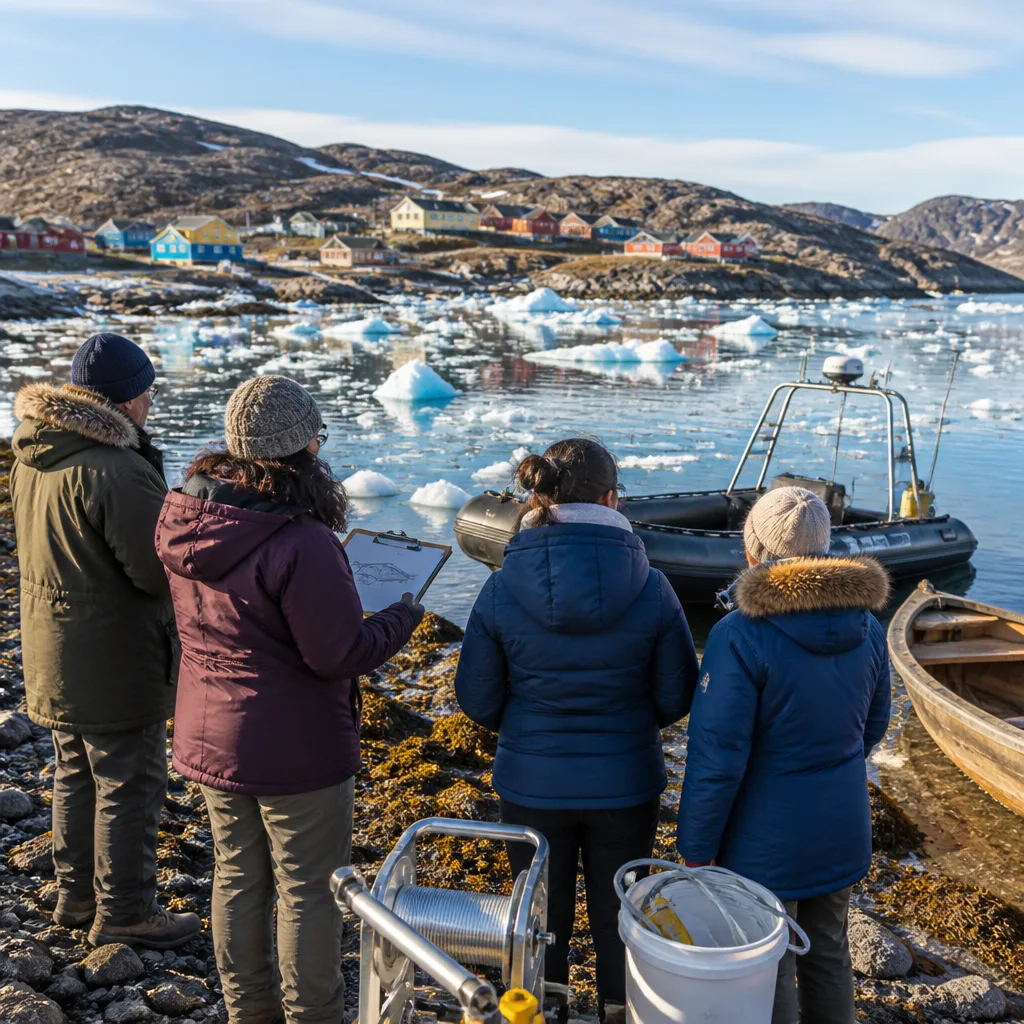
Gjoa Haven, a small Inuit community north of the Arctic Circle with fewer than 1,500 residents, lies on the edge of a striking ecological paradox: within a broad expanse of near-barren ocean, a nearby coastal inlet known as Sherman Basin supports an unusually rich assemblage of marine and terrestrial life.
Local knowledge and modern science meet
University of Manitoba oceanographer Kristina Brown has spent several years trying to understand what makes Sherman Basin an oasis for species such as bearded seals and Arctic char, while caribou and muskoxen thrive on the adjacent tundra. Her work links contemporary oceanographic methods with generations of Inuit observation — an approach aimed at answering a practical question central to the community’s subsistence and future resilience: why is this place so productive when much of the surrounding sea is inhospitable?
The research has involved multiple expeditions to the basin that included both youth and elders from Gjoa Haven. Those journeys were not only scientific missions but also exercises in co‑production of knowledge, where modern instruments and long-standing local expertise are treated as complementary.
Logistical challenges in an uncharted environment
Brown has described the logistical hurdles her team faced. The area has no marine charts, she said, which made even getting a vessel in a risky endeavour. Winter conditions in Gjoa Haven are extreme: engines must often be kept running all day to prevent them from freezing.
“Because otherwise the engine will get too cold and you can’t turn it on again,”
Brown also characterised the broader region as, ecologically, “kind of a desert,” underscoring how exceptional Sherman Basin appears by contrast.
Why it matters to Canada
The work in Sherman Basin intersects with several national priorities. It bears on food security and cultural continuity for an Indigenous community that has relied on local marine and land resources for millennia. It offers a model for collaborative research that respects and integrates Inuit knowledge. And it contributes to understanding of Arctic ecosystems at a time when warming temperatures and shifting sea ice are transforming northern environments.
Brown’s description of the light in winter — long periods of pink at sunrise and sunset — also hints at the human dimension of life above the Arctic Circle: small communities enduring harsh conditions, maintaining traditions and deep connections to place while adapting to contemporary scientific partnerships.
Community-centred research and its lessons
Several elements of Brown’s approach stand out:
- Inclusion of elders and youth in fieldwork to blend memory, observation and scientific measurement.
- Persistence despite practical barriers, including lack of marine charts and extreme cold that affects equipment.
- An emphasis on why a local ecological anomaly matters to people who depend on it.
These practices reflect growing recognition across Canada that northern research must be collaborative and directed by community concerns, not only external scientific agendas.
Snapshot: Gjoa Haven and Sherman Basin
| Feature | Detail |
|---|---|
| Community | Gjoa Haven (Inuit settlement) |
| Population | Fewer than 1,500 |
| Region | Kitikmeot, north of the Arctic Circle |
| Nearby ecological site | Sherman Basin, under 100 miles away |
By pairing oceanography with Indigenous observation, Brown’s work seeks to reveal how a remarkably productive coastal basin can persist amidst an otherwise sparse seascape. The findings — and the collaborative method behind them — have implications for conservation, local livelihoods and Canada’s stewardship of its Arctic waters.
As Arctic research accelerates under the pressure of climate change, projects rooted in partnership with northern communities will likely provide the most practical and culturally respectful pathways to understanding and responding to rapid environmental change.