The Saskatchewan government has widened a provincial program designed to attract health-care professionals to smaller communities, announcing that 12 additional centres are now eligible for financial incentives for recruited workers.
Financial incentive aimed at stabilizing rural services
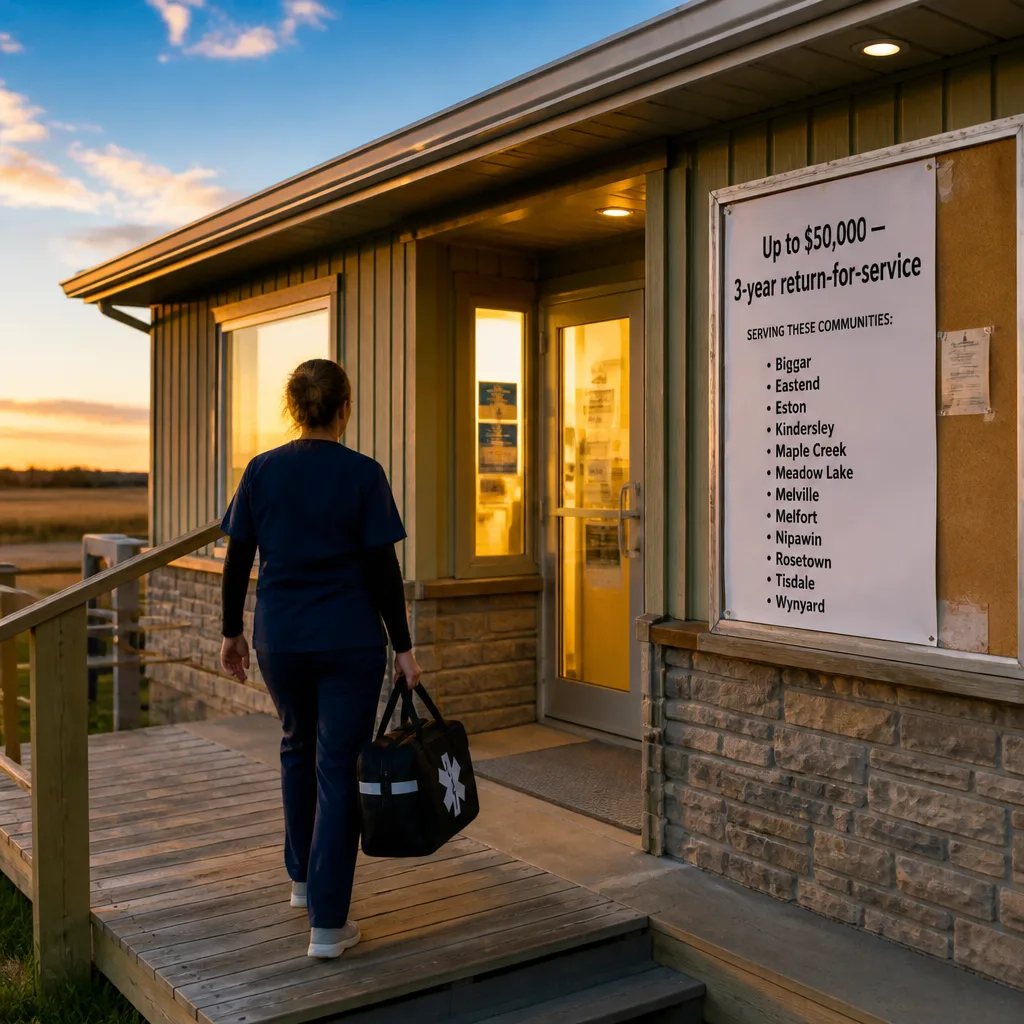
The expanded program — known as the Rural and Remote Recruitment Incentive Program — will allow health-care workers who commit to work in participating communities to receive up to $50,000 in funding in exchange for a three-year return-in-service commitment.
The new communities added to the list are: Hafford, Cudworth, Sandy Bay, Loon Lake, Whitewood, Canwood, Stoughton, Strasbourg, Eston, Langenburg, Leask and Norquay. The announcement follows earlier efforts that placed nurse practitioners and other clinicians in underserved areas.
“Building a stronger, more stable health-care workforce is essential to putting patients first and ensuring the right care is available, in the right place, and at the right time,” said Health Minister Jeremy Cockrill in a news release.
The program targets what the province labels high-priority health-care roles, a designation used to steer limited resources toward positions where recruitment difficulties most affect local access to services. In addition to the financial offer, the initiative pairs recruitment incentives with a stipulated minimum service period to help communities retain newly hired providers for several years.
Where this fits in the provincial picture
The incentive scheme is one of several provincial tools aimed at addressing workforce shortages outside urban centres. Earlier coverage of the program noted that nurse practitioners have been among professionals recruited under similar arrangements; an event last year saw three nurse practitioners sign contracts to provide care in the province.
- Incentive amount: Up to $50,000 per recruited worker
- Service commitment: Three-year return-in-service
- Newly eligible communities: 12 rural and northern Saskatchewan centres
The province frames the investment as a step to improve continuity of care in communities that struggle to recruit and retain clinicians. By offering financial support tied to a multi-year commitment, authorities hope to reduce turnover and ensure local residents have more stable access to primary and other health services.
| Program element | Detail |
|---|---|
| Maximum incentive | $50,000 |
| Required service commitment | Three years |
| Number of newly added communities | 12 |
Health officials have said such measures are necessary to make smaller communities competitive when recruiting clinicians who might otherwise choose positions in larger centres with more amenities, professional supports and opportunities for spousal employment.
What communities and patients may expect
For residents in the newly added towns and villages, the expansion could translate into earlier access to primary care appointments, improved continuity with a consistent provider and, in some cases, new services such as extended primary care hours or additional chronic-disease management supports. For local administrators and health-care partners, the program offers a funding lever to offset initial recruitment costs and incentivize candidates to accept positions they might not otherwise consider.
While the announcement highlights the government’s efforts to bolster staffing, recruitment incentives are typically one part of a broader strategy that also includes housing supports, locum coverage, interprofessional team development and measures to address workload and professional isolation. The success of such programs often depends on local capacity to integrate and retain incoming clinicians beyond the initial contractual period.
Officials did not attach broader provincial workforce data or projected timelines for placements in each community in the news release. The immediate next step for eligible towns will be to work with provincial recruitment teams to identify and hire professionals who meet local needs and agree to the program’s conditions.
The expanded eligibility comes amid ongoing national conversations about health staffing shortages in rural and remote parts of Canada, where access to family physicians, nurse practitioners and other clinicians remains uneven. Program expansions such as this one are likely to be watched by other jurisdictions considering financial and non-financial incentives to stabilise care in smaller communities.
This report draws on the provincial announcement regarding the program’s expansion and the list of newly included communities.