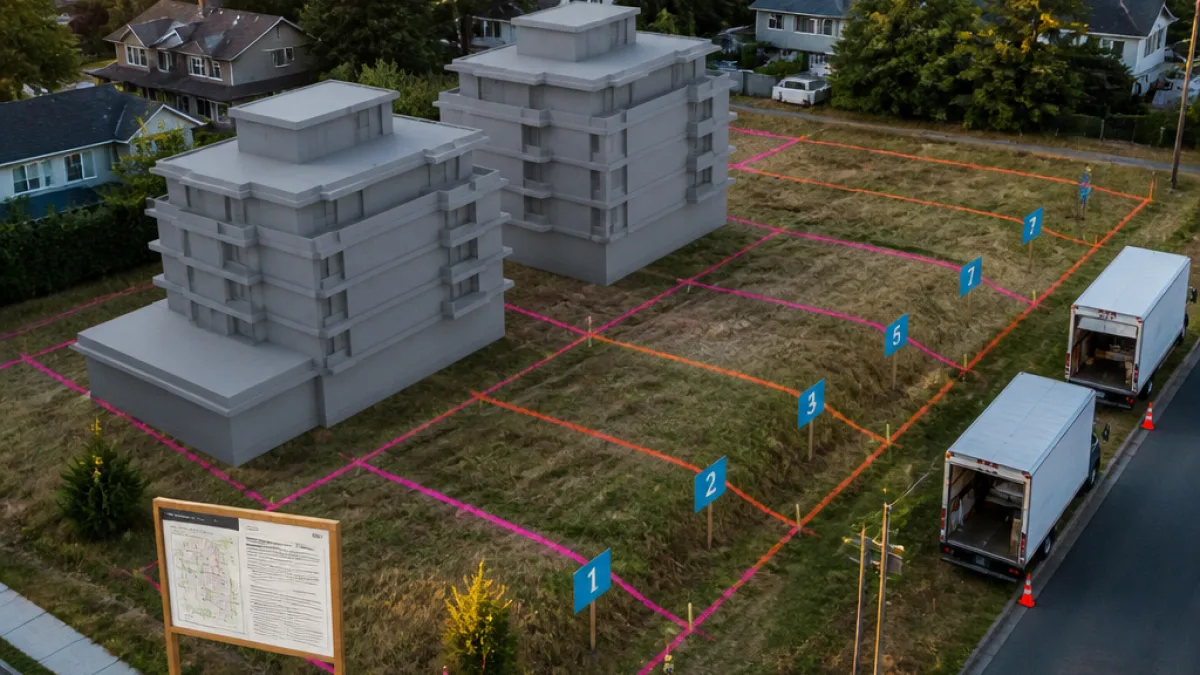
Saanich council used its last available authority to put a contentious rental project near the University of Victoria on hold, rejecting a rezoning and development permit for two six-storey buildings that would have delivered 349 market-rental units.
Council stops development over incomplete lot consolidation
At the Aug. 17 meeting, council voted 6-2 to refuse a proposal from Invictus Commercial Investment Corp. for two buildings located at 2315–2335 Edgelow St. and 3876A Finnerty Rd. The project, aimed at providing a mix of studios up to three-bedroom units, also included plans for 177 underground parking spaces and 364 bicycle spaces.
District staff had advised council to approve the rezoning of seven single-family lots and the associated development permit, concluding the proposal aligned with provincial Transit-Oriented Area (TOA) regulations. Those regulations set minimum height and density expectations for sites near transit hubs: up to 10 storeys within 200 metres and up to six storeys between 201 and 400 metres from a hub.
However, the staff report noted a technical difficulty: only two of the seven lots fall inside the UVic TOA. The developer had proposed consolidating the seven parcels into a single property so the entire site would meet provincial thresholds — but that consolidation had not been completed when the application came before council.
“This is a very contentious (project), and it’s a very technically difficult one because a lot of people who came tonight came to speak about just not wanting to see this level of density in Gordon Head,”
Coun. Colin Plant, who led the opposition at the meeting, said council was constrained by the incomplete consolidation and could not responsibly approve the application while the legal status of the lots remained unresolved. “There is a responsibility to make sure that we pull every lever we have to ensure that what is done is done in a way that is very clear to the public,” he told colleagues, according to the staff report.
What the proposal would have delivered
| Item | Detail |
|---|---|
| Units | 349 market-rental units (studios–three-bedrooms) |
| Buildings | Two six-storey complexes |
| Parking | 177 underground spaces |
| Bicycle spaces | 364 |
| Addresses | 2315–2335 Edgelow St. and 3876A Finnerty Rd. |
Supporters of the project argued it complied with provincial direction to increase housing supply near transit, a central pillar of recent housing legislation in British Columbia. The TOA framework limits municipal discretion when a proposal meets provincial height and density thresholds.
Local pushback and the limits of municipal authority
Residents who spoke to council described concerns about the scale of density in the Gordon Head neighbourhood, traffic, and neighbourhood character. The controversy highlights a broader municipal challenge: how to reconcile provincial housing mandates with neighbourhood expectations and municipal planning frameworks.
- Provincial TOA rules allow limited municipal refusal when site requirements are not met.
- Council cited the developer’s incomplete lot consolidation as a legal and procedural barrier to approval.
- The decision leaves the developer with the option to return with a completed consolidation or a revised application.
Municipal staff had recommended approval on the basis the consolidated site would meet TOA requirements. But several councillors said approving a plan that relied on an uncompleted legal step would create confusion and erode public confidence in the process.
The refusal does not permanently prohibit development on the properties. Instead, it underscores the procedural necessity for developers to align lot configurations with provincial policy thresholds before seeking council endorsement. Invictus Commercial Investment Corp. could pursue consolidation and return with a new application that addresses council’s concerns.
For Saanich residents, the decision is a tangible example of the tensions shaping Greater Victoria: the pressing need for rental housing set against local desires to preserve neighbourhood scale and character, and the limits of municipal powers in the face of provincial housing directives. How the developer responds, and whether the province or municipality will take any further steps, will determine whether the proposal resurfaces in a form acceptable to both the community and provincial policy.
Local reporting will continue as the developer and the district clarify next steps.