
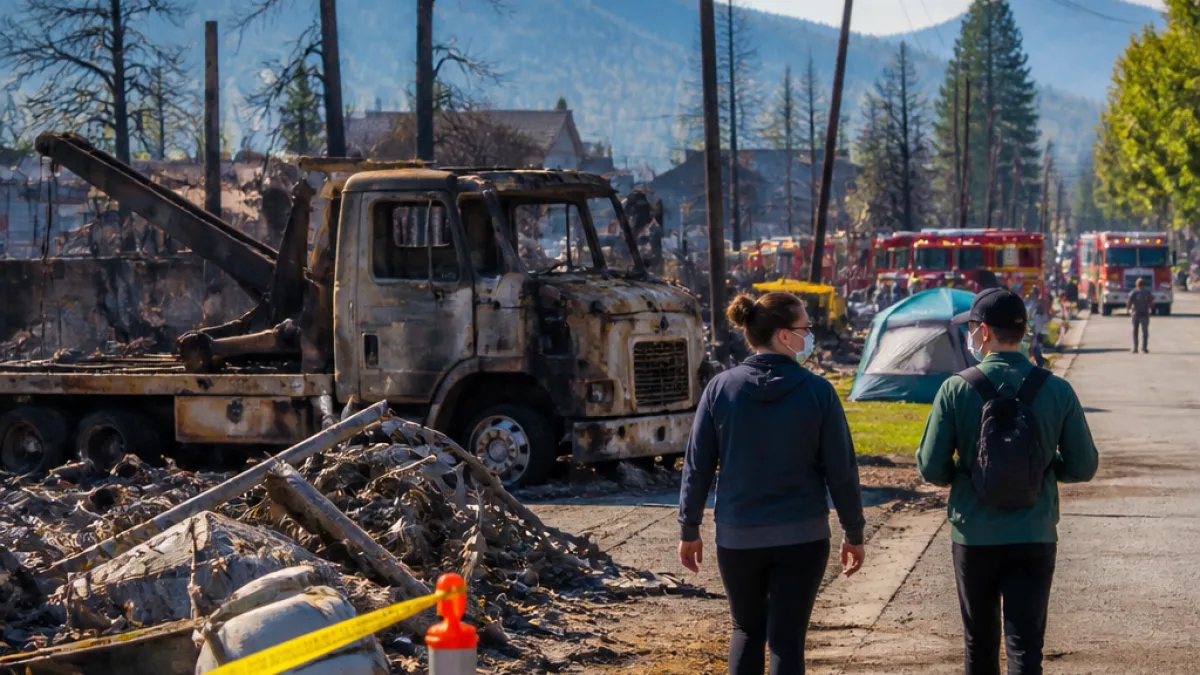
CLINTON, B.C. — Some evacuees were allowed back into the Clinton area on Saturday to assess damage and begin the lengthy work of cleanup and recovery, but for many the return will be to properties that no longer exist after the nearby wildfire tore through the outskirts of the village.
Homes, businesses lost and families displaced
At 52, local tow-truck operator Steve Larabie is facing the prospect of rebuilding from scratch after fire claimed his residences and his business on a property three kilometres south of Clinton. Larabie, his wife and children escaped safely, but he described the scene of loss in stark terms.
"It's all gone. I have nothing left. Nothing,"
He added how difficult it is to explain the loss to his children. Larabie said he has been focusing on what cleanup he can do immediately, and expects to sleep in tents for a while as he figures out next steps.
Evacuation changes and areas still at risk
Local authorities eased some evacuation directives early Saturday, converting a number of orders to alerts. The Thompson-Nicola Regional District has said the majority of downgraded alert areas stretch north and east of Clinton along Highway 97 and beyond 70 Mile House.
However, not all nearby terrain is clear. Regions to the west of the town — from the Kelly Lake substation north to the district boundary — remain under evacuation orders because of ongoing danger posed by the blaze.
| Area | Status (as of Saturday) |
|---|---|
| North and east of Clinton (along Hwy 97 to past 70 Mile House) | Most areas downgraded to alert |
| West of town (Kelly Lake substation north to district border) | Evacuation orders remain in place |
The scale and footprint of the fire
The blaze known as the Pear Lake wildfire spans roughly 1,500 square kilometres and has burned through rugged terrain north of Lillooet, including the Pavilion Creek area. Imagery and handout photos from earlier in August showed the fire moving through forested country, complicating firefighting and evacuation efforts.
Community services limited, recovery uncertain
Clinton's mayor, Roland Stanke, warned residents in a special video update that while some people can go home, they should not expect normal services to be available. He noted the community itself has been profoundly affected and that the broader wildfire season and related hazards have not ended.
For people returning, the immediate priorities are safety, assessing structural damage and securing perishable items. Larabie said he has been offering to help neighbours by hauling away damaged appliances such as fridges and freezers at no charge — a small gesture amid large loss.
What returning residents should consider
- Confirm the current evacuation status for your address with the Thompson-Nicola Regional District before returning.
- Exercise caution around burned structures: they may be unstable and contain hot spots.
- Be prepared for limited utilities and local services; pack water, food, protective clothing and a flashlight.
Local officials have advised people to avoid entering areas still under evacuation orders and to look for local updates as conditions can change quickly.
Long road to rebuild
With houses, a business and equipment lost for some residents, the coming weeks and months will focus on insurance claims, demolition, debris removal and planning for reconstruction where possible. For others who have not yet been allowed to return, uncertainty continues as officials monitor fire behaviour and terrain hazards.
The community of Clinton and surrounding areas face the twin tasks of physical rebuilding and tending to the emotional and social needs of families who have lost homes and livelihoods. For some, like Larabie, that will mean practical work now and the slow task of replacing what once stood — a process that may take years.
Authorities urge anyone affected to contact local government offices and emergency services for guidance on recovery resources and to keep following official communications as the situation evolves.














