
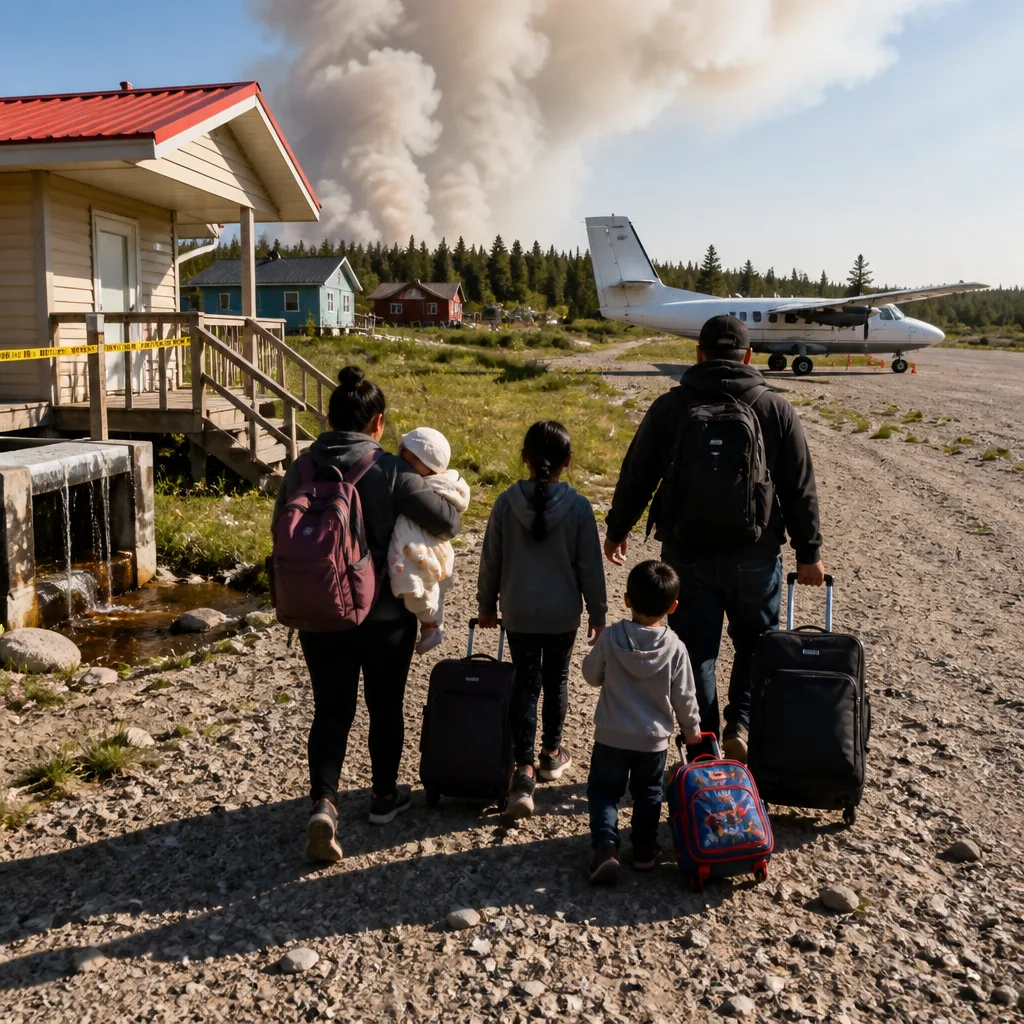
NESKANTAGA, Ont. — A two-week-old infant who briefly returned to her fly-in community after a wildfire evacuation was forced out again days later, an episode that community leaders say highlights growing mental-health strain from successive displacements and failing infrastructure.
Evacuations, then an infrastructure failure
The infant, Nova Moonias, was born after health professionals induced labour on July 28 so the mother could travel north with family and neighbours. The delivery followed an earlier evacuation from Neskantaga First Nation, a remote northwestern Ontario community that had fled advancing forest fires.
Three days after the family returned, a contractor working on the local health centre reportedly made an error that led to raw sewage backing up into the building’s basement. That problem prompted authorities to arrange a second evacuation two days later, leaving many residents once more displaced.
“It’s kind of stressful,” said the baby’s mother, Wanita, speaking from a Toronto hotel where she remained after the second evacuation. “I have worries about our clinic. And the kids are really homesick already.”
Mental-health concerns and observable impacts
Chief Gary Quisess and council declared a state of emergency on Aug. 4 as the community grappled with repeated disruption. Chief and council and local leaders have described residents as showing observable symptoms of stress and disruption tied to infrastructure failures and successive evacuations.
Wanita described practical concerns that amplified anxiety: missed postnatal assessments for the newborn, the need to hastily prepare multiple children for travel, and leaving fresh food and other possessions behind. Those practical losses compound emotional strain in a community already coping with the upheaval of an evacuation.
Timeline
| Date (July–Aug) | Event |
|---|---|
| July 28 | Labour induced so mother and newborn could return north following wildfire evacuation |
| Early August (three days later) | Return to Neskantaga; baby becomes symbol of hope for evacuees |
| Five days after return | Sewage backup reported at health centre; second evacuation organised two days later |
| Aug. 4 | Chief and council declare a state of emergency |
Practical and psychological consequences
Residents face a mixture of immediate logistical problems and longer-term mental-health risks. The case illustrates several overlapping issues:
- Interrupted health care: Newborn assessments and routine services can be missed when families are uprooted suddenly.
- Loss of possessions and routine: Evacuations force families to leave food, household items and supports behind, increasing stress.
- Compounded trauma: Successive emergencies — wildfires followed by infrastructure failures — can deepen anxiety and erode confidence in local services.
Community leaders have raised concern that repeated displacements may produce cumulative mental-health effects among children and adults, while also stretching the capacity of support systems both within the community and in reception centres such as hotels in southern Ontario where many evacuees have stayed.
For one mother, the rapid sequence of events meant missing routine newborn care. “I just wanted her to have all her assessments and tests done on time,” she said, describing worry about the clinic and her newborn’s missed assessments.
Broader implications
The Neskantaga events underscore how climate-related hazards and infrastructure problems intersect to affect health in remote communities. While this report is focussed on one community’s experience, the dynamics — wildfire-driven evacuations, critical-structure failures, and the mental-health fallout — are issues policymakers and health planners face across Canada’s northern and Indigenous communities.
Community leaders and health providers will need to consider both immediate supports — such as timely medical assessments and culturally appropriate mental-health services — and longer-term strategies to strengthen local infrastructure and emergency-response capacity to reduce the likelihood and impact of repeated displacements.
As residents wait for repairs and clarity about returning home, the human toll is visible in weariness, concern for children, and the disruption of routines that new parents and other vulnerable residents rely on.















