
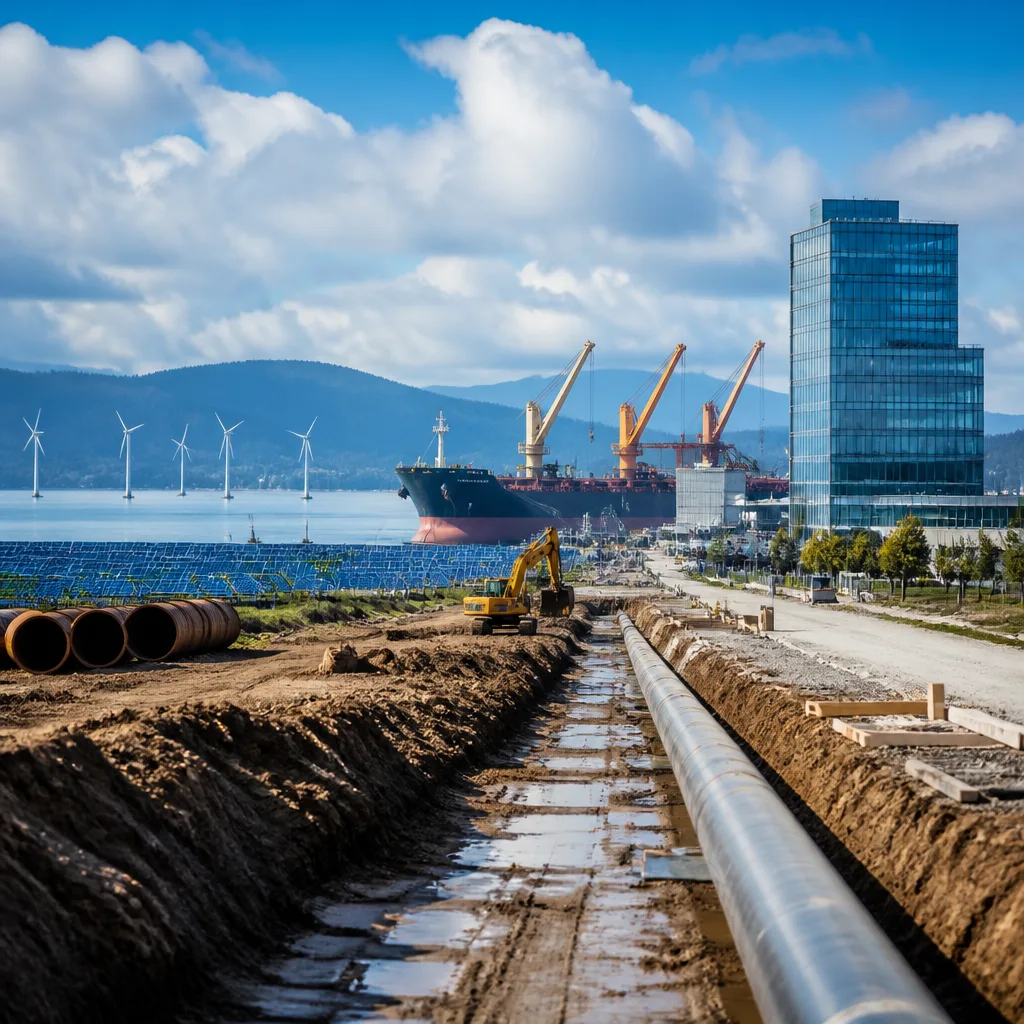
Ottawa’s recent interventions to accelerate oil and gas development represent a clear policy pivot that treats hydrocarbon expansion as a central national project. Measures such as the government’s intent to fast-track the West Coast pipeline, encouragement for large pension funds to deploy capital into new oil and gas infrastructure and the creation of the Canada Strong Fund signal an active push to grow fossil-fuel capacity and export potential.
A strategy built on external demand
The federal strategy, as laid out by an analysis from Carbon Tracker, appears to rest on the assumption that demand — particularly from key Asian markets — will be robust enough to absorb increased Canadian production over coming decades. That outlook underpins policy moves to marshal public and private capital behind new pipelines and terminals oriented toward the Pacific.
But Carbon Tracker cautions that the global energy landscape is shifting in ways that could undermine that assumption. Two key trends stand out in the report:
- Asia’s rapid electrification: the region is electrifying at a pace the analysis describes as roughly five times faster than Western markets, a transition accompanied by a rapid build-out of renewable generation.
- Investment patterns: worldwide, investment in clean energy systems already roughly doubles that directed to fossil fuels, signalling where private capital is moving.
Those dynamics mean importing countries may increasingly favour cheaper, more secure alternatives to hydrocarbon imports — a structural shift that could reduce long-term demand for oil and gas.
Short‑term market conditions versus long‑term fundamentals
Carbon Tracker notes the current global energy crunch — driven by geopolitical disruptions such as closures of key shipping routes — has temporarily elevated the attractiveness of non‑Gulf suppliers. That short window, however, may not justify the substantial upfront capital required for new oil and gas projects, which need sustained demand and supportive prices for decades to be economically viable.
Analysts cited in the report outline energy scenarios under which oil and gas demand peaks as early as 2030 or by the mid‑2030s. If those projections hold, assets built now could face declining value well before investors have recouped their outlays.
| Trend | Implication |
|---|---|
| Asia electrifying five times faster | Reduced long‑term import growth for oil and gas |
| Clean energy investment roughly double fossil investment | Private capital shifting toward renewables and storage |
Policy choices and financial risk
The federal government’s push — from regulatory acceleration to financial incentives — frames oil and gas expansion as nation‑building. Yet Carbon Tracker raises a pointed question for policymakers and institutional investors: is expanding fossil‑fuel capacity the best use of public and private capital given probable future demand trajectories?
For Canadian pension funds and other long‑term investors, the risk is that new fossil fuel infrastructure becomes a stranded asset if markets evolve as some scenarios anticipate. Conversely, investing in cleaner energy systems aligns with the current flow of global capital and with the rapid pace of electrification in export markets.
Domestically, backing new pipeline capacity and export infrastructure has political appeal — promising jobs, regional investment and higher export revenues — but the analysis urges decision‑makers to weigh those short‑term gains against the likelihood of lower demand and rising competition from renewables abroad.
As Ottawa advances measures such as the Canada Strong Fund to mobilize capital, the debate will centre on whether state‑directed support for fossil export infrastructure is prudent in a world where clean technologies are scaling quickly and where energy security concerns accelerate local production of electricity and fuels in importing countries.
The question facing Canada now is whether federal policy will pivot to align with the global surge in clean‑energy investment or will double down on hydrocarbons in the expectation that near‑term market dislocations translate into sustained long‑term demand. The answer will shape the country’s economic and climate trajectory for decades.