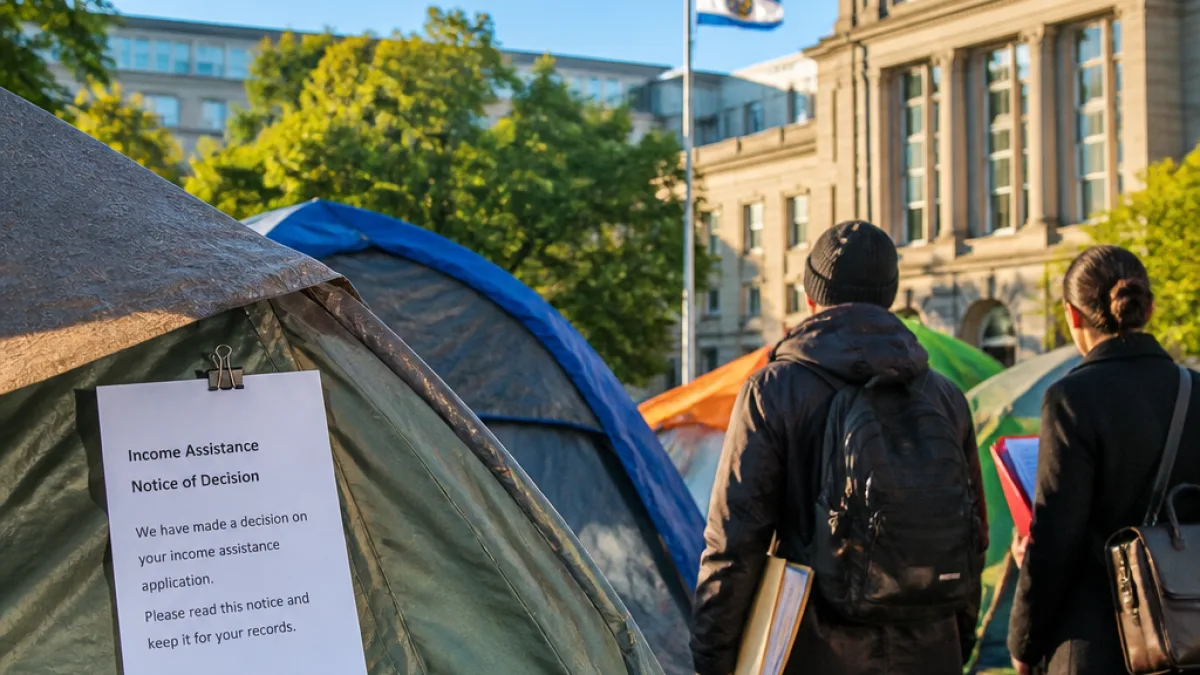
Halifax's legal community and advocates for people experiencing homelessness say a recent provincial change to income assistance rules effectively undoes a Court of Appeal decision and leaves people living in tent encampments with lower benefits.
On Aug. 5, Nova Scotia's Court of Appeal found that a tent could be considered a form of legal accommodation. Two weeks later, the provincial government amended its income assistance legislation on Aug. 25, narrowing the definition of a "home" to residential units that contain a kitchen and bathroom or to municipally approved rooming homes and similar spaces. The result, critics say, is that people living in tents are no longer eligible for the enhanced assistance that would have applied after the court ruling.
Lawyers call the move a deliberate reversal
Human rights lawyer Vince Calderhead, who has spent years advocating for better supports for people sheltering in tents, said the regulatory change was effectively a direct response to the court's finding. He said the rewrite of the rules forces many back to the base income assistance rate of $400 a month.
"By choosing the option of rewriting the law to overturn that decision, they've effectively forced people back onto that $400 a month rate,"
Calderhead noted the legal recognition of tents as an accommodation would have qualified some people for at least an additional $300 a month in support. The court’s earlier decision had overturned a ruling that a man who died in 2023, Bradley Lowe, did not qualify for additional accommodation support because he was living in a tent.
Front-line advocates say the change lowers benefits and ignores real costs
Workers at Dalhousie Legal Aid, which began assisting people in tent encampments to apply for the enhanced rate after the court decision, say the August regulation change immediately disqualified clients. Mark Culligan, a Dalhousie Legal Aid worker, said the effect of the changes is to reduce benefits available to unhoused people.
Culligan questioned the province's premise that people living in rentals have greater expenses than those living in tents. He pointed out practical costs for people without a place to store food — the need to buy smaller quantities, more packaged items and a lack of bulk discounts — all of which can increase monthly living costs.
- Aug. 5 — Court of Appeal ruled tents can count as legal accommodation.
- Aug. 25 — Province amended income assistance rules to limit the legal definition of "home."
- Advocates say change strips tent-dwellers of eligibility for higher assistance, lowering their income to about $400/month.
Calderhead and his legal team are reviewing the new rules for possible discrimination against people based on their housing situation. The change raises questions about how the province balances court findings, legislative power and the rights of people experiencing homelessness.
What the regulation change does — at a glance
| Date | Action | Effect |
|---|---|---|
| Aug. 5 | Court of Appeal decision | Tents deemed possible legal accommodation, potentially unlocking higher assistance |
| Aug. 25 | Provincial regulation amended | Definition of "home" limited to units with kitchen/bathroom and similar approved housing; tents excluded |
Reaction and next steps
Legal-aid staff and rights lawyers argue the government's step looks like a legislative override of a judicial determination. They say the change does not address root causes of homelessness and may compound hardships for people already living on the margins.
Dalhousie Legal Aid and Calderhead are reported to be reviewing next steps, including potential legal challenges. For now, people in tent encampments who hoped to access the higher accommodation-rate supports face the consequences of the tightened definition.
The alteration of the rules puts the province at the centre of a debate over whether statutory changes should be used to narrow access to benefits that courts have interpreted more broadly. For advocates, the human costs are immediate and concrete: lower monthly income, higher food costs and continued exclusion from supports that could improve dignity and safety.
The province has framed the revisions as a clarification of what constitutes a residential unit for income-assistance purposes. But lawyers and front-line workers say that clarification looks, in practical effect, like exclusion.
As this dispute moves from courtrooms to regulatory interpretation and potentially back again, the people sleeping in tents remain on the front lines of a policy choice that could reshape who receives provincial supports in Nova Scotia.