
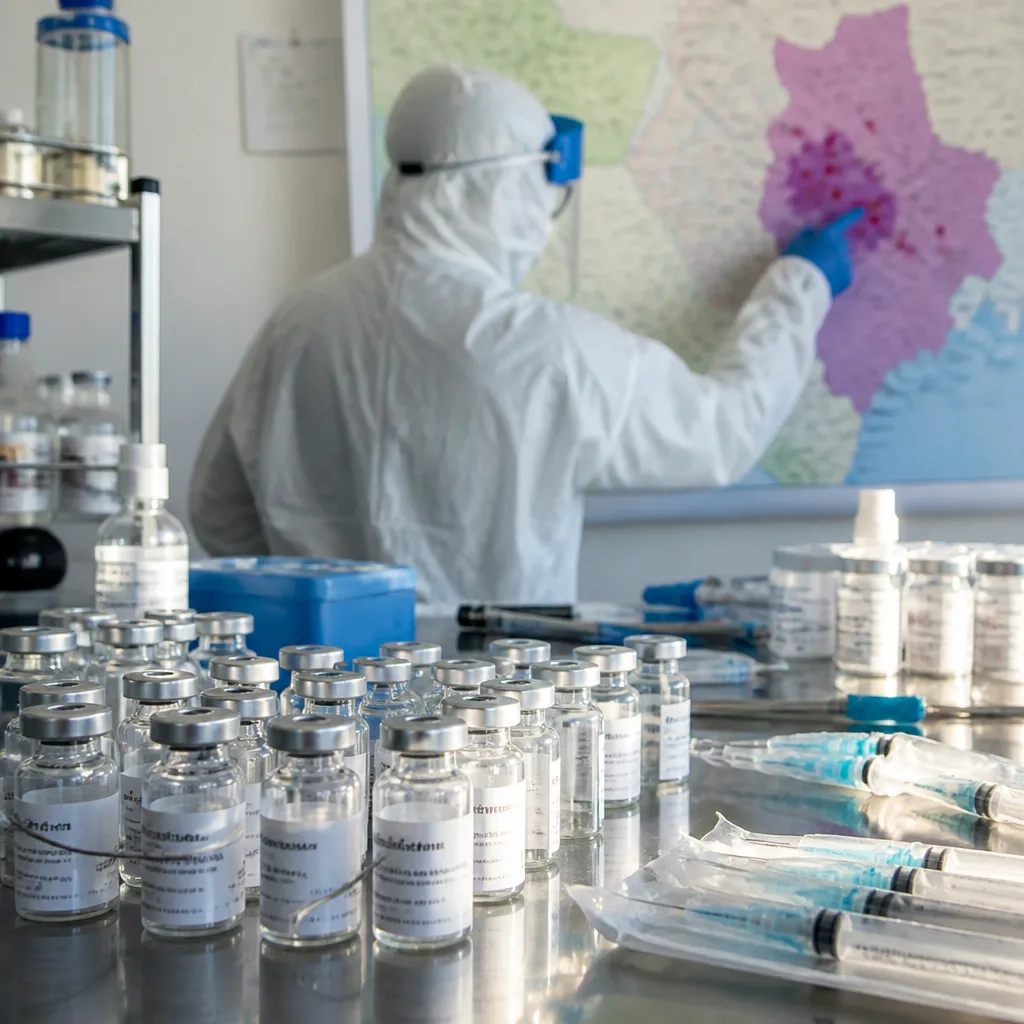
The international effort to produce a vaccine against the fast-moving Ebola outbreak in the Democratic Republic of the Congo is accelerating as health authorities warn the epidemic has become the world’s second-largest on record.
More than 4,000 people have been infected and roughly 1,800 have died nearly three months after the United Nations health agency declared the situation a Public Health Emergency of International Concern, officials say. The only larger outbreak was the 2014–2016 epidemic in West Africa, which infected about 28,000 people and caused about 11,000 deaths.
Vaccine development: a portfolio approach
The virus implicated in the current outbreak is the Bundibugyo strain, first identified in Uganda in 2007, and now spreading rapidly across north-eastern and eastern regions of the DRC. There are presently no vaccines approved specifically for this strain.
The Coalition for Epidemic Preparedness Innovations (Cepi), the Oslo-based non-profit coordinating vaccine development, is supporting a set of candidates through early testing. Cepi’s deputy chief executive, Aurélia Nguyen, described the strategy as a deliberate diversification of approaches to increase the odds of producing an effective vaccine.
“Every countermeasure is going to be essential – diagnostics to identify, therapeutics to treat and vaccines ultimately to prevent,”
Two of the vaccine candidates have recently entered first-stage clinical trials to assess safety and initial immune response in healthy volunteers. They are:
- ChAdOx1 BDBV — developed by Oxford University in collaboration with the Serum Institute of India, using an adenovirus-vector platform, and
- mRNA-1469 — developed by Moderna, built on messenger-RNA technology similar to COVID-19 vaccines.
Initial readouts from those early-stage studies are expected in late September or early October. If those trials demonstrate acceptable safety and promising signs of immune response, organizers plan to move into larger, in-country studies in the DRC.
Context and consequences
The rapid spread of this outbreak has raised alarms about regional containment and about the global capacity to respond to emergent pathogens. Health leaders say that diagnostics, treatments and vaccines will all be necessary to control transmission and reduce mortality.
Cepi’s approach mirrors lessons from the COVID-19 pandemic: backing several vaccine platforms at once reduces the risk inherent in any single technology failing to deliver. In practical terms, that means funding and coordinating parallel development tracks and preparing regulatory and logistic pathways to accelerate transitions from small safety trials to larger efficacy studies in affected communities.
For countries and international agencies, the timeline is compressed. Initial phase‑one results expected this autumn will determine whether rapid scale-up and in-country efficacy trials proceed before the outbreak expands further. Public health authorities will need to weigh data on safety, immune response and logistical feasibility — including cold‑chain requirements and manufacturing capacity — when selecting tools for deployment.
| Comparison | 2014–2016 West Africa | Current DRC outbreak |
|---|---|---|
| Approximate infections | 28,000 | 4,000+ |
| Approximate deaths | 11,000 | 1,800 |
While international investment in candidate vaccines is under way, public-health experts stress that vaccines will be one component of an effective response. Early detection, clinical care and community engagement remain central to interrupting transmission and lowering fatalities.
As candidate vaccines move through trials in the coming months, global health agencies — and governments, including Canada’s — will monitor results closely to determine whether and how to support accelerated testing and potential deployment in the Democratic Republic of the Congo and neighbouring countries.
The coming weeks are likely to be decisive: safety and immunogenicity data expected this autumn will shape whether the vaccine candidates can progress to larger trials and, ultimately, whether a licensed vaccine can be available to help curb an outbreak that is already moving at an unprecedented pace.















