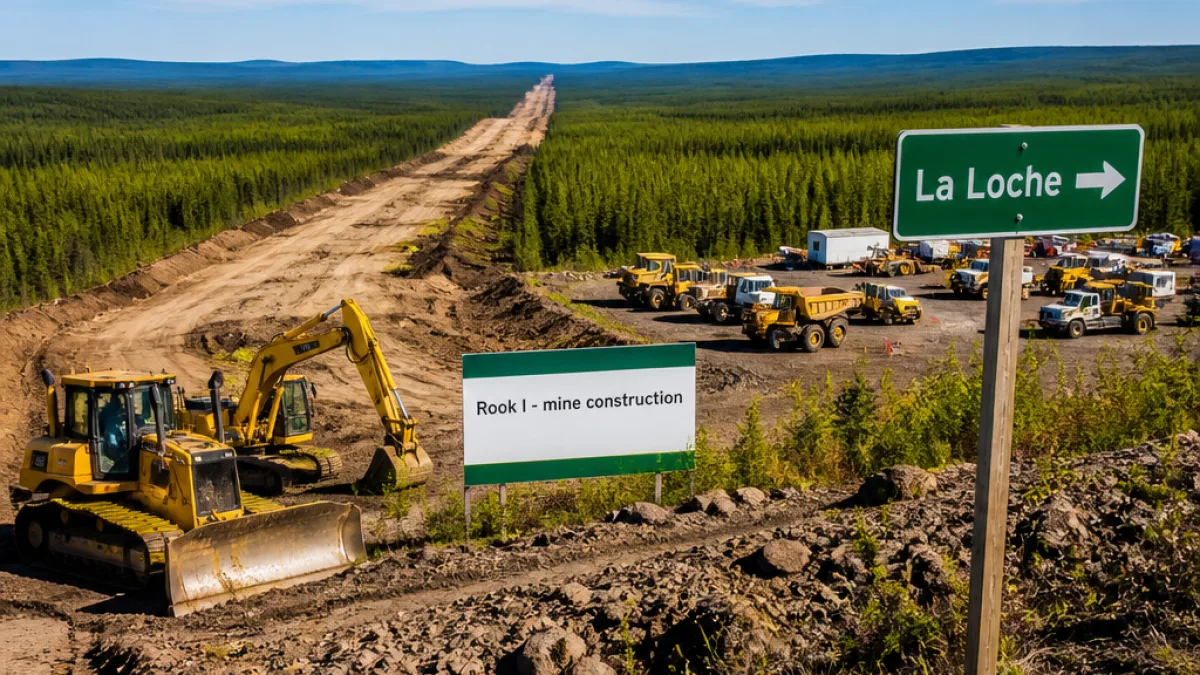
FORT MCMURRAY — Provincial leaders are again pointing to an old idea with new urgency: a permanent road linking Fort McMurray and La Loche, Sask., as neighbouring resource projects move ahead.
Province moves from talk to planning
Speaking at the Oil Sands Expo in Fort McMurray, Premier Danielle Smith said Alberta has begun planning and engineering work on a permanent connection between the Fort McMurray Wood Buffalo region and La Loche. The route has been discussed for years — initially as an additional evacuation option after the 2016 wildfire — but the premier said its economic significance has grown.
"We’ve been in active planning for that," Smith told attendees, adding the road could be a candidate for acceleration. She said Alberta’s Transportation and Economic Corridors ministry is managing hundreds of projects and will prioritise those with the greatest potential economic impact.
“I’ll put this on the radar and we’ll see if it can be accelerated. But it’s definitely needed.”
Link to Rook I shifts the calculus
That shifting calculus is tied in part to NexGen Energy’s Rook I uranium project in the southwestern Athabasca Basin of northern Saskatchewan. The underground mine, centred on the Arrow deposit, is under construction roughly 150 kilometres north of La Loche and about 170 kilometres from Fort McMurray as the crow flies, the premier’s office noted.
Rook I received final federal construction approval earlier this year from the Canadian Nuclear Safety Commission and formally broke ground in August. NexGen estimates pre-production capital costs at about $2.2 billion, with construction expected to take roughly four years and potential production to begin around 2030.
| Item | Figure |
|---|---|
| Pre-production capital cost (NexGen estimate) | $2.2 billion |
| Construction timeline | ~4 years |
| Potential production start | ~2030 |
| Designed annual production | up to 30 million pounds of uranium oxide |
Local implications and unanswered details
For Fort McMurray, a direct permanent link to La Loche would create a new overland corridor to northern Saskatchewan’s mineral development, potentially easing movement of personnel, equipment and supplies. The premier framed the proposal in economic terms, saying her government will prioritise projects that promise the biggest economic returns among the hundreds on Alberta’s books.
- Alberta has begun planning and engineering work on the proposed Fort McMurray–La Loche road.
- NexGen’s Rook I mine is under construction and aims for production by about 2030.
- The road was originally considered as an evacuation option after the 2016 wildfire but is being weighed now for economic benefit.
What remains unclear is a detailed route, an estimated cost for the proposed road, timelines for construction and the extent to which federal, provincial or Indigenous partnerships would be involved. The premier said she would raise the connection with the Transportation and Economic Corridors ministry to see whether the project can be accelerated, but provided no commitment of funding or schedule.
Industry scale and regional context
NexGen’s published design for Rook I points to a substantial operation. The company estimates the underground mine could produce as much as 30 million pounds of uranium oxide annually, which NexGen says would place it among the world’s largest producers if those figures hold.
For a region built on moving natural resources, new corridors matter. Fort McMurray’s economy remains closely tied to large-scale energy and mining projects: better access north and east could influence labour logistics, supply chains and service-sector demand in the city and surrounding communities. But until the province publishes a route, costs and timelines, the conversation will remain in planning — one that residents, local governments and Indigenous partners will want to follow closely.
— Alberta correspondent, WE NEWS